- Place
- Klaipėda City Municipality
- Region
- Klaipėda
- Type
- bronze sculpture with a stone plinth and granite square composition created in 1972-1983
- Address
- Kūlių Vartų g. 6, Klaipėda
- Coordinates
- 55.70662, 21.14068
- Visit duration
- 15-30 minutes; 1-2 hours when combined with Klaipėda Old Town
- Best time
- daylight, when the bronze texture, two ships, and stepped granite setting are clearly visible
Skulptūra Neringa, Decorative Sculpture Neringa, Giantess Neringa Sculpture
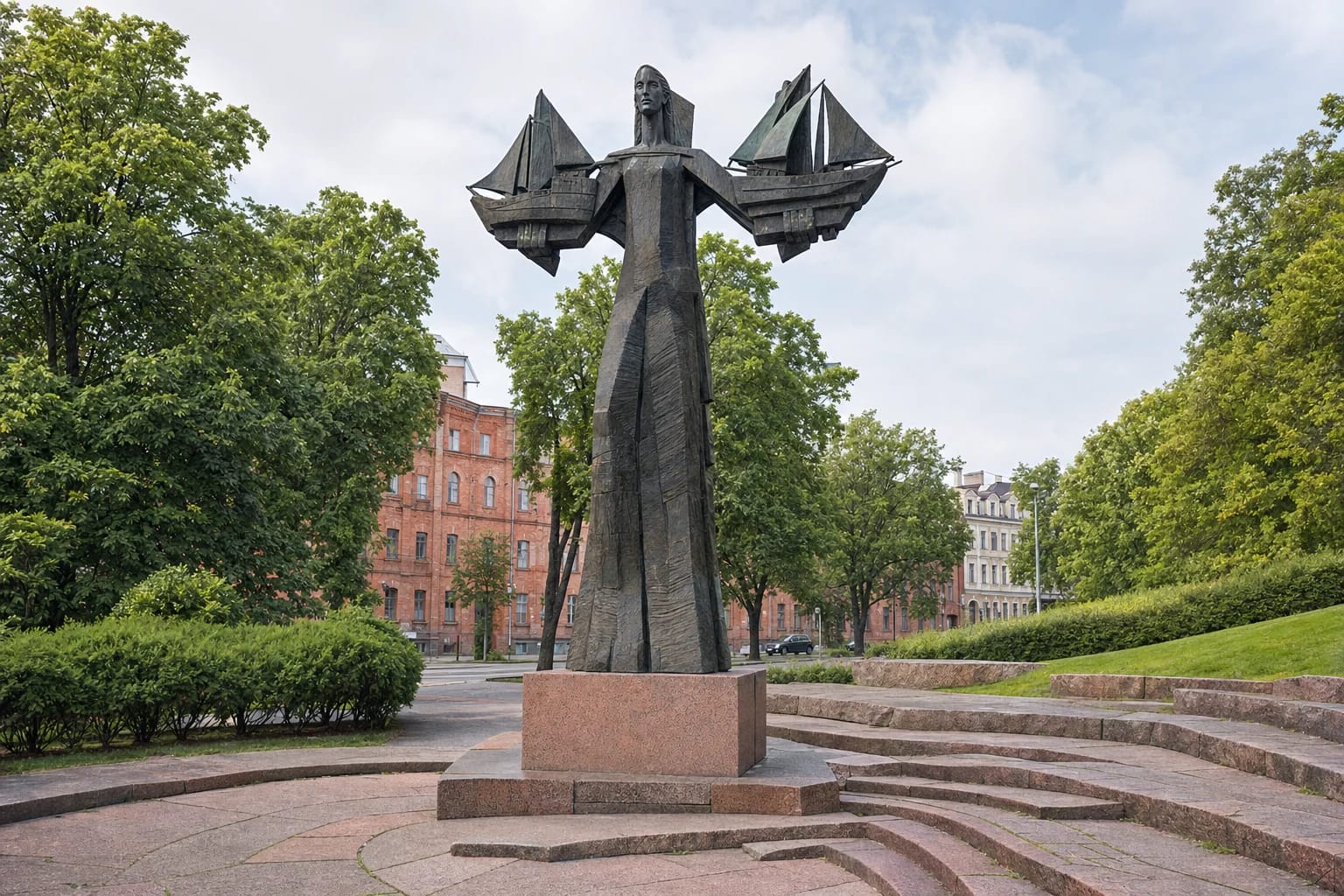
A bronze giantess carrying two ships
A vertical, broadly modelled female figure forms the centre of the composition. Her narrow torso rises from a pink stone plinth, while two ships spread across the upper section. Their hulls, sails, and wing-like silhouettes frame Neringa's individualized head on both sides. The entire bronze form is dark, rough, and angular, with surfaces that retain the character of a carved wooden model.
The Lithuanian Artists' Association dates Neringa to 1972-1983 and lists bronze, stone, and a height of 500 cm. This is a useful overall dimension for the monumental work, not proof that every step in the square belongs to the same five-metre measurement. The sculptor was Daliutė Ona Matulaitė, commonly known as Dalia Matulaitė, and the architect was Rimantas Buivydas.
This is not a sculpture in Nida or another settlement of Neringa Municipality. It stands in Klaipėda, in Neringa Square beside Kūlių Vartų Street and Taikos Avenue. Its name identifies the giantess and the square, not the artwork's administrative location.
The long development from 1972 to 1983
The Regional Guide traces the project to 1972. That year, the Pranas Domšaitis Gallery accepted a wooden Neringa, and the bronze version was completed roughly a decade later. The Lithuanian Artists' Association gives the full span as 1972-1983, a more accurate description of the long creative and implementation process than a single supposed casting or unveiling date.
The dates are not entirely uniform across sources. The Universal Lithuanian Encyclopedia dates Buivydas's square with the Neringa sculpture to 1984. This may refer to completion of the square's architectural project rather than contradicting the sculptor's 1972-1983 record. The authoritative sources reviewed do not provide an exact public unveiling date, so this page does not attempt to derive one.
The work is listed in Lithuania's Register of Cultural Property under unique code 15329, with the official record name Decorative Sculpture Neringa. That registration helps distinguish the protected public artwork from the folklore text, the city of Neringa, and other sculptures carrying the same name.
Granite paths shaped like lagoon ripples and dunes
Rimantas Buivydas designed more than a plinth. Granite paths, sloping planes, and steps wind around the sculpture. The Regional Guide compares this architectural setting to ripples on the sea and windblown dunes. It is therefore worth circling the work: the profiles of the ships, angles of the plinth, and sculpture's relationship to the square change as you move.
The setting brings together two material languages. The bronze figure feels heavy and vertical, while pink and grey granite extends movement horizontally across the ground. Ships and sails focus the eye above, and the paths and steps return it to a square that abstracts the coastal landscape.
What Matulaitė's Neringa means
According to the sculptor as quoted by the Regional Guide, the idea came as a vision: she saw Neringa carrying two ships and appearing more powerful than the American Statue of Liberty. The giantess's strength is expressed not through extraordinary scale but through maximum formal tension and concentrated energy. It rises from the torso into the sails, wings, and head crowning the central axis.
The stern features and coarse bronze surface are associated with the harsh nature of the lagoon coast. The two ships allow the work to be read as a sign of maritime Klaipėda, but it does not commemorate a particular vessel, sailor, or historical event. It also marks the area from which post-war Klaipėda began expanding southward along the Curonian Lagoon.
The artistic image draws on the tale of the giantess Neringa, but the bronze sculpture is not an old folklore object. The legend says that Neringa carried sand and built the Curonian Spit to protect fishermen from a stormy sea. Matulaitė's composition transforms that protective strength into the motif of ships raised aloft. The separate Giantess Neringa page covers the story in greater depth.
Finding and viewing the sculpture
The exact sculpture site point is 55.7066168, 21.1406837, in the square beside Kūlių Vartų g. 6. The navigation link uses the Google Maps listing with place ID ChIJg-SgDffb5EYRNIZjADhvVZA. The pin marks the artwork itself, not Neringa Municipality, a car park, or a general point in central Klaipėda.
This is a public outdoor artwork without a separate ticket desk, admission charge, or indoor opening hours. Daylight best reveals the coarse bronze and the silhouettes of the two ships. Square repairs, events, or temporary barriers may affect access, so follow signs on site and do not climb on the sculpture or plinth.
There are level paths around the composition, but steps and sloping granite planes form part of the artistic setting. No detailed independent audit was found confirming a step-free route to every viewing angle.