- Place
- Tabariškės village, Šalčininkai District Municipality
- Region
- Vilnius Region
- Type
- memorial folk-art exhibition housed in the former Tabariškės school
- Address
- 7 Mokyklos Street, Tabariškės, Šalčininkai District
- Coordinates
- 54.43746, 25.60391
- Visit duration
- 1-1.5 hours; allow longer for a pre-arranged tour or a combined visit to Tabariškės church and cemetery
- Best time
- at a time confirmed by the museum; summer is convenient for exploring Tabariškės, but book group visits in advance
Anna Krepsztul Museum, Ana Krepštul Memorial Museum, Muzeum Anny Krepsztul
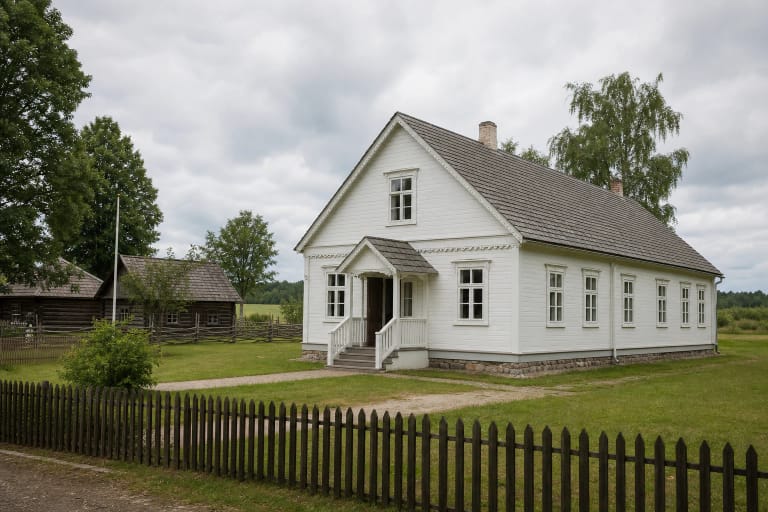
The museum occupies a former school, not the artist's house
Ana Krepštul Museum is in Tabariškės at 7 Mokyklos Street. Coordinates 54.437463, 25.603912 identify the former school, now a multifunctional community centre, which contains the exhibition. This distinction matters: visitors enter a memorial created by the community, not the artist's preserved private home.
The museum opened in 2008, approximately a year after Krepštul's death. Its original exhibition occupied two rooms. A third room for embroidery, small pictures, clothing, and her distinctive rugs sewn from gathered textile strips was added across 2012-2013. Different dates in official accounts refer to the room's opening and the completion of its display.
The Krepštul family, Tabariškės community, and Šalčininkai Cultural Centre gathered artworks, personal belongings, and memories. This is therefore not a closed state catalogue but a collection that continues to grow as works return from private hands. Two early paintings came back in 2024: willow branches in a vase and a broken yet still green birch.
Three rooms place the art beside the conditions in which it was made
The district's museum description says that about fifty paintings by Ana Krepštul are exhibited. An earlier report counted forty-six, so these figures are best understood as selections at particular dates rather than a fixed total. Paintings hang beside drawings, embroidery, photographs, clothing, honours, and objects preserved by the family.
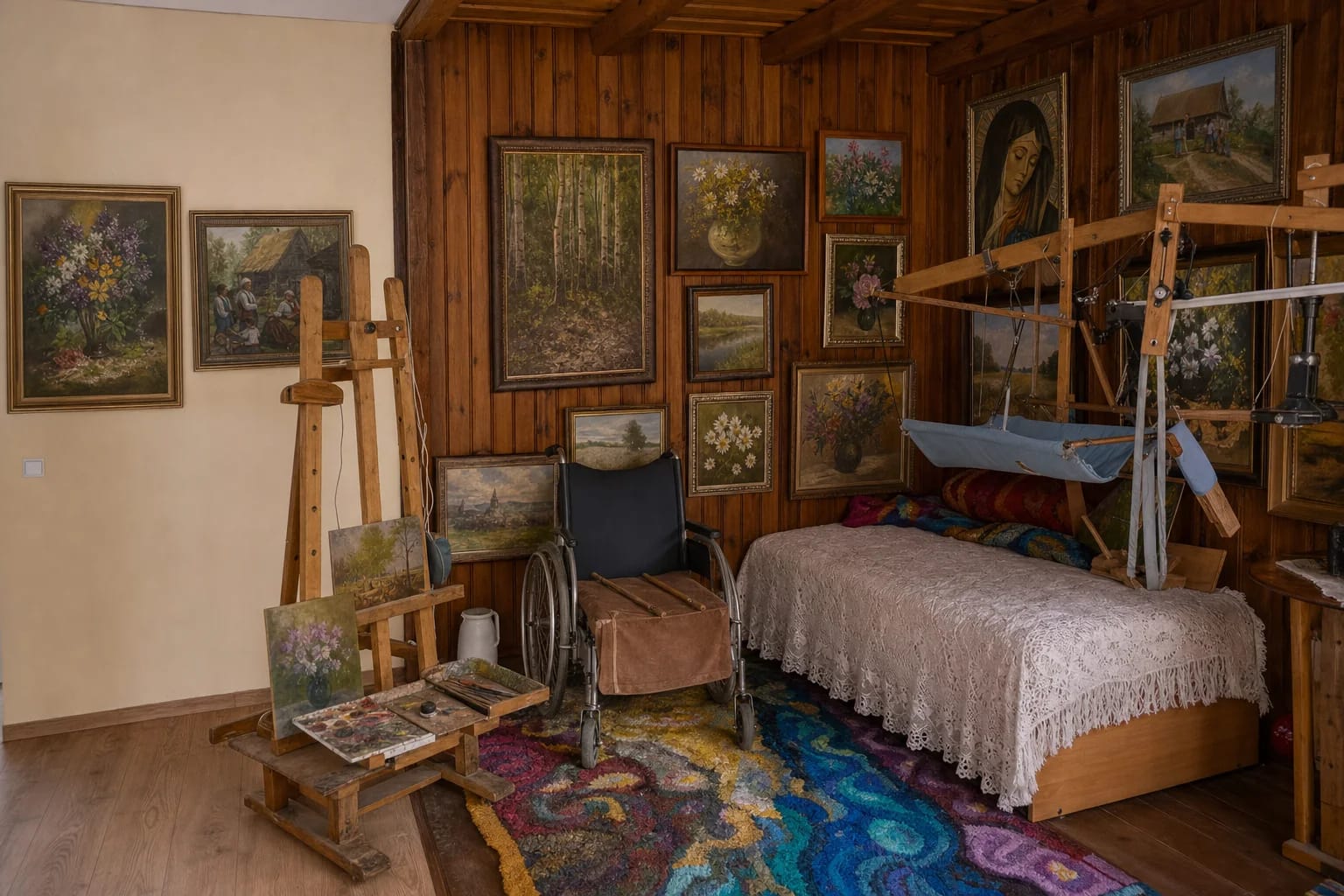
Part of one room reconstructs the artist's bedroom and working area, with a bed, wheelchair, easel, palette, and devices that assisted her. It is not an entire untouched room relocated from her house. Instead, the reconstruction makes practical questions visible: where a canvas rested, how tools were kept within reach, and how rest and painting shared one limited space.
The installation is dense and domestic in scale, with neither long neutral gallery walls nor a compulsory route. Begin with the recurring subjects in the paintings, continue to the textiles, and only then examine the workspace. This keeps the wheelchair and medical equipment in their proper role as context for an artist's self-designed working system rather than turning them into spectacle.
Krepštul began painting as a teenager and produced thousands of works
Ana Krepštul was born in Tabariškės on 20 February 1932 to teachers Stanisław and Józefa. Her father, a teacher and amateur sculptor, gave her first lessons in drawing and carving. She began painting at thirteen and held her first exhibition at sixteen. Largely self-taught, she worked at the Vilnius Art Combine from 1969 to 1972.
After a long interval, an exhibition in 1985 brought recognition as a folk artist. Flowers, trees, village landscapes, and the faces of people close to her remained recurring subjects; devotional imagery became more prominent later. Her painting of the Virgin and Child stands on the high altar of St Michael the Archangel Church in Tabariškės.
Official sources describe her output differently: the museum says more than 3,000 paintings, while the municipality's biography estimates about 3,500. These are approximate totals recorded at different times, not an inventory of works held by the museum. Her art entered collections in Lithuania and abroad, was exhibited in Chicago in 1995, and was also presented to Pope John Paul II.
Illness is documented history, but not the sole explanation for the art
Official biographies state that Ana Krepštul lived with severe bone disease from childhood, sustained numerous fractures, and used a wheelchair during approximately the final twenty years of her life. The municipality's account gives a figure of seventy-two fractures. These are biographical records, not a visitor attraction or a measure of artistic merit.
In the reconstructed workspace, the wheelchair, bed, easel, and support apparatus appear beside the paintings. This arrangement reveals concrete creative choices rather than an abstract tale of willpower: adapted body positioning, tools kept within reach, manageable picture formats, and textile methods built through patient repetition.
Krepštul continued making art until the end of her life and died on 12 October 2007; she is buried in Tabariškės. She became an honorary citizen of Šalčininkai District in 2005 and was posthumously awarded the Officer's Cross of the Order of Polonia Restituta in 2008. Those honours place this community-held legacy within a wider Lithuanian and Polish cultural memory.
The explicit timetable dates from 2023, while fees were checked in 2026
The most recent municipal notice found with an explicit schedule was published for summer 2023. It listed Tuesday to Saturday from 09:00 to 18:00, with a lunch break from 13:00 to 14:00. This does not prove that identical hours apply every week in 2026. Before departure, contact the museum on +370 639 16455 or at a.krepstulmuziejus@salcininkaikultura.lt.
On 19 July 2026, the official Šalčininkai Cultural Centre service list priced a visit with a guide at €2 for an adult and €1 for a school pupil, student, senior, or person with a disability. The wording explicitly joins the fee to a guided visit, so it should not be read as proof of a separate self-guided ticket or free admission. Confirm the price, payment method, and tour language when booking.
Allow about one hour for an individual visit or up to ninety minutes for a fuller conversation with a guide. Because this is a small branch of a cultural centre, the staff member may be leading an educational activity or community event. Calling ahead matters not only for groups but also for individual visitors travelling a substantial distance.
A Tabariškės visit requires clear expectations about access and sacred sites
The official museum pages reviewed do not provide a detailed physical-access audit. The presence of the artist's wheelchair cannot establish that today's entrance, every gallery, and the WC are step-free. Ask in advance about steps, thresholds, door widths, a vehicle drop-off point, and seating within the exhibition.
The museum pairs naturally with St Michael the Archangel Church in Tabariškės, where one of Krepštul's paintings hangs. The church remains a working sacred space, and its opening and service times are separate from the museum. The artist's grave in the local cemetery is another distinct memorial site where quiet conduct and leaving objects untouched are appropriate.
Tabariškės lies near the Lithuanian-Belarusian border, but a museum visit is not itself a border-zone hike and need not involve minor roads within a controlled frontier area. Remain on public roads and follow current signs. Check photography rules on arrival: family photographs, personal objects, and densely hung works do not automatically permit flash or the publication of close reproductions.