- Place
- Jurbarkas District Municipality
- Region
- Panemunė
- Type
- former manor park, late Classicist service wings, and museum
- Address
- Vydūno g. 19, Jurbarkas
- Coordinates
- 55.07790, 22.76550
Jurbarkas Manor Estate, Jurbarkas Manor Park
A Manor Where the Missing Palace Matters
Jurbarkas Manor differs from many Lithuanian manor estates because you will not see the representative palace here. According to sources, the Classicist main building was destroyed by the German army during the First World War in 1914-1915. Only the portico columns survived, restored in 2015 as a marker of the site. Jurbarkas therefore tells not only of manor culture but also of loss.
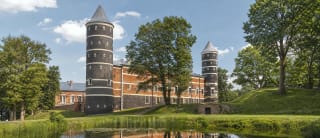
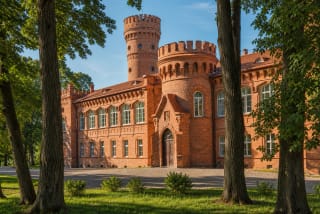
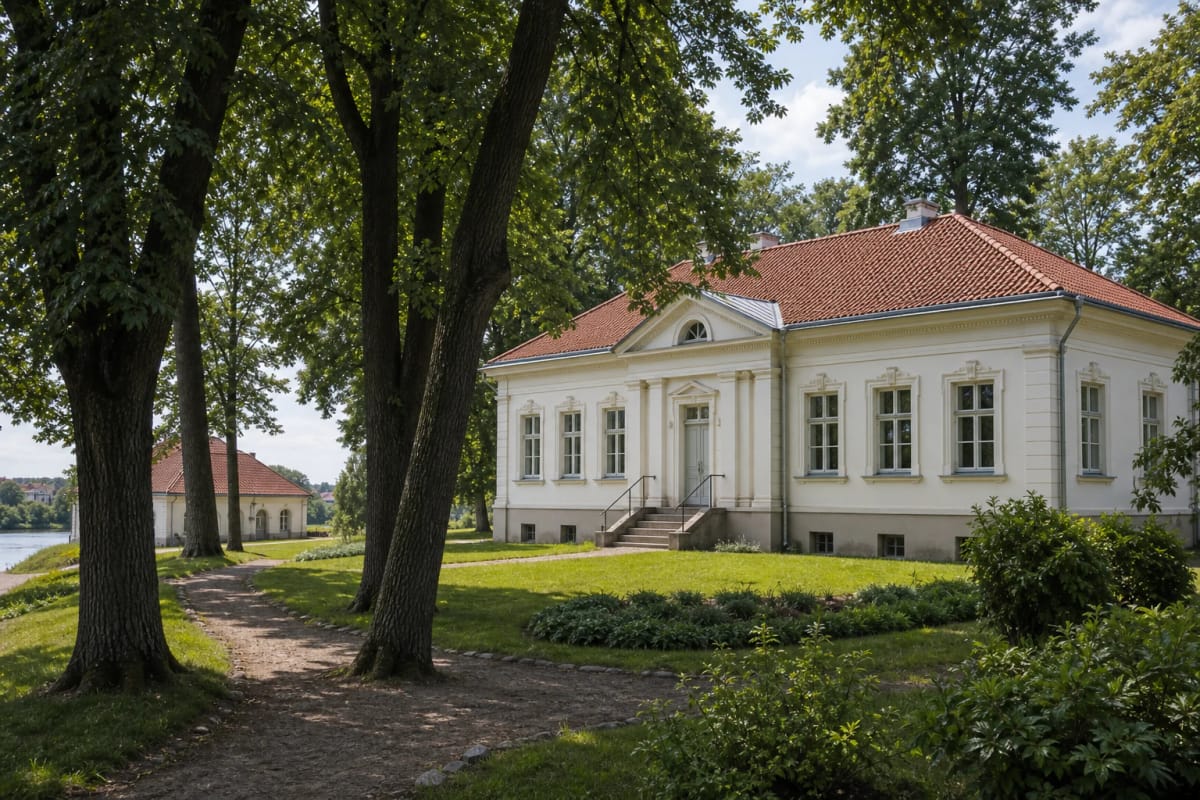
Today the visitor sees a mixed-plan manor park along Vydūnas Street, laid out in the mid-nineteenth century, two late Classicist service wings, a workers' house, a former Orthodox church, and museum spaces. It is worth knowing this before arrival so you do not look for a palace facade that no longer exists and can value what remains.
Royal Manor and Queens' Estates
Jurbarkas Manor has deep royal-manor roots. The manor is mentioned already in the early sixteenth century, while Jurbarkas district is recorded in 1502. After the 1422 Treaty of Melno, Jurbarkas passed to Lithuania and became an important border-trade point by the Nemunas. In the sixteenth to eighteenth centuries Jurbarkas repeatedly belonged to the wives of Polish and Lithuanian rulers, including Bona Sforza, Anna of Austria, Cecilia Renata, and Marie Louise Gonzaga.
In the early eighteenth century Augustus II entrusted Jurbarkas to the Radziwiłłs; in 1795 Catherine II gave it to Platon Zubov; and in 1846 Nicholas I transferred the manor by majorat right to the Princes Vasilchikov. The Vasilchikovs shaped the visible core of the estate in the mid-nineteenth century and held it until it was parcelled out in 1918.
Late Classicist Service Wings and Estate Buildings
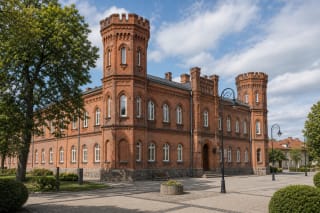
The most important surviving buildings are the two late Classicist service wings, built in the mid-nineteenth century. Estate servants lived in the southern service wing, while the more elegant northern one was intended for the princely family and guests; since 1991 the northern service wing has housed the Jurbarkas Regional Museum. A workers' house from the same period also survives.
The estate also contains a late-nineteenth-century Orthodox church building, now adapted as the museum's concert and exhibition hall, the so-called Dragūnai Club from the late nineteenth to early twentieth century, an outbuilding, and fence fragments with gate posts. The service wings and auxiliary buildings are not secondary here; they have become the main material witnesses to manor memory.
Jurbarkas Regional Museum
The Jurbarkas Regional Museum operates in the historic manor service wings and former Orthodox church, so visiting the museum is the most direct way to enter authentic manor spaces. Exhibitions present the history of Jurbarkas town and region, manor past, ethnography, and local memory.
Other cultural objects nearby strengthen the manor setting: the homestead museums of sculptor Vincas Grybas and actor Kazys Glinskis operate close by. This lets the estate area function not merely as a park but as a broader town centre of culture and memory.
Jurbarkas Manor Park in Panemunė
The mixed-plan manor park, established in the mid-nineteenth century, is an important part of the visit. It helps you feel the scale of the former estate and provides a quiet walk before or after the museum. Paths, tree groups, and the arrangement of buildings show how the representative and working parts of the estate once functioned.
On a Panemunė route, Jurbarkas Manor Park is a useful contrast to castles. If Panemunė or Raudonė work through strong architectural silhouettes, Jurbarkas requires a slower eye, focused less on one building than on the remaining structure of the whole estate.
How to Visit Jurbarkas Manor
Allow 45-90 minutes for Jurbarkas Manor. If you plan to visit the Jurbarkas Regional Museum, give yourself more time and check opening hours on the museum website because exhibitions and event schedules change.
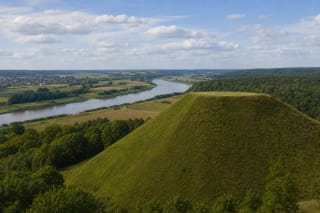
The site is especially convenient on the Panemunė route: combine Jurbarkas with Panemunė Castle, Raudonė Castle, Seredžius Hillfort, the Nemunas banks, or the Tauragė direction. The key is not to expect the central palace to survive; the present value lies in the park, service wings, former Orthodox church, and museum.