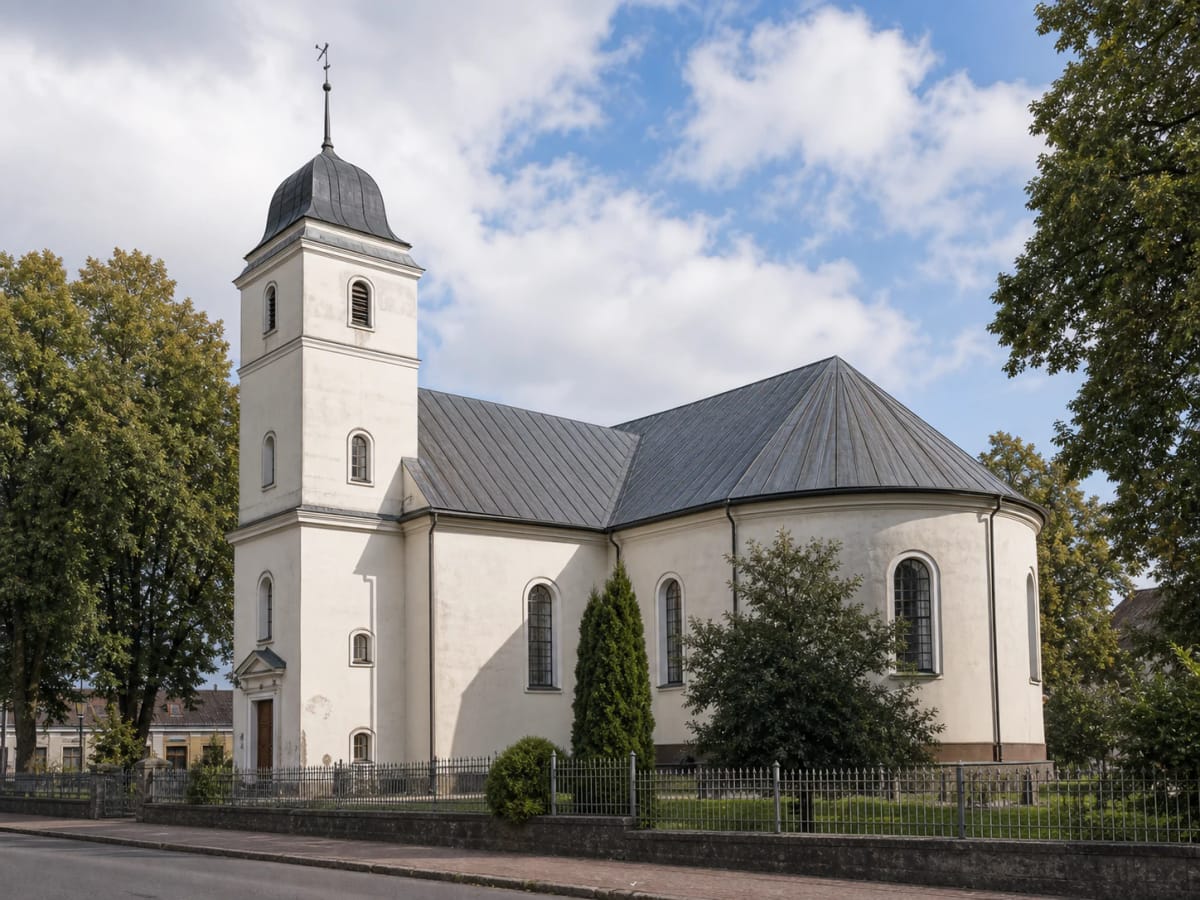
- Place
- Tauragė District Municipality
- Region
- Tauragė Region
- Type
- Evangelical Lutheran church and parish-history site
- Address
- Vytauto Street 56, Tauragė
- Coordinates
- 55.25239, 22.29087
Tauragė Martynas Mažvydas Evangelical Lutheran Church, Tauragė Parish, Tauragė Evangelical Lutheran parish church
Tauragė Martynas Mažvydas Lutheran Church - a mark of the Reformation in the town
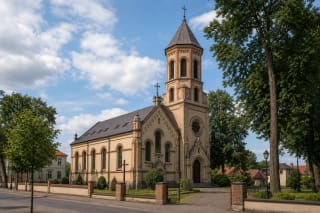
Tauragė Evangelical Lutheran Church stands at the corner of Vytauto and J. Tumo-Vaižganto Streets in the old town. It matters not only as an architectural object but as a sign of Tauragė's confessional history: the town's Lutheran community reaches back to the Reformation, one of the oldest layers of its identity.
The Universal Lithuanian Encyclopedia and the municipality call it the Martynas Mažvydas Evangelical Lutheran Church. The church received this honoured name in 1947, marking the 400th anniversary of the first Lithuanian book, Martynas Mažvydas's Catechism of 1547.
A parish from 1567: Jonas Šemeta and pastor Tomas Ridanskis
The official Evangelical Lutheran Church of Lithuania page dates the parish's beginning to 1567. Tauragė manor then belonged to the old Samogitian noble Šemeta family; Jonas Šemeta, who also served as elder of Batakiai, built the Lutheran church and founded the parish in 1567.
That same year, the first parish pastor, Tomas Ridanskis (also written Rydanskis, Thomas Rydonsky), was invited. The parish history stresses that he held services in Lithuanian, because there were no other-language Lutherans in Tauragė at the time - a sign that the community was Lithuanian-speaking from the very start.
The 1836 fire and the 1843 stone church
The parish history spans several buildings and disasters. On May 21, 1836 (June 2 in the new calendar), a great fire swept through the old part of Tauragė, destroying roughly 200 buildings, including the wooden Lutheran church. This time the parishioners resolved to rebuild at their own expense, collecting funds for seven years.
The new church was designed by the Vilnius governorate architect Karolis Gregotovičius (1799-1848), and the master builder was Cimermanas. The result is a restrained, strict split field-stone building with an elegant square tower, attributed to Romantic Classicism. The cornerstone was laid on June 7, 1840, and the finished church was consecrated on May 21, 1843 - exactly seven years after the fire.
The tower's wartime collapse and 1938 rebuild
During the First World War, German cannon fire destroyed the church tower, though the sanctuary itself survived. After the war, parishioners first restored the ruined entrance, while rebuilding the tower dragged on until the end of the interwar period.
The tower work was led by the parish council chairman Jurgis Preikšaitis; it was finished in 1938 and solemnly consecrated on August 18. The ceremony was attended by consistory president Dr K. Gudaitis and the visiting Latvian Archbishop Dr T. Grinbergs. The present silhouette is therefore best read as an accumulation of war, fire, and community effort.
The Mažvydas name and Antanas Bagdonas's sculptures
The name given in 1947 is no accident: Mažvydas was a Prussian-Lithuanian Lutheran pastor who prepared the first printed Lithuanian book. In this way the Tauragė parish is tied to the beginnings of both Lithuanian writing and the Reformation.
The facade underlines the link: since 1987 it has carried copper sculptures of Martin Luther and Martynas Mažvydas by the folk artist Antanas Bagdonas. They are a reminder that this sanctuary is not only a place of prayer but also a memorial to Lithuanian culture and the printed book.
Services, events, and a Tauragė route
There are no reliable tourist opening hours or tickets for this active church. It is a parish sanctuary, so the interior is most easily seen during services, concerts, or a visit arranged in advance. The parish office is at J. Tumo-Vaižganto Street 50, so check the official parish page or contact the community before travelling.
Tauragė is often introduced through the castle, borderland history, and the museum, but the Lutheran church opens another layer. Pairing both town churches and the Santaka Museum, and then turning to the Pagramantis Outcrop or the Akmena and Jūra confluence, makes the centre of Tauragė a story about the different communities that shaped its identity.