- Place
- Jurbarkas District Municipality
- Region
- Panemunė
- Type
- Holocaust and Jewish community memorial
- Address
- Kauno g. 58, Synagogue Square, Jurbarkas
- Coordinates
- 55.07630, 22.77000
Synagogue Square Memorial, Jurbarkas Jewish Memorial
Memory on Synagogue Foundations
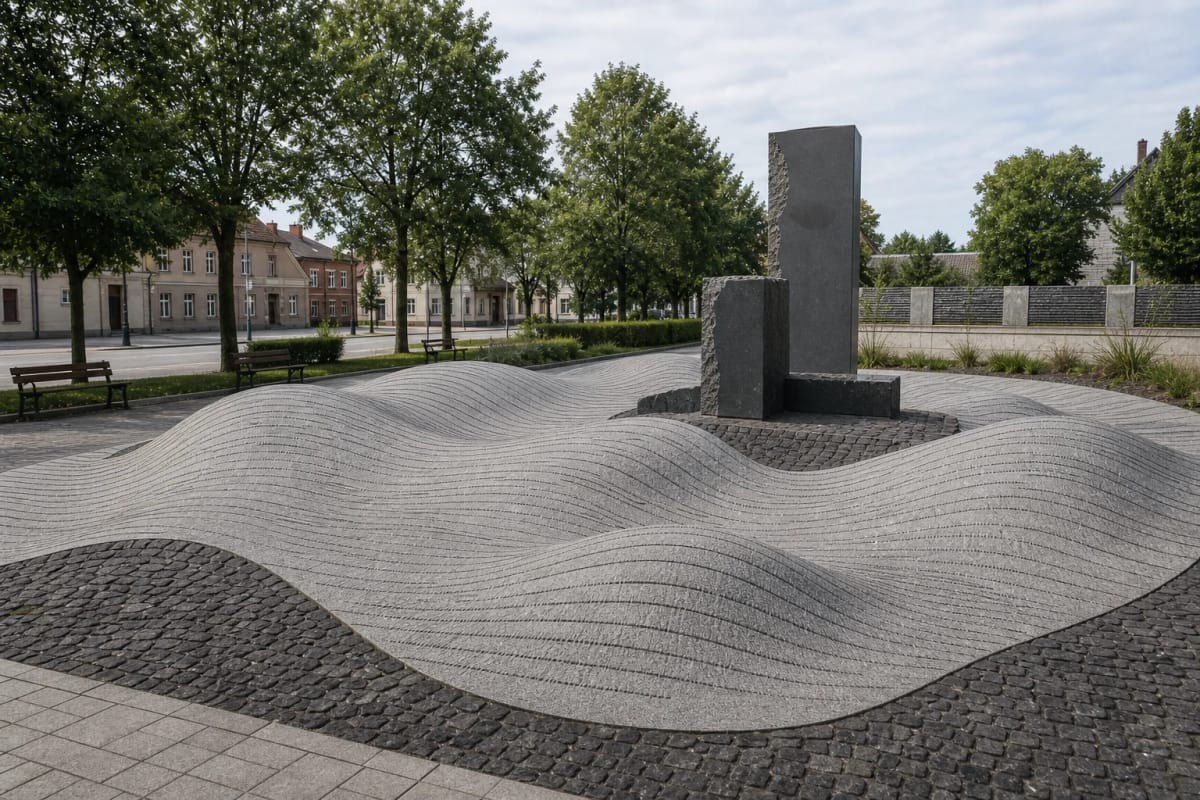
The Jurbarkas Synagogue Square Memorial stands in the town centre, in the former Synagogue Square, on the site of the Jurbarkas synagogues that once stood here. It is a memorial to the Holocaust and to the town's Jewish, or Litvak, community, unveiled on July 19, 2019.
For more than three years the memorial was created without payment by the Zundelovich family, originally from Jurbarkas and now living in Israel: sculptor David, architect Anna, and art director Grigoriy. The works cost about 180,000 euros and were funded privately and partly by the Good Will Foundation; descendants of Jurbarkas Jews from around the world donated.
Memorial Symbolism
The square's paving is covered by undulating granite bands representing the Nemunas; about one thousand family names of Jews who lived in Jurbarkas are carved into them in Yiddish and English. Above the waves rises a central basalt composition recalling the destroyed wooden synagogue of Jurbarkas, the community's spiritual centre.
From the waves rise 22 basalt stones with letters of the Hebrew alphabet, symbolising language, culture, and education. A black-granite axis crosses the square diagonally toward Jerusalem and commemorates the Righteous Among the Nations who rescued Jews. The creators describe it as the only memorial of its kind in the world for shared Jewish and Lithuanian history; this should be understood as their assessment.
The Famous Wooden Synagogue
One of Lithuania's most beautiful and oldest wooden synagogues once stood in the square, built around 1790. It was a masterpiece of vernacular wooden Baroque, famous for its carved interior: the Torah ark, bimah, and Elijah's chair were covered with animal, bird, and plant carvings that drew not only worshippers but artists.
In 1941, after Germany occupied Jurbarkas, the occupying authorities forced Jews themselves to dismantle the wooden synagogue, after which it was burned. The fate of the neighbouring masonry synagogue is described differently in sources, so it is worth mentioning cautiously; the wooden synagogue was certainly destroyed in 1941.
Jurbarkas Jews and the Holocaust
Jews are mentioned in Jurbarkas from the fifteenth century, and the community began to grow rapidly in the mid-seventeenth century. Before the Second World War, Jews made up about 42-43 percent of the town's population, around two thousand people, and Jurbarkas was a living centre of Litvak culture.
The first mass killing took place on July 3, 1941: 322 people were murdered, including about twenty Lithuanians and the sculptor Vincas Grybas. Almost the entire community had been destroyed by the end of September 1941; three centuries of history were ended within a few months. Memory of the victims is also preserved at Jurbarkas genocide-victim sites and the old Jewish cemetery.
Visiting
The memorial is an open, freely accessible place in the town centre and can be visited at any time without charge. A QR code by the former synagogue well leads to information about Jurbarkas Jewish history.
Allow 15-30 minutes. This is a place of memory, so visit respectfully. Annual commemorations take place here on January 27 and September 23. The memorial combines well with the Jurbarkas Regional Museum and a walk through Jewish Jurbarkas sites.