- Place
- Tauragė, Tauragė District Municipality
- Region
- Tauragė Region
- Type
- Urban riverside park whose landscaped 2011 core combines greenery, a sculptural fountain, and modern interpretations of Baltic symbols
- Address
- Kranto g., Tauragė
- Coordinates
- 55.25118, 22.28055
- Visit duration
- 30-60 minutes for the park's main ensemble; 1.5-2 hours if you continue along the Jūra riverfront to the pedestrian bridge, Lovers' Avenue, and Vymeris Hill
- Best time
- in daylight from spring to autumn, checking the river level, path condition, and local signs first after heavy rain or a thaw
Jūra River Trail in Tauragė, Jūra Park, Baltic Park, Jūra Riverfront Park
Where Jūra River Park is, and what the map pin actually marks
Jūra River Park lies close to central Tauragė on the Kranto Street side of the river. A local-history guide prepared by Tauragė's public library in 2018 describes an approximately 6-hectare park extending from the Molupis stream to Vymeris Hill. The landscaped core most visitors seek is smaller: it lies between the Tilžė highway bridge, the Jūra dam, and the riverfront, where the fountain, twelve decorated benches, and anniversary boulder stand.
The coordinates 55.251177, 22.280548 mark a representative point by that main ensemble, not a verified driveway, car park, or sole entrance. The names Jūra River Park and Jūra River Trail are used alongside one another online. Baltic Park is an informal local name for the symbol-rich part, not a separate formally enclosed attraction.
Do not merge this place with Tauragė's other riverfront projects. Jovarai Park, Picnic Park, the newer paths towards Tarailiai, and architectural proposals for the former hippodrome are different spaces, even though they belong to a wider network along the Jūra. Consequently, the kilometre figures for a longer riverside trail cannot simply be assigned to the park core landscaped in 2011.
The river valley, trees, and changing water levels
The park is fundamentally a green part of the Jūra valley rather than merely a sculpture plaza. The local-history guide lists lindens, poplars, oaks, and pines, together with blue spruces, weeping willows, European larches, and Siberian larches. It associates some planting with the late seventeenth century but provides no separate dendrological date for each tree. Treat that date as a local account of the green space's history, not a guarantee that any particular tree now standing is that old.
According to VLE, the Jūra is a 174.6-kilometre right-bank tributary of the Nemunas. It is impounded at Tauragė, where its mean discharge is 21.4 cubic metres per second. The encyclopaedia stresses sudden high floods and frequent surges, with very large fluctuations in water level. This explains why path conditions should be checked on site after heavy rain, thaw, or ice jams.
The park is not presented as an official beach or bathing facility. The nearby dam, current, variable water level, and potentially slippery bank require care, especially with children. Views across the water and a riverside walk are the main experience; access to the water's edge should not be mistaken for an invitation to wade or swim.
The Tree of Life fountain and Steponas Juška's twelve benches
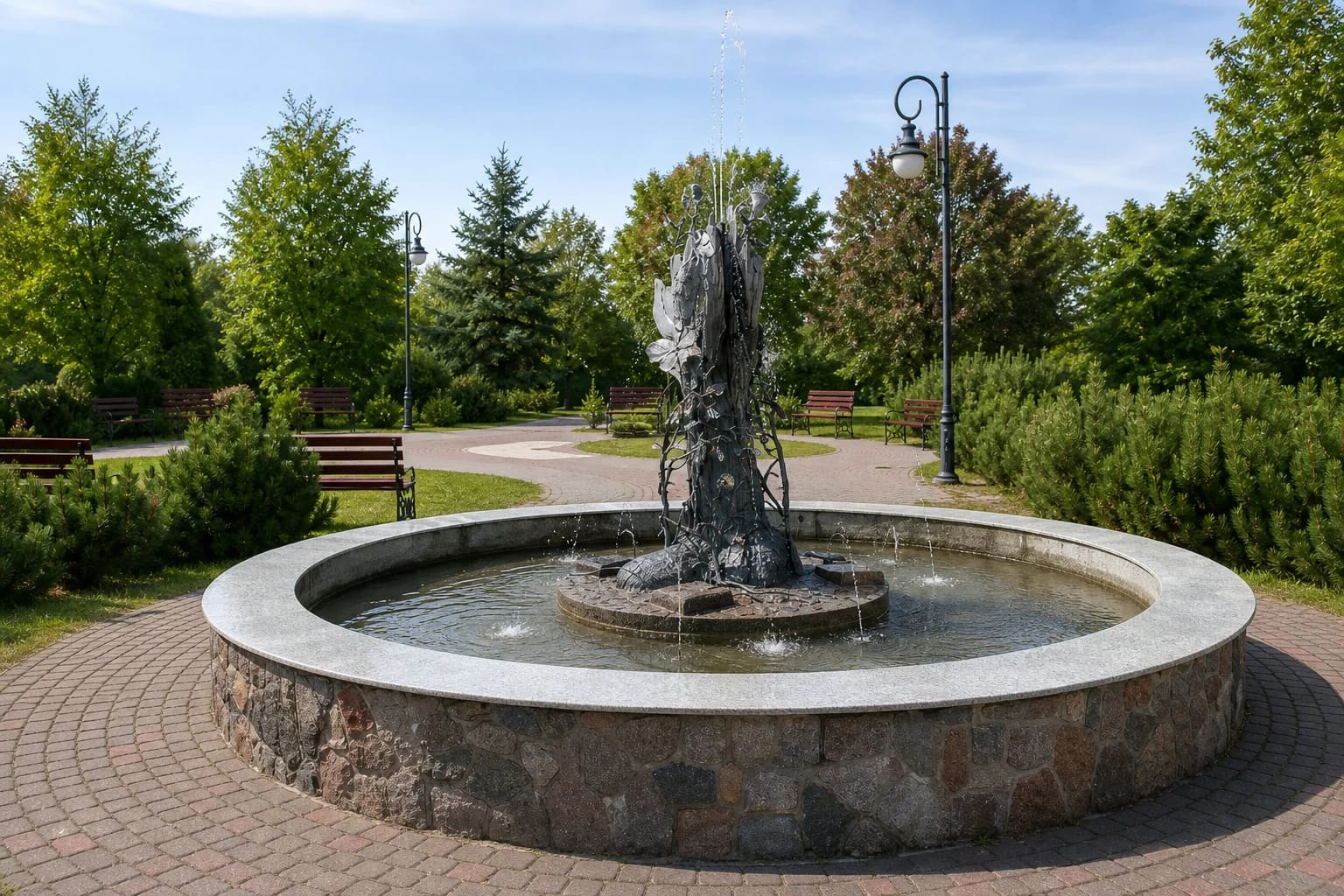
The park's most distinctive ensemble took shape during the 2011 reconstruction between the bridge and the dam. At its centre stands folk artist Steponas Juška's sculptural Tree of Life fountain, surrounded by twelve benches made from oak, granite, and metal. Their celestial and other motifs described as Baltic include the Sun, Moon, a harmony or infinity sign, the World Tree, and serpent forms.
In 2021 the municipality reported that the ten-year-old fountain was badly worn and rusting. Some mechanical components were replaced, the main body of Juška's sculpture was retained, and blacksmith Kęstutis Plyskaitis added forged plant compositions. The work visitors see therefore combines a core created in 2011 with a documented layer of artistic and technical renewal from 2021.
A repair in 2021 does not prove that water flows every day in 2026. Fountains commonly depend on season, maintenance, weather, and water supply, while the reviewed official pages publish no current daily schedule. Even when the water is off, the sculpture and symbolic benches remain the park's principal works to examine.
What the Baltic zodiac signs mean, and where certainty ends
The benches are presented as a circle of twelve ancient Lithuanian or Baltic zodiac signs. The popular explanation connects them with burned images on an old ritual ladle discovered in a church basement in Grodno after the Second World War and dated approximately to the sixteenth century. An ethnoastronomical reconstruction developed the proposed link between those images and the zodiac, and the park's creators translated that interpretation into a modern urban space.
Visitors should distinguish between the surviving object, a researcher's interpretation, and the park design created in 2011. Twelve images on an old ladle are not the same as a continuously documented Lithuanian horoscope system, nor do they prove that every explanation attached to a park bench was used in precisely that form centuries ago. The signs are best read as an interpretation of culture and ethnoastronomy, not a scientific personality test or prediction.
That caution does not diminish the concept. It encourages a closer look at how oak, granite, and forged iron combine with images of the Sun, Moon, World Tree, and serpent, while raising a useful question about how present-day Tauragė chooses to tell a story about Baltic culture.
The Tauragė boulder, and why not to search for the Fairy-Tale Giant
A boulder dedicated to Tauragė's 500th anniversary stands near the symbolic benches and is often nicknamed the Tauragė Puntukas. The local-history source gives a height of about 4.4 metres and an approximate weight of 100 tonnes. Members of the Tauragė Rotary Club brought it from Pagramantis Forest and presented it to the city in 2007. This is a permanent park object and should not be confused with the later timber giant installation.
The six-metre Fairy-Tale Giant appeared in Jūra River Park in December 2021 as a temporary light, sound, and animation installation. Raimondas Kavaliauskas and Gediminas Tamulynas devised it, folk artist Nerijus Alšauskas built it from timber boards, and its narrative combined motifs of the Nine-Horned Deer, Perkūnas's smith, and a giant. The official showing announced at the time ran only until New Year.
The work later travelled to the 2022 Vilnius and 2024 Brussels light festivals. Old photographs of the giant rising from the ground therefore do not establish that it is now in the Tauragė park. Plan a normal visit around the Tree of Life, the benches, boulder, and riverfront, and rely only on a new official event announcement if a travelling light installation is said to return.
Opening hours, route, accessibility, and a safe visit
Jūra River Park is an open public space. As of July 20, 2026, the reviewed official sources listed no admission charge, ticket office, or permanent gate hours. This does not mean every facility operates around the clock: the fountain, lighting, events, maintenance, floods, or winter conditions can change the experience. Current notices and barriers on site take priority over an older online description.
For a short visit, begin at the representative point on the Kranto Street side, examine the fountain, walk around the twelve benches, and find the anniversary boulder. With more time, continue along the riverfront towards the pedestrian bridge, climb to the upper bank, follow Lovers' Avenue, and reach Vymeris Hill. The longer route includes different paths and changes in elevation rather than forming one level park circuit.
The landscaped core has paved paths and benches, but the reviewed sources provide no current universal-access audit, guaranteed step-free link from a parking place, or separate official car-park pin. A wheelchair user, a family with a pushchair, or anyone who finds steps difficult may prefer the core paths and should assess kerbs, gradients, and surfaces on arrival. Park only where signs permit, never on grass or a pedestrian path.