- Place
- Tauragė, Tauragė District Municipality
- Region
- Tauragė Region
- Type
- museum opened in 1997 within Tauragė's former NKVD and MGB headquarters of 1944-1954, with exile collections, reconstructed interrogation and detention spaces, a partisan bunker, and exhibitions on the Kęstutis District and Sąjūdis
- Address
- 38 Prezidento Street, Tauragė
- Coordinates
- 55.25047, 22.28987
Tauragės tremties ir rezistencijos muziejus, Šubertinė, House of Suffering of Deportees and Political Prisoners, Museum of Struggles and Suffering
The newest Lithuanian price list says €3, while older English pages still misleadingly show €2
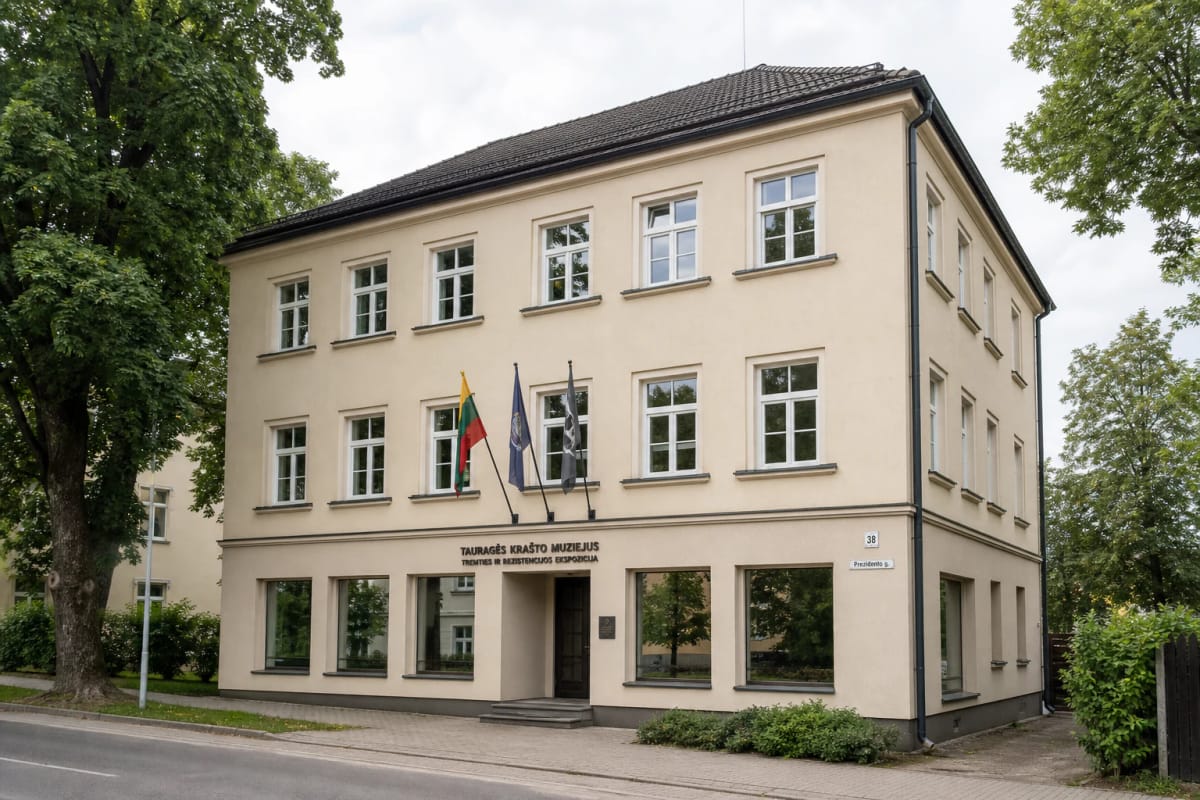
The museum stands at 38 Prezidento Street, coordinates 55.250469, 22.289871, about a ten-minute walk from Tauragė Castle. On 13 July 2026, its Lithuanian branch page listed Tuesday-Thursday 9:00-17:00, Friday 9:00-15:45, and Saturday 10:00-16:00. Lunch closure is 12:00-12:45 each open day; Monday and Sunday are closed, as are public holidays.
The current Lithuanian tariff listed adult admission at €3 and a €1 concession for pensioners, students, conscripts, and schoolchildren. An older English version and several regional pages still showed €2, so follow the newer Lithuanian branch listing and check again before a later trip. A guide for a group of up to 25 cost €15, with an individual admission ticket still required for each visitor.
Preschool children, deportees, political prisoners, people with recognised victim status, Lithuanian museum workers, visitors aged 80 or over, POLA card holders, disabled visitors, and one assisting person were admitted free. School groups from Tauragė District and accompanying teachers received free Wednesday entry. A concession does not prove that every basement and bunker area is step-free; call +370 655 56 300 to discuss the specific route.
Šubertinė was a joiner's family house and workshop before two Soviet occupations changed its purpose
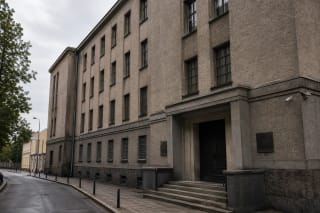
Prosperous Tauragė joiner Otto Šubertas, also written Otto Shubert in museum publications, built this three-storey masonry house in 1936. One heritage catalogue gives 1937, making 1936-1937 the safest construction range. He intended the basement as a furniture workshop and the upper floors as the family home. The local name Šubertinė derives from its owner, not from any Soviet institutional term.
When the Soviet Union occupied Lithuania in 1940, the house was nationalised, its owners displaced, and an NKVD office with short-term detention installed. The Šubertas family departed for Germany in 1941, briefly returned in 1943, and left permanently as the front approached. The intervening Nazi occupation of 1941-1944 means it would be inaccurate to describe one uninterrupted NKVD prison here from 1940 to 1954.
The second and best-documented repressive phase began when Soviet forces returned to Tauragė in October 1944. Until 1954, the house served the district NKVD and later MGB, with an internal prison. Institutional abbreviations changed, and KGB is often used in public memory for the whole security system, but NKVD and MGB are the historically precise names for this post-war prison.
Basement imprisonment, interrogation above, and the escape of 23 prisoners in 1946 belong to the site's real history
From 1944 to 1954, basement cells and punishment rooms held Lithuanian partisans, their couriers and supporters, and civilians suspected of anti-Soviet activity. They were interrogated, pressured to become informants, and tortured on the upper floors. The museum grounds this history not only in general statistics but also in testimony, photographs, letters, and objects preserved by families from the Tauragė region.
On the night of 13 June 1946, members and contacts of the Kęstutis District's Rolandas and Vytenis units organised one of Lithuania's largest prison escapes. Nurse Margarita, Juozas Marozas, and Viktorija Labanauskaitė bribed guard Andrei Gorbachev, who opened the punishment room and almost all cells. Twenty-three prisoners emerged and were met by contacts in the gardens of Vaižganto Street, then guided towards Karšuva Forest and Purviškiai Wood.
This was not a cinematic storming of the building. Covert assistance from inside, unlocked doors, and a waiting underground network proved decisive. Some escapees immediately joined armed resistance. The episode explains why the museum presents active choices to resist alongside victim suffering, and why the Kęstutis partisan district is much more than a background label in the exhibition.
Today's cells and bunker are reconstructions because post-1954 use destroyed almost all of the prison interior
The repressive office closed in 1954. Conversion to flats destroyed the old internal arrangement, cells, and most authentic prison elements; a clinic later occupied the house. The address, walls, and historical location are genuine, but visitors should not assume that every bar, cell bed, or interrogator's desk is an untouched object from 1946.
Memory returned in stages. A plaque went onto the house in 1990 and a monument to freedom defenders rose in the yard in 1993. Pranas Rindokas, chair of the local Union of Political Prisoners and Deportees, initiated collecting in 1995. On 14 June 1997, Lithuania's Day of Mourning and Hope, the Museum of Struggles and Suffering opened in the basement with more than 1,000 objects already assembled.
The display maintained by Rindokas and his daughter Zita Rindokaitė-Knatauskienė remained in the basement until reconstruction began in 2010. Work finished in 2016 with a new interactive exhibition on two floors, followed by a hologram in the deportation section in 2018. The former long name, House of Suffering of Deportees and Political Prisoners, was subsequently replaced by Museum of Exile and Resistance.
Personal possessions from exile form the core, while technology opens the partisan and Sąjūdis stories
The exile section displays suitcases, letters, photographs, prisoner numbers, clothing, handicrafts, and religious objects brought back from Siberia. Worn prayer books, improvised crosses, censers made from food tins, and a handmade tabernacle are among the evidence. These are not props evoking abstract cold but records of identifiable families trying to preserve faith, Lithuanian identity, and mutual ties.
The resistance section introduces the Kęstutis District's organisation, commanders, uniforms, weapons, press, and daily routines. A partisan dugout-hideout has been reconstructed; visitors may see an authentic Soviet security training film about locating bunkers and hear partisan songs. The reconstruction conveys life in a confined underground space, but it is not an original forest bunker transplanted into the house.
The chronology does not stop in 1954. A separate display covers the Lithuanian Reform Movement Sąjūdis, demonstrations and symbols in Tauragė, and the collapse of the Soviet Union. A film about deportees from Tauragė, made in 2019, is shown on request. The hologram, sound, and moving image work best when they restore witness voices, so leave time for labels and object histories rather than rushing only between interactive effects.
The interrogation performance is a separately booked intense activity, not part of ordinary €3 admission
A regular visitor can see the museum without participating in role-play. In the activity KGB Interrogation Methods, an actor simulates a Soviet interrogator, humiliation, violence, recruitment pressure, and ideological manipulation. Participants first receive rules and sign consent; the museum does not recommend it for people with claustrophobia or high anxiety. In 2026 it was for grades 9-12 and adults, accepted no more than ten, lasted 60 minutes, and cost €5 per person.
The gentler 60-minute Become a Kęstutis District Partisan programme served grades 5-12, groups up to twenty, and cost €3 per person. Participants choose a codename, mark their clothing, and discuss the oath. Museum in the Dark uses flashlights to examine exile objects. All require advance arrangement on +370 655 56 300 or at ausra.norviliene@tauragesmuziejus.lt, and prices can be revised.
The exhibitions address violence, imprisonment, separated families, and death. For a younger child, request a shorter, curator-adapted explanation instead of an intense role. On 13 July 2026, Google Maps averaged 4.9 out of 5 from 32 reviews. The score is excellent, but its small sample means a few new ratings can move it much more than the average of a large national museum.