- Place
- Tauragė District Municipality
- Region
- Tauragė Region
- Type
- nineteenth-century customs and prison complex, now a castle-shaped regional museum
- Address
- Dariaus ir Girėno g. 5, Tauragė
- Coordinates
- 55.25251, 22.28457
Tauragė Castle, Tauragė Regional Museum Santaka, Prison Castle
Tauragė Castle: castle appearance without a medieval myth
Tauragė Castle is one of the city's clearest symbols, but it needs to be introduced accurately. It is not a medieval defensive castle and is not connected with the Radziwiłłs. That mistake was made by Polish historians in the early twentieth century, when they confused the nineteenth-century customs complex with the fifteenth-century Tauragė manor. The inaccuracy was clarified back in 1963, but it still sometimes circulates.
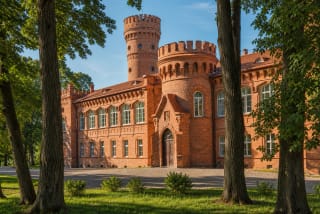
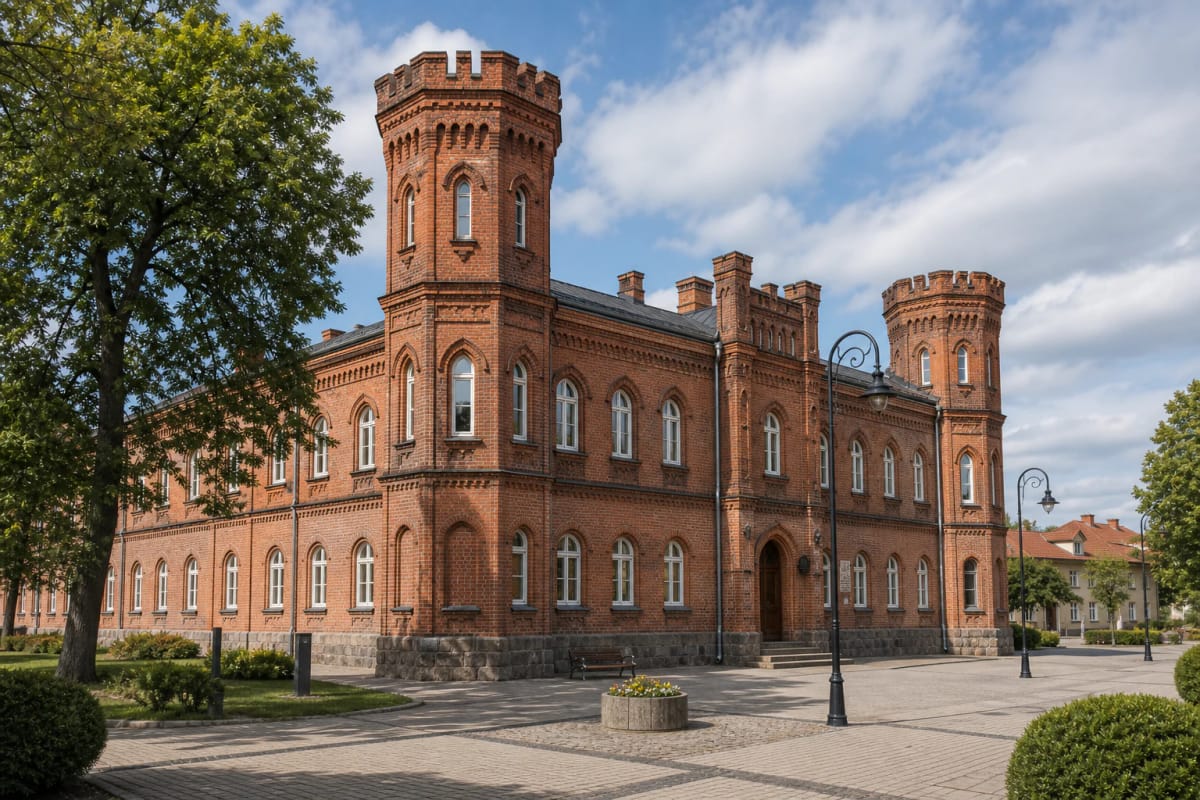
In reality, this is a nineteenth-century tsarist customs and prison complex that later gained a romantic castle appearance with towers. That mismatch between name and origin is exactly what makes the site interesting: in Tauragė, the 'castle' is a sign of city history, border control, imperial power, and architectural representation, not a knightly fortress.
Customs house, book smugglers, and border city
The complex began after the fire of 1836, when the Russian Empire decided to move Tauragė to a new site aligned with the strategic Tilsit-Riga road. The final customs-building project was prepared in 1842 by Karolis Gregotovičius, architect of Vilnius Governorate. In 1846-1847 the first two-storey brick building with a basement was erected; people detained at the border were held there, including Lithuanian book smugglers.
In 1852 the southwestern block was built, now used for museum exhibition spaces. The territory was fenced, a well was dug, and a bathhouse was built. According to historians, the first works were financed by Platon Zubov, manager of Tauragė manor, and bricks were supplied from manor stores. In the late nineteenth century, tsarist troops were stationed here, while book smugglers were later taken to Kaunas Governorate prison or awaited trial on site.
Why the building looks like a castle
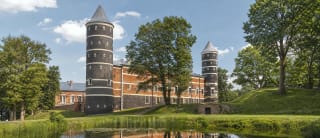
The major transformation took place in 1881-1886, when the customs complex was rebuilt and received a new name: Prison Castle. Four two-storey corner towers with loophole-like openings were added, and the architecture gained historicist features with Neo-Gothic and Neo-Renaissance defensive motifs. VLE dates the tower construction to 1866, so exact dates differ slightly between sources.
The key point is that the defensive motifs were aesthetic rather than functional. Although the building looked like a fortress, it never served that purpose. Its architecture was a visual symbol of imperial power in a border city. Knowing this before the visit makes the site more interesting as an example of a nineteenth-century institutional building.
From psychiatric hospital to schools
Over almost two centuries, very different institutions used the castle. In 1916 a German-established state psychiatric hospital operated here, where hunger and unsanitary conditions caused the deaths of many patients. In 1926 the building housed Tauragė County Hospital and the Higher Commercial School. Later it held a gymnasium, the First Secondary School, and from 1967 to 1990 Tauragė Polytechnic.
This layered use explains why Tauragė Castle today is more than a facade. It is a condensed history of twentieth-century Tauragė, from imperial repression to education and cultural revival. The building also expanded: in 1971 a new building was added to the southwestern block, and in 1986 the northeastern block was built, now used by the art school.
Santaka Museum
Today Tauragė Castle houses Tauragė Regional Museum Santaka. The museum was officially founded on September 1, 1990, with Česlovas Vaupšas appointed its first director. The name Santaka, meaning confluence, symbolises the meeting of people of different nationalities, confessions, and fates in Tauragė. The first ethnographic exhibition opened in autumn 1992, and modernised history, ethnography, and nature exhibitions opened in the castle in 2019.
The museum collection contains more than 22,000 items, with the largest groups in history, ethnography, and folk art. The Archaeology Tower tells of the Skalvians and Samogitians; the Tower of Ages presents sound and video projections; and the basement halls, once used as prison space, tell the story of customs, smuggling, and book smugglers. The museum also has branches, including Skaudvilė Regional Museum and Norkaičiai Crafts Centre.
How to visit Tauragė Castle
A look at the exterior takes 20-30 minutes, but with the museum you should plan 1-2 hours. The easiest way is to include the castle in a Tauragė city-centre walk together with the Martynas Mažvydas Evangelical Lutheran Church and the city square.
Before travelling, check the museum's opening hours, tickets, and exhibitions. With children, an educational activity or the escape game Szwents Szmugelis in the castle tower can help separate the myth of the name from the true origin of the building and the story of Lithuanian book smugglers.