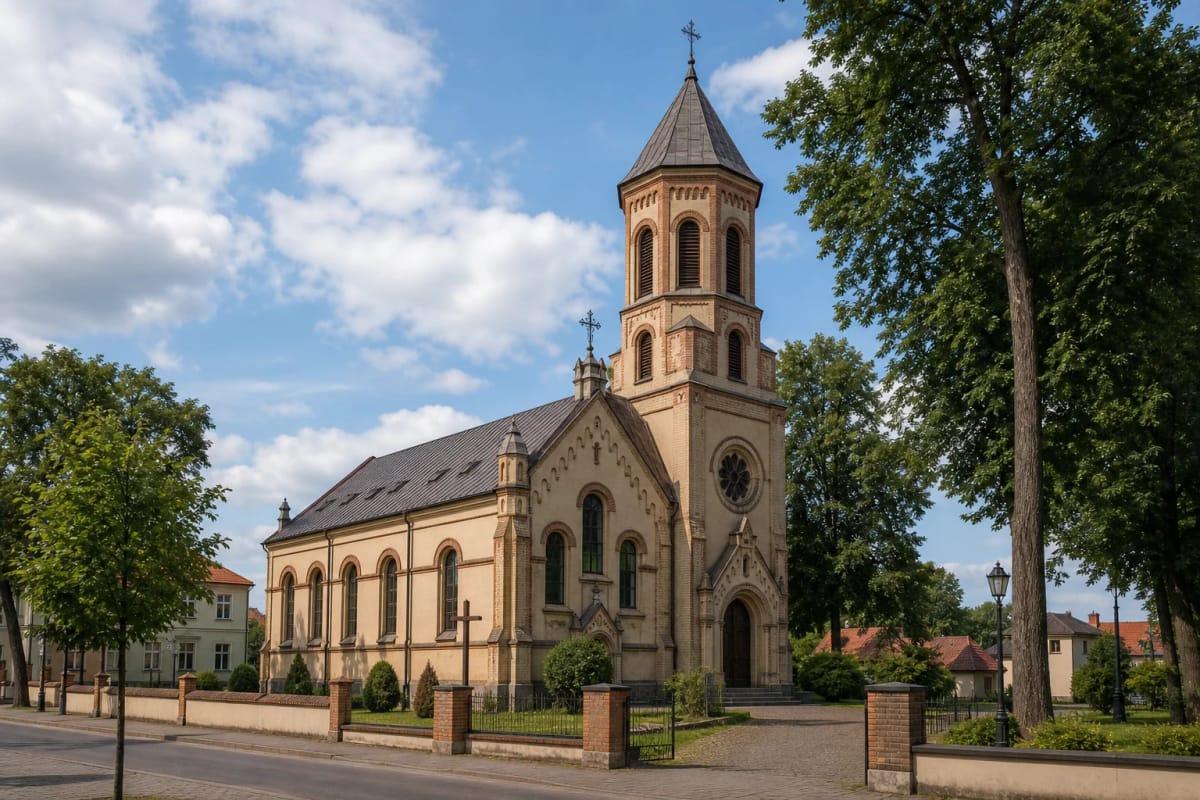
- Place
- Tauragė District Municipality
- Region
- Tauragė Region
- Type
- historicist Catholic parish church (1904)
- Address
- Stoties g. 2, Tauragė
- Coordinates
- 55.24910, 22.28470
Tauragės Švenčiausiosios Trejybės bažnyčia
Tauragė Church of the Most Holy Trinity: old-town landmark
Tauragė Church of the Most Holy Trinity is the dominant Catholic church in Tauragė old town, near the Jūra River. It is a brick, plastered church with one octagonal tower rising above the city roofs, and it has become one of Tauragė's symbols.
The church also matters as a witness to border-city history: Catholic and Evangelical Lutheran communities lived side by side in Tauragė for centuries. This Catholic church should be distinguished from Tauragė's Martynas Mažvydas Evangelical Lutheran Church and from Tauragė Castle, the former customs complex.
Architecture
The present church was built in the historicist style, with Neo-Romanesque and Classicist features; it is not a Neo-Gothic church. The building has a Latin-cross plan, a five-sided apse, and one octagonal tower, while the churchyard is enclosed by an openwork masonry fence.
Inside the church are six altars. The probable author of the design was Karolis E. Strandmanas, a Swedish-born architect living in Liepāja, but this authorship is considered likely rather than fully certain. The organ installed here in 1908 by Königsberg master Bruno Göbel has not survived; the present organ was moved to Tauragė from Vilnius around 1955.
History
The Catholic parish of Tauragė and its parish school were founded in 1507. Later wooden churches stood here, the last from 1702. In the nineteenth century, the tsarist authorities long refused permission to build a brick church, so the wooden church was only repaired.
The old wooden church was demolished in 1899, and the new brick church was built and consecrated on August 5, 1904. Construction was led by parish priest Fabijonas Kemėšis. The church suffered during the First World War in 1915 and again in 1941, and in 1955 it was rebuilt by parishioners; the tower was also reconstructed at that time.
Visiting
This is an active parish church of the Diocese of Telšiai, so it is mainly open during services and there is no ticket. If you want to see the interior outside service times, it is best to arrange this with the parish. The main indulgence feasts are the Most Holy Trinity, after Pentecost, and St Bartholomew, in late August.
A visit usually takes 15-30 minutes. The church fits naturally into a Tauragė old-town walk with Tauragė Castle and Santaka Museum and the Evangelical Lutheran church, together revealing the mixed history of a border city.