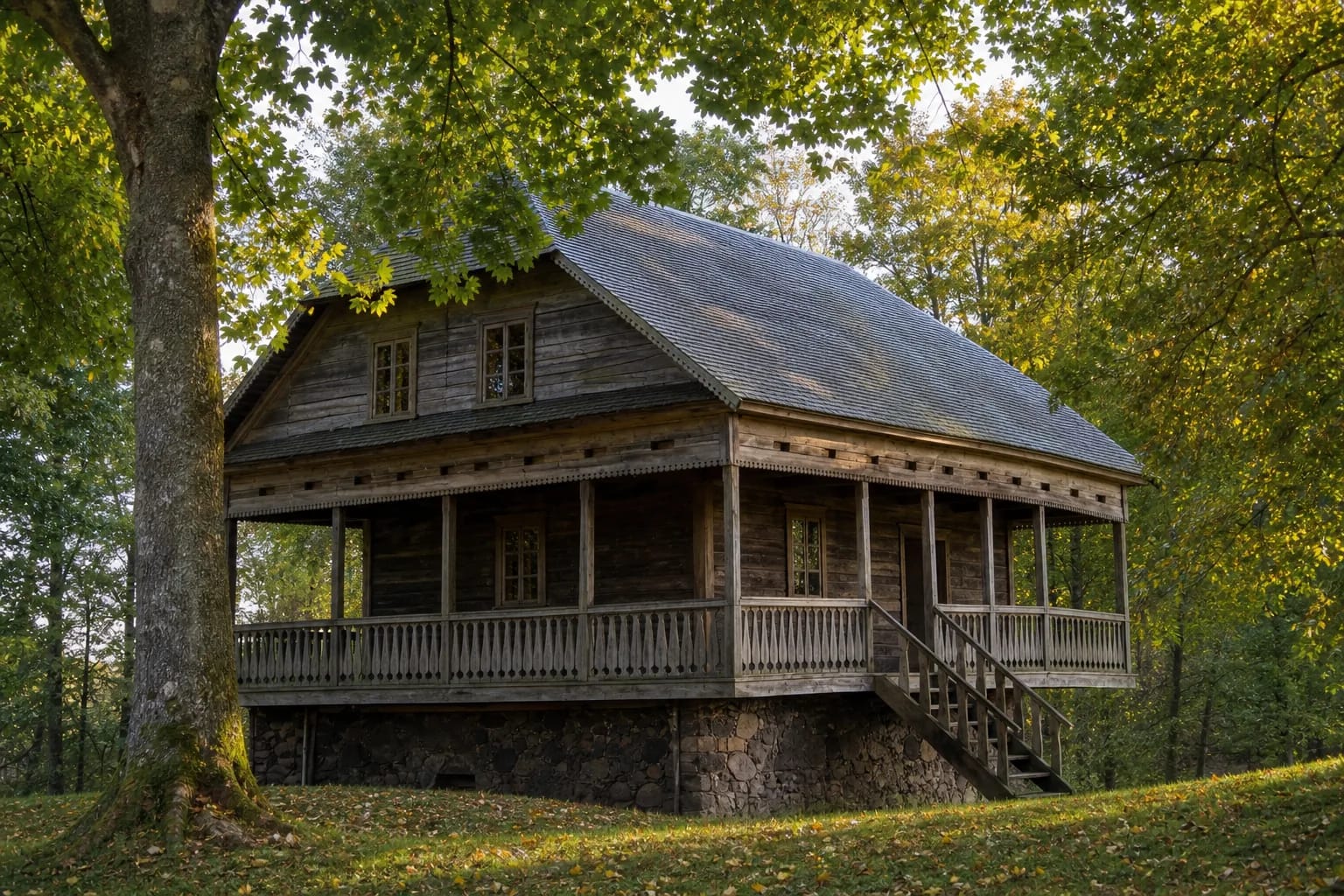
- Place
- Ustronė, Panevėžys District Municipality
- Region
- Aukštaitija
- Type
- a museum of Lithuanian book smuggling and Juozas Tumas-Vaižgantas in the late-nineteenth-century Ustronė farmstead granary
- Address
- 1A Ustronė, Krekenava Eldership, Panevėžys District
- Coordinates
- 55.61549, 24.10212
- Visit duration
- 60-90 minutes for the museum; workshops last about one hour, with extra time needed to walk from the car park
- Best time
- Tuesday to Saturday after arranging the visit, preferably arriving in daylight
Ustronė Book Smugglers Museum, Ustronė Granary, Juozas Tumas-Vaižgantas and Book Smuggling Museum
The museum occupies one protected farmstead building, not an entire restored manor
The address is 1A Ustronė, but the principal visitor site is neither a country house nor a recreation of elite estate life. The exhibitions are inside the late-nineteenth-century granary of Ustronė farmstead. The Register of Cultural Values lists the farmstead as a regional-level complex under code 15872 and the granary as a separately identified component under code 16752. The neighbouring house is another protected component, so the names of the museum, the granary, and the whole farmstead should not be treated as interchangeable.
The granary has two timber storeys over a fieldstone semibasement, log walls, and a half-hipped roof covered with small wooden shingles. Its exceptional feature is the open timber gallery, or priesvirnis, carried around the entire rectangular building. Slender posts, pierced balusters, decorated bargeboards, and an exterior stair make it resemble a dwelling wrapped in a veranda, although its original purpose was agricultural storage.
The heritage record dates restoration to 1984-1985 and notes that the interior plan changed during reconstruction. It even identifies the present carved gallery railing as non-original. Visitors are therefore seeing a genuine late-nineteenth-century building and the survival of a rare architectural type, but should not assume that every visible board and decorative cutout has remained untouched since the press-ban era.
Garšviai was a distribution network; Ustronė was one cache and sorting point within it
The 1864-1904 press ban prohibited the printing, import, and distribution of Lithuanian publications in Latin type within the Russian Empire. Material printed in Lithuania Minor moved across the border to intermediate caches, where it could be hidden, divided, and passed to regional distributors. Ustronė matters because it preserves one of those logistical places. The story is more precise, and more compelling, than the simplified image of a solitary carrier walking with books under a coat.
The Encyclopaedia of Lithuania dates the Garšviai society from 1883 or 1884 to 1895, while the museum and heritage descriptions use 1885-1895. All agree that it operated from Garšviai near Naujamiestis and collapsed after most members were arrested. Its press circulated through the Panevėžys and Ukmergė districts and reached Riga, Jelgava, Suwałki, Vilnius, and the Hrodna area. The encyclopaedia locates its main underground store in J. Dilkis's barn at Garšviai, which is why Ustronė should not be called the society's sole headquarters.
Povilas Vidugiris acquired Ustronė farmstead in the late nineteenth century. According to the heritage register, his brothers Antanas and Vaclovas built the house and granary to their own design with help from book smuggler Kazimieras Ūdra. At Ūdra's suggestion, two separate hiding places were incorporated into the granary. Press brought from Tilsit was concealed, sorted, and dispatched onward, and gendarmes failed to discover the caches during searches. Since the interior was later altered, ask the guide which elements survive, which have been reconstructed, and how access was disguised.
Vaižgantas arrived later, so his Ustronė story must not be folded into the active Garšviai society
Juozas Tumas, better known by his literary name Vaižgantas, served as a priest at nearby Vadaktėliai in 1902-1905. He visited the Vidugiris family, stayed on the granary's upper floor, read and worked there, and took part in circulating Lithuanian publications. The Garšviai society, however, had ended in 1895, seven years before he arrived. It is accurate to connect him with local book smugglers and with a site used by their network; it is inaccurate to cast him as a member of the still-functioning Garšviai organization.
A second dividing date is 1904, when the press ban ended. Vaižgantas remained at Vadaktėliai into 1905, but hiding and distributing the prohibited Latin-alphabet press could only be illegal before the ban was lifted. His Lithuanian cultural work, public activity, and visits to Ustronė continued afterward under a different legal reality. Keeping those dates separate prevents a three-year local biography from becoming a false claim of three full years of clandestine smuggling.
The heritage register also associates Ustronė with his writing, stating that he worked on Aukštaičių vaizdeliai while staying upstairs. That specific formulation is safer than claiming that the whole of his major work Pragiedruliai was written in the granary. The museum holds a chair transferred from Naujamiestis church, while its literary display places the Vadaktėliai and Ustronė episode within a career that later unfolded in Vilnius and Kaunas.
The present museum grew from two exhibitions and the campaign to preserve the granary
The restored building did not become a complete museum in a single opening. The heritage record dates the Vaižgantas exhibition to 1987 and the book-smuggler display to 1991. The granary has belonged to Panevėžys District Public Library since 1992. Regulations approved at the end of 2024 still define the museum as a structural unit of that library, responsible for collecting and interpreting material on Vaižgantas, book smugglers, book smuggling, and the heritage of the Panevėžys region.
Inside are books, photographs, documentary panels, and portraits of book smugglers painted by folk artist Leonas Juozonis. The Vaižgantas material covers his personality, writing, and Vadaktėliai period, including the chair transferred from Naujamiestis church. This is an intimate memorial museum rather than a national collection measured by object count. Its great advantage is context: the building, gallery, basement, and concealed-space story are part of the historical evidence visitors have come to understand.
A phone-based virtual experience called Knygnešių keliu, or Along the Book Smugglers' Route, operates on the grounds. Location-based tasks evoke preparation beside the granary, crossing a border, finding press, encountering obstacles, and returning to the building. It is a modern game available only on site, not navigation along a fully documented nineteenth-century itinerary. Becoming a Garšviai member in the finale is a symbolic reward, not a reconstruction of historical membership.
The deity in a workshop title explains a pen name; it does not turn the writer into a mythological god
One programme is titled Vaižgantas - linų ir kanapių dievas, or Vaižgantas, God of Flax and Hemp. It brings together Juozas Tumas's pen name and the mythological Vaižgantas recorded in early written accounts as a deity associated with flax, hemp, fertility, and related rites. The session uses folklore, songs, dances, games, and traditional plants to explain that cultural association. It does not claim that the priest and author was himself worshipped as a god.
The one-hour Knygnešio pasakojimai, or A Book Smuggler's Stories, introduces the 1864-1904 ban, regional carriers, and the Garšviai society. A costumed encounter, quiz, songs, and games create an accessible narrative, but theatrical characterization is not additional historical proof. Dates, network geography, concealment methods, and the risks of arrest should still be read from the documented exhibition and discussed with the guide.
A Culture Passport session called Per knygnešystę į valstybingumą, or From Book Smuggling to Statehood, is designed for pupils in years 4-7 and combines the authentic setting with interactive work. When arranging a school or adult group, state the ages, preferred topic, and whether you want one session or several. Two thematic hours are not equivalent to a brief self-guided look around the granary, so both duration and charges can differ.
Published hours exist, but book before travelling and expect a walk from the car park
On 19 July 2026 the museum's official page listed Tuesday to Saturday, 9:00-17:30, with lunch from 13:00 to 13:30; Monday and Sunday were rest days. The same page tells visitors to arrange access in advance. Call the museum on +370 698 71 162 before setting out. At a small rural branch, the museum worker may be leading a programme, running an event, or working elsewhere on the grounds even during the published window.
The checked admission price was EUR 2 for an adult and EUR 1 for a child or school pupil. A participant ticket for an educational session was EUR 2, while the Culture Passport listing stated EUR 1. When several programmes are combined, the page lists an additional museum charge by group size: EUR 5 for up to 10 people, EUR 10 for up to 20, and EUR 20 for up to 30. Confirm how those lines apply to your booking and which payment methods are available.
A new 2.5-metre-wide bridge with a metal structure and timber deck was completed across the Vadaktis stream in 2024. The municipality says service vehicles may cross, while visitors leave cars at the parking area and continue on foot or arrive by bicycle. The granary stands on a slope and its gallery is reached by timber steps. No lift or fully step-free exhibition route is confirmed in the official information, so discuss mobility, assistance, and accessible toilet provision before visiting.