- Place
- Stultiškiai, Panevėžys District Municipality
- Region
- Aukštaitija
- Type
- a four-storey timber smock windmill with three visitor floors devoted to flax processing, weaving, and rural household life
- Address
- 17A Ėriškių Street, Stultiškiai, Upytė Eldership, Panevėžys District
- Coordinates
- 55.62923, 24.23109
- Visit duration
- 45-75 minutes for the displays; about 90 minutes with a pre-arranged practical workshop
- Best time
- in daylight after arranging interior access in advance; check the separate summer Sunday programme before relying on it
Linų muziejus, Stultiškiai Windmill, Panevėžys District Flax Museum
This is a working-era windmill reused as a museum, not a scenic replica built for a flax display
The Flax Museum stands in Stultiškiai, roughly between Upytė and Ėriškiai. Current Panevėžys District Culture Centre documents give its address as 17A Ėriškių Street, while older official pages and maps may still show 2A Stultiškių Street. The two addresses refer to the same windmill, not separate museums. The coordinate 55.629234, 24.231092 marks the building itself; it is not a reserved parking bay or a surveyed accessible entrance.
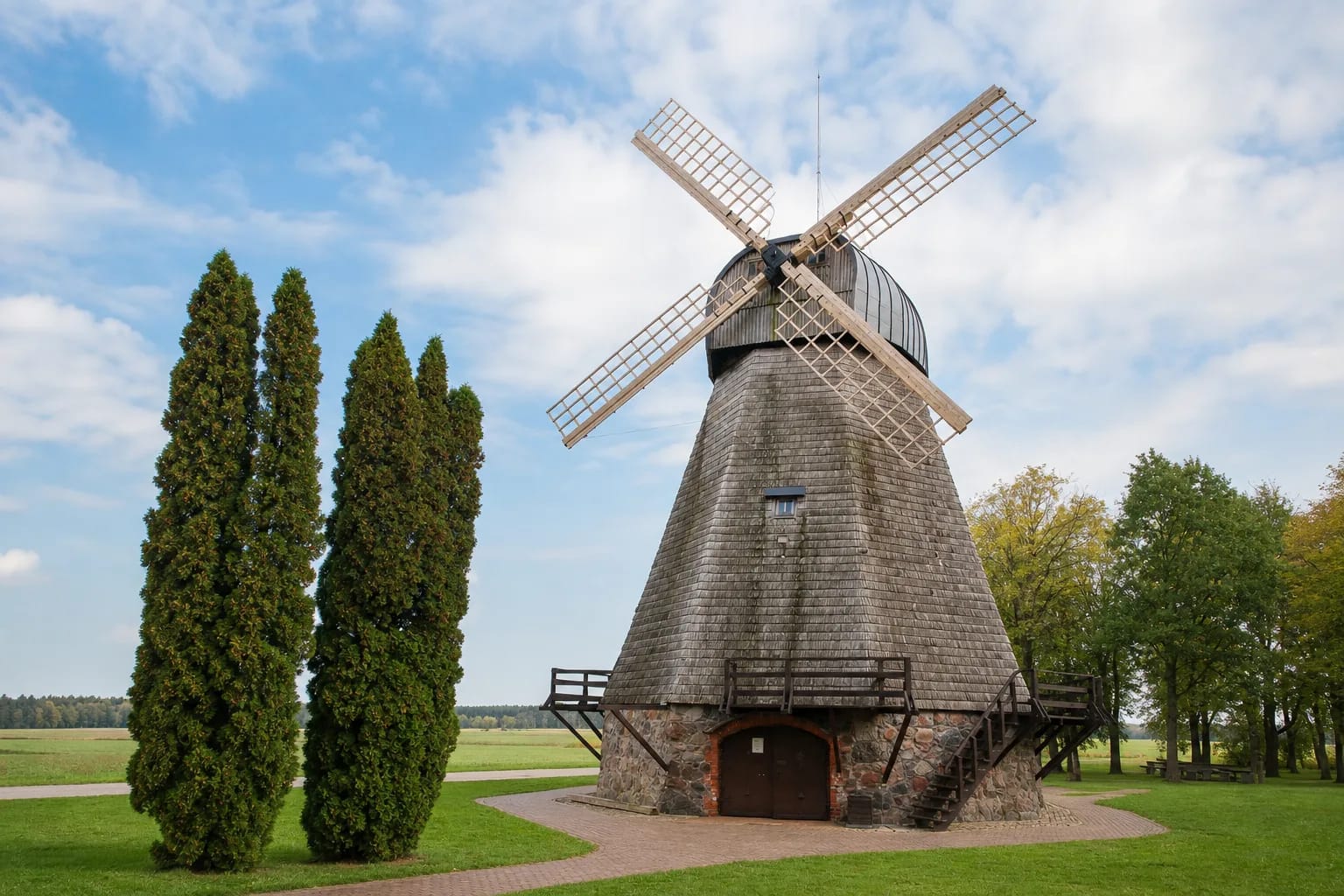
The building is recognizable by its irregular fieldstone base, tall tapering body clad in grey-brown timber shingles, dark movable cap, and four wooden lattice sails. A narrow timber stage runs around the junction of the masonry and shingled tower, with exterior steps rising at the side. It is a four-storey smock, or Dutch-type, windmill, but describing the entire tower as masonry would misrepresent what visitors see.
Panevėžys District Municipality calls this the only Flax Museum in Lithuania. That is best understood as the institution's official description, not a claim that no other Lithuanian museum has a flax display. The municipality also states that the windmill is not entered in the Register of Cultural Values. It should therefore not be assigned an invented heritage code or described as a state-protected registered monument.
From an 1880 grain mill to the Flax Museum that opened in 1996
Stultiškiai windmill was built in 1880 to grind grain. A memorable local story says that it rose around a huge pine whose trunk supported the millstones. The official venue page presents this as something people say, not as an engineering fact proven by original construction records, so it belongs to the site's oral story rather than its securely documented chronology.
After milling ceased, the building fell out of use and became a warehouse during the Soviet period. It was restored to the former owners' descendants after Lithuanian independence. The municipality's historical account says it then remained locked for about four years and was offered for sale before Panevėžys District Municipality acquired and restored it.
The Flax Museum opened in the windmill in 1996. That is the museum's foundation date, not the construction date of the building. The original and present functions are related through rural work rather than a shared mechanism: a surviving grain mill became the setting for a different but equally demanding chain of agricultural and household production.
Three public floors follow a process instead of presenting an undifferentiated store of old objects
The first display floor contains the heavy tools used near the beginning of flax processing: brakes for crushing the dried stalks, scutching tools for removing the woody fragments, and hackles for aligning the fibre. Their different forms matter. They reveal how many distinct operations were needed before a rough dried plant was clean and supple enough to spin.
On the second floor, the sequence moves from dressed flax to thread and cloth. Prepared fibre, looms, lengths of linen, towels, and other woven objects show why flax belonged both to agriculture and to skilled household production. Growing the crop was only the first stage; the quality of the finished textile depended on a long chain of practiced decisions.
The third floor displays nineteenth-century rural household and farm tools. This broadens the visit beyond flax and places spinning and weaving among the other seasonal demands of a farming household. The windmill has a fourth floor, but the municipality says it is used to store old objects and is not admitted to the normal visitor route. This is a three-floor exhibition, not four public galleries.
The Lino kelias workshop restores the movement that a static tool cannot explain
The museum's educational route reconstructs the late nineteenth-century sequence of flax work. After cultivation, flax was pulled, retted, and dried; its stalks were then broken, scutched, hackled, spun, and woven. Individual farms could vary parts of the practice, but this progression explains why the apparently similar wooden implements on the first floor had separate jobs.
Official museum descriptions say visitors can try breaking, scutching, and hackling flax themselves. This practical element is normally arranged as an educational programme, so do not assume every historic tool is available during any unaccompanied visit. When booking, confirm the group size, duration, language, and which hands-on stages will be offered on your date.
The focus does not dissolve into generic ethnography. Flax brakes, scutching tools, hackles, spinning equipment, and looms let a visitor compare the raw plant, successive intermediate materials, and finished textile in one building. The clearest route is consequently from the first floor upward, rather than beginning with the most decorative towels.
The sails returned after a 2024 storm, and Lino pasaka brought sound and film in 2025
A storm on 29 June 2024 tore away three ageing sails, and the fourth was removed for safety. A replacement set of four lattice sails was made and installed later that year; the doors and entrance canopy were also replaced. The municipality gave the combined value of those works as EUR 19,200. The sails restore the windmill's silhouette, but the official material does not say that it mills grain again or that the sails now turn routinely under wind power.
Work in 2025 went beyond appearance. The municipality records improvements to windows, doors, floors, drainage, facade lighting, and heating, together with a purpose-built entrance ramp for disabled visitors. Before the project, the museum received visitors in the warm season. Heating made cold-season operation technically possible, but it does not by itself establish permanent daily opening hours.
The renewed Lino pasaka, or Flax Tale, exhibition officially opened on 22 December 2025. It uses film, sound, and interactive media developed from recordings of local craftspeople and their working processes. The digital layer does not replace the historic tools. Its purpose is to recover movement and voice where fragile objects cannot simply remain in constant use.
Book the visit, and read the 2026 fee schedule literally
Following the 2026 reorganization of district cultural institutions, the museum belongs to Panevėžys District Culture Centre. The current official sources reviewed for this guide do not provide one unambiguous permanent weekly timetable replacing the older seasonal arrangement. The museum and municipal pages direct visitors to arrange access in advance on +370 653 10047. Confirm your date and time before setting out; a summer Sunday event does not automatically define the year-round schedule.
The municipal Culture Centre fee schedule effective from 5 May 2026 explicitly lists a Flax Museum visit with an educational programme at EUR 3 for an adult and EUR 2 for a visitor under 18, a senior, or a disabled visitor. It does not separately state a price for a simple self-guided visit, so that fee should neither be invented nor assumed to equal the workshop charge. When reserving, verify the current amount, eligibility evidence, payment method, and whether your booking includes the programme.
The entrance ramp added in 2025 improves access to the initial level, but the three public galleries occupy successive floors inside a historic windmill. The official information does not identify a lift or confirm a step-free route through all of them. Discuss access to the second and third floors, toilet provision, and any assistance needed with staff beforehand. Outside, keep clear of restricted areas if sail or building maintenance is under way.