- Place
- Upytė, Panevėžys District Municipality
- Region
- Aukštaitija
- Type
- hillfort with an outer bailey, centre of the historic Upytė land
- Address
- Upytė village, Upytė eldership, Panevėžys District
- Coordinates
- 55.65600, 24.22720
Čičinskas Hill, Tarnagala Hillfort
The Centre of a Historic Land
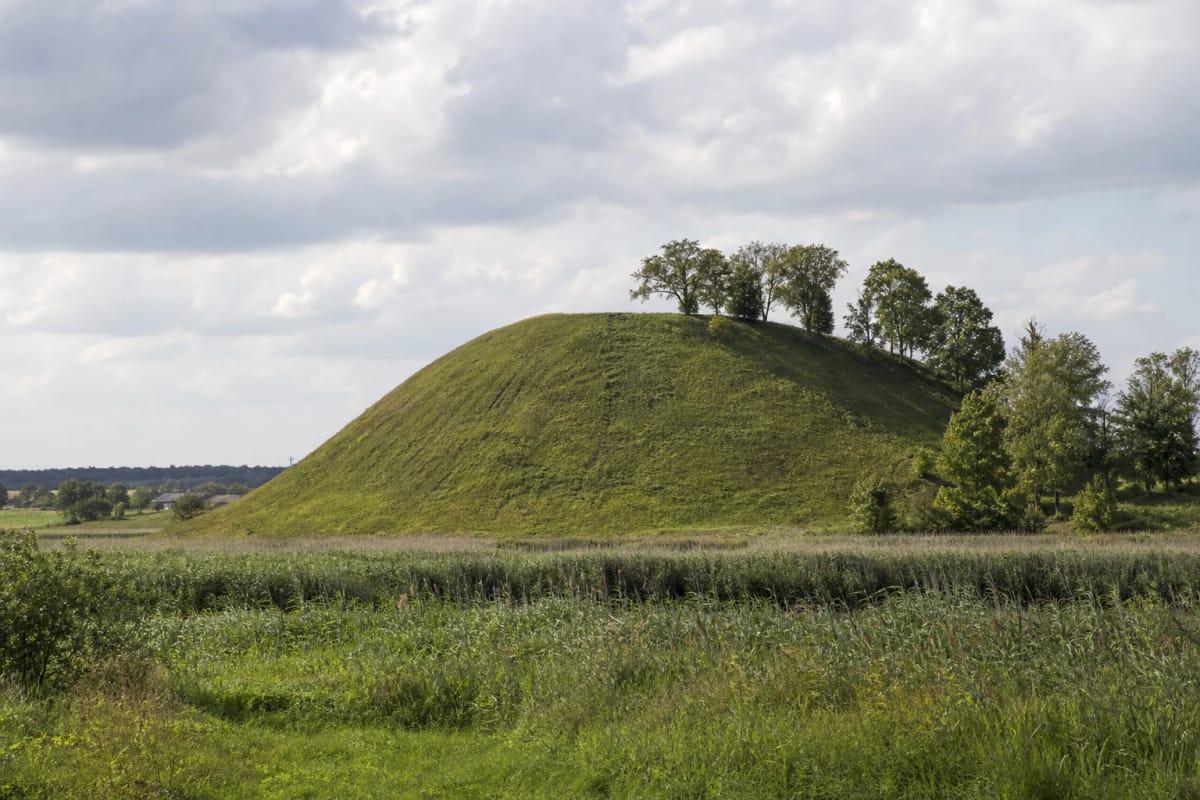
Upytė Hillfort rises near Upytė village in Panevėžys District, in the area of the former Vešeta marshes. In local speech it is called Čičinskas Hill, a name that comes from a well-known legend. Historically, however, its greatest significance is as the centre of the Upytė land, one of the medieval Lithuanian lands whose name appears in chronicles.
The hillfort is not large or ornate, but its importance lies in history and memory. The Cultural Heritage Register lists it as a monument of national significance with archaeological and mythological value.
Upytė Land in the Chronicles
The land of Upytė and its castle are first mentioned in written sources in 1254. In the fourteenth century Upytė was attacked repeatedly by the Livonian Order; eleven attacks are recorded for 1363-1394 alone. This shows that the place was an important defensive frontier in northern Lithuania.
Later Upytė became the centre of an eldership and volost, and after the administrative reform of 1564-1566 it became the centre of Upytė county, or pavietas. Although the administrative centre eventually shifted to Panevėžys, the name Upytė remained a powerful symbol of the region's history.
Čičinskas Hill: History and Legend
The hill's popular name is linked with Upytė nobleman Vladislovas Sicinskis (about 1615-1672), who in 1652 was the first to use the liberum veto and prevented the Sejm from being extended. That historical fact is documented. In literature he became famous as Čičinskas.
Many legends formed around Čičinskas: that he sold his soul to the devil, oppressed people, was struck by Perkūnas, and that his manor sank into the marsh. These stories should be understood as folklore, not history. Modern historians no longer treat Sicinskis simply as a traitor. Maironis' 1919 ballad Čičinskas further fixed the figure in Lithuanian culture.
Hillfort Dimensions
The hillfort was built on a massive gravel hill with steep slopes. Its platform is quadrangular, elongated northeast-southwest, and measures about 40 x 18 m. Ramparts and ditches were built at the ends; the northeastern rampart reaches about 1.2 m, while the slopes are steep and up to 6 m high.
Archaeological investigations in 2004 and 2014 showed that the cultural layer is not very rich, and part of it was disturbed by gravel extraction. Finds included hand-built pottery sherds and parts of seventeenth- to nineteenth-century iron knives. The hillfort is dated broadly, from the first millennium to the eighteenth century.
Upytė Town and Visiting
The hillfort itself takes only about 30-45 minutes to see, but it is worth combining with Upytė town. The wooden Church of St Charles Borromeo, built in 1878, stands there, and local museum sites connected with flax tradition operate nearby. Upytė has long been known as a flax-growing area.
The hillfort is an open site that can be visited freely. After rain the surroundings may be wet because drained marshes once lay around it, so wear practical footwear. Check official pages before travelling if you also want to visit the town museum sites or church.