- Place
- Pagėgiai Municipality
- Region
- Lithuania Minor
- Type
- museum of Lithuania Minor printing, book-smuggling, and Martynas Jankus memory
- Address
- M. Jankaus g. 5, Bitėnai, Lumpėnų sen., Pagėgių sav.
- Coordinates
- 55.07890, 22.04020
Martynas Jankus printing house, Bitėnai printing-house museum
Martynas Jankus Museum in Bitėnai
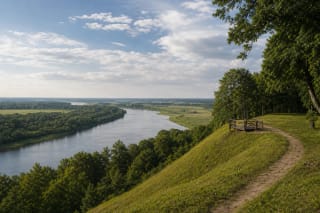
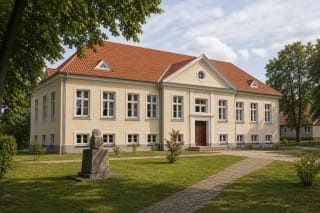
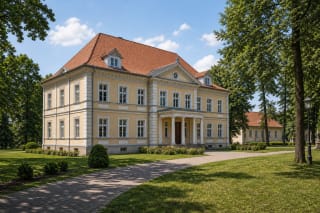
Martynas Jankus Museum is one of the most important places of Lithuania Minor press memory. It operates in Bitėnai, on the right bank of the Nemunas near Rambynas Hill, in a reconstructed printing-house setting, so visitors see not only a biographical story but also the technology of printing: type, press, paper, typesetting, and publishing.
The place is powerful because printing in Lithuania Minor was not only a profession. It was part of culture, language, political self-awareness, and the survival of the Lithuanian word, especially during the press ban in Greater Lithuania in 1864-1904.
Who was Martynas Jankus, Patriarch of Lithuania Minor
Martynas Jankus (7 August 1858 Bitėnai - 23 May 1946 Flensburg; reburied in Bitėnai cemetery in 1993) was a political and public figure of Lithuania Minor, press publisher, publicist, and one of the leaders of the national movement, known as the Patriarch of Lithuania Minor. He initiated the founding of Aušra (1883-1886), was its responsible editor in 1884-1885, and helped found the Birutė cultural society in 1885.
Jankus' importance is not only local. In 1918 he signed the Act of Tilsit, declaring Lithuania Minor's aspiration to unite with Greater Lithuania; in 1922-1923 he led the Supreme Committee for the Salvation of Lithuania Minor and took part in the Klaipėda Region uprising. For his national activity, Prussian authorities repeatedly arrested and fined him over several decades.
The Bitėnai printing house and banned-press warehouse
According to VLE, Jankus' printing house, moved from Tilsit, operated in Bitėnai in 1892-1909: six newspapers were issued and 104 books printed there. From 1883, Bitėnai also held a Lithuanian press warehouse, mainly for Aušra, from which banned publications were distributed into Greater Lithuania.
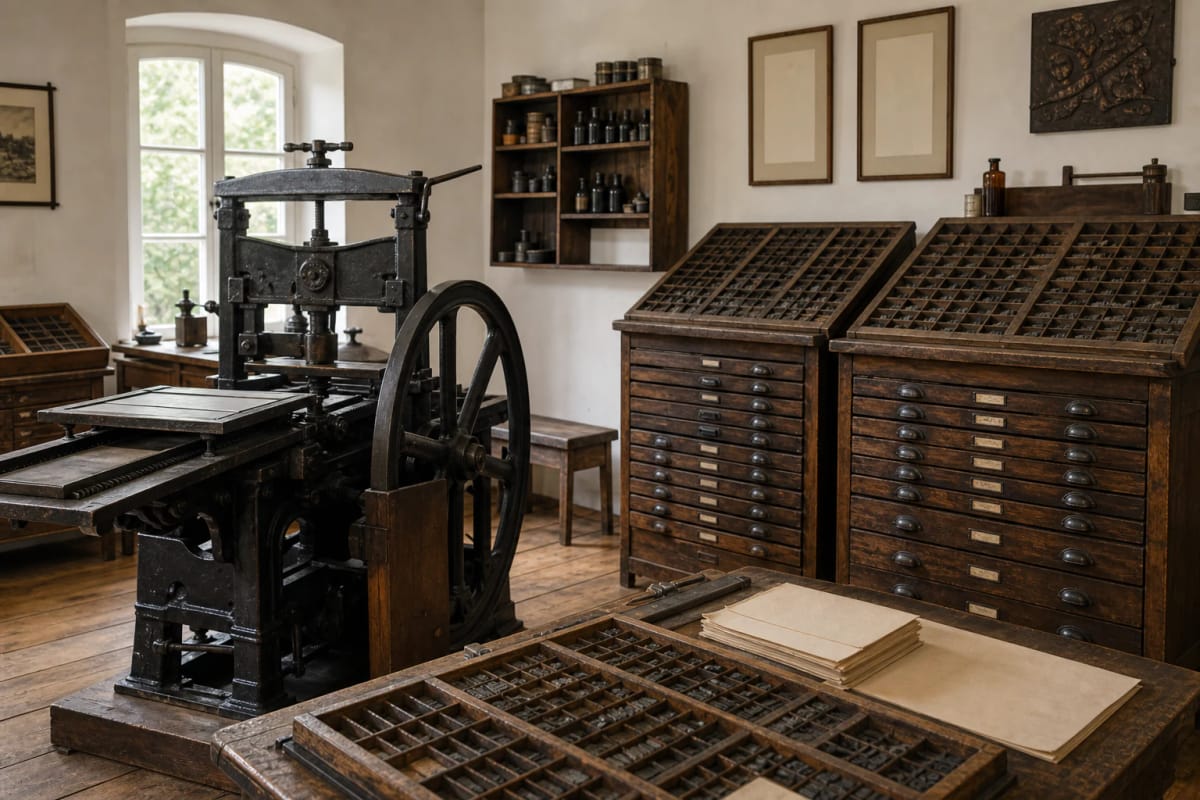
Today the museum's official presentation emphasizes the reconstructed printing-house environment with authentic printers' tools, a type case, letters for setting text, and a working rotary letterpress machine. This matters because press history is easily reduced to a list of texts; in Bitėnai you can see printing itself as a material and risky process.
Museum history: from 1981 to the reconstructed printing house
During the Second World War, about 80 percent of Bitėnai's buildings burned, including M. Jankus' house and printing house. VLE states that the museum was founded in 1981; at first the exhibition operated in the former primary school, and since 1999 it has been in the reconstructed printing house rebuilt in 1998.
This history matters because it shows a conscious restoration of memory: a destroyed place was brought back not as decoration but as a working printing environment. The museum preserves a wide heritage of printing, documents, photographs, and Lithuania Minor culture.
The Bitėnai-Rambynas pantheon
Near the museum is the Bitėnai-Rambynas cemetery, called the pantheon of Lithuania Minor. Notable regional figures are buried there: Vydūnas, Martynas Jankus, and Vilius Karolis Banaitis, whose remains were brought from Germany in 1991, 1993, and 1999 respectively. The pantheon gates were installed in 1999.
A visit to Bitėnai therefore becomes not only a museum visit but a memory route: the printing house tells of cultural struggle, while the cemetery remembers the people who led that struggle and were symbolically returned to their native region.
How to visit Martynas Jankus Museum
Allow 1-2 hours for the museum. With a guide or education programme, the printing-house theme becomes clearer because tools and technology are understood not only as old objects but as a work process. Nearby is also the Lithuania Minor Art Garden, an open-air space.
A Bitėnai route is especially worth combining with Rambynas Hill and the Bitėnai-Rambynas pantheon. Then one trip brings together the Lithuania Minor landscape, press history, and cultural memory. Check opening hours and education programmes on the official museum website.