- Place
- Kalnelis, Naujamiestis Eldership, Panevėžys District Municipality
- Region
- Krekenava Regional Park
- Type
- botanical nature-heritage object - multi-trunk pine
- Address
- Kalnelis village, Nevėžis riverbank, Panevėžys District
- Coordinates
- 55.66900, 24.15000
- Visit duration
- a short stop by the tree; allow longer for a Nevėžis valley and Krekenava park route
- Best time
- a dry, bright part of the year, when the open crown is clearer and the natural approach is firmer
Kalnelio daugiakamienė pušis, Kalnelis Pine
A three-trunk tree beside the Nevėžis
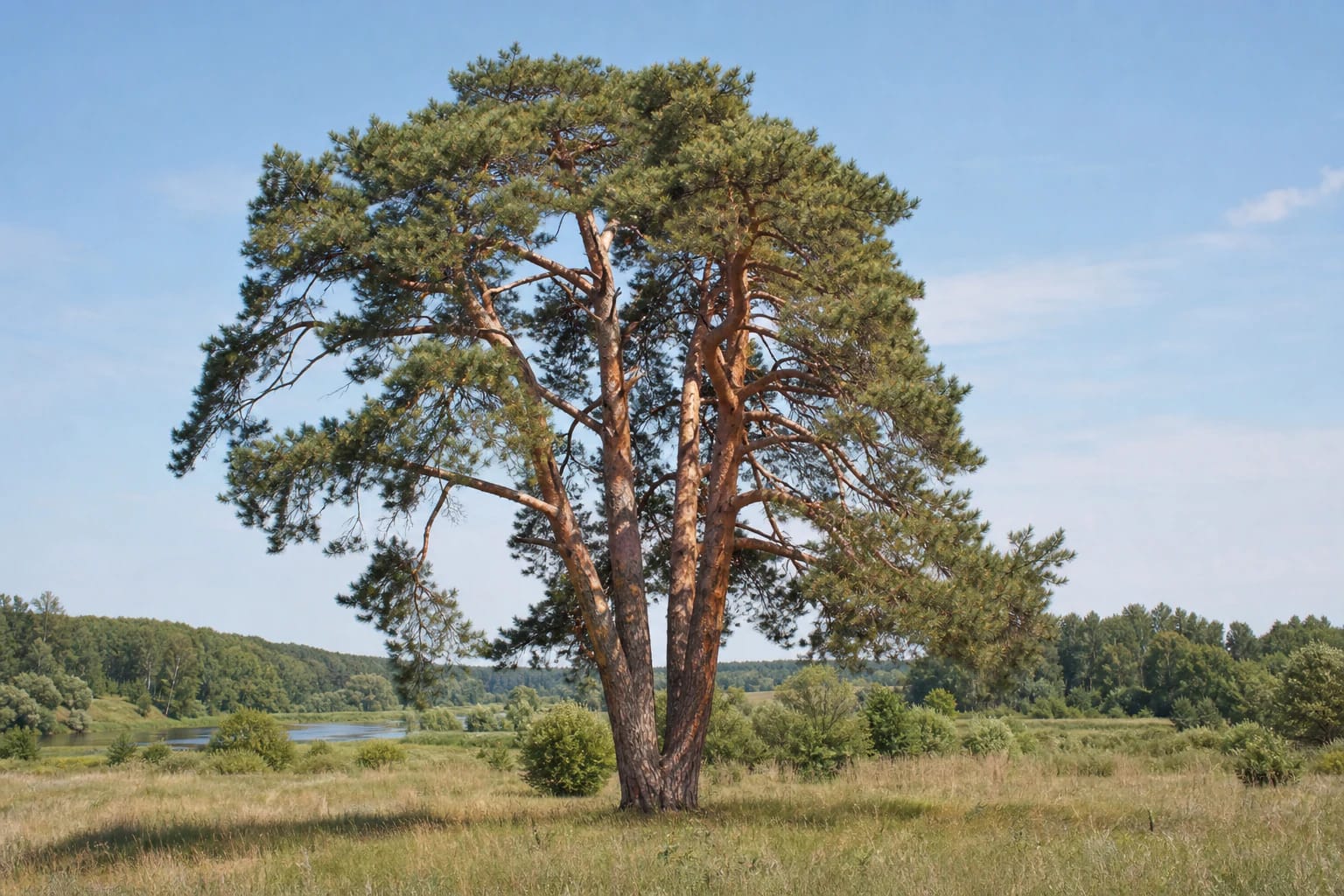
Kalnelis Multi-Trunk Pine is a state-protected botanical nature-heritage object in Kalnelis village, beside the Nevėžis and within the landscape of Krekenava Regional Park. From a distance it looks like a large pine in an open riverside space; its defining feature becomes clear at the meeting of the trunks.
Saugoma.lt records three trunks. Each branches into its own part of the crown, so the tree does not have the regular silhouette of a woodland pine: its structure reads as several directions of growth held in one living form.
Look at the pine from more than one point, while keeping clear of the trunks and root zone. The open Nevėžis bank reveals the crown's scale, and a closer view shows the bark, branches, and intertwined bases without needing to touch them.
Three trunks and the official measurements
The current official object record gives the three trunk circumferences as 2.3 m, 2.2 m, and 1.7 m. These figures describe the individual trunks, not the total mass of the pine seen from a distance or the spread of its crown.
Each trunk branches higher up, so the pine being measured and the pine seen in a photograph can look like two different subjects. From below, the dense cluster of trunks dominates; from farther away, the irregular crown reads as one broad tree.
Measurements are not a reason to touch or encircle the tree. Do not climb the roots, lean on the trunks, or hang objects from the branches: for a living heritage object, an undisturbed setting matters more than a particular photographic angle.
The Nevėžis riverbank landscape and protection
The pine grows beside the Nevėžis, where an open setting lets one tree become a landscape marker. Kalnelis village, the riverbank relief, and the farther meadows make a broader scene than the fenced tree site alone.
Krekenava Regional Park descriptions include Kalnelis Multi-Trunk Pine among protected nature-heritage values. Its importance is therefore connected not only with the unusual number of trunks but also with the landscape in which the tree has remained.
The Krekenava Regional Park Directorate has reported maintenance work at the distinctive pine. Such a notice cannot guarantee the tree or its surroundings will look the same on every visit, so assess barriers, the approach, and other signs on site.
Finding Kalnelis Multi-Trunk Pine
The official Saugoma.lt record gives the object point as about 55.669, 24.150. The coordinate marks the pine itself, not a guaranteed car park, road surface, or complete pedestrian approach from the village.
Kalnelis lies in the Naujamiestis and Upytė area, and the pine stands on the Nevėžis side of the village. Use the official object point as the final bearing, but check navigation and local road signs before travelling because the last approach may be over natural ground.
Leave the car without blocking a local road and without driving onto meadow or riverside grass. If the final approach is unclear, it is safer to stop farther away and walk than to try to reach the trunks by vehicle.
Accessibility and seasonal conditions
Saugoma.lt says that Kalnelis Pine is not adapted for visitors with mobility disabilities. Natural ground, riverside relief, gates, or temporary protective arrangements may be barriers, so a map point alone does not confirm step-free access.
Dry, bright weather makes the three-trunk structure easier to see and the final approach easier to assess. After rain, grass and natural ground may be slippery; in spring and autumn, check riverside conditions before travelling.
The checked object descriptions publish no separate ticket or box-office hours. That is not a promise of identical access throughout the year: protected-site signs, maintenance work, and the condition of local roads can change.
A living tree is not visitor equipment
Do not cross a barrier if one is present, and keep away from the trunks' root zone. Do not break branches, damage bark, hang swings or other objects, light fires, or leave rubbish.
The pine is striking because it is alive and still growing in its place. Choose a photographic angle that does not require climbing roots or crossing sensitive riverside vegetation; a protected site is not a set that can be rearranged for a frame.
In strong wind, do not stand beneath large branches and follow any warnings on site. Leave the Kalnelis riverbank as you found it so the three-trunk tree remains part of the landscape for future visitors.