- Place
- Ignalina, Ignalina District Municipality
- Region
- Aukštaitija
- Type
- five-metre oak sculpture of the city legend, newly carved in 2016 on the site of the 1993 work
- Address
- 13 Mokyklos Street, shore of Lake Paplovinis, Ignalina
- Coordinates
- 55.34483, 26.16039
- Visit duration
- 15-30 minutes; about 1 hour with the Lake Paplovinis shore and footbridge
- Best time
- in daylight and dry weather, when shadows reveal the deep oak relief and both sides can be examined comfortably
Ignas and Lina sculpture, Sculpture to Ignas and Lina, Ignalina Legend sculpture, Legend of Ignalina
Two oak carvings form one open work designed to be read from both sides
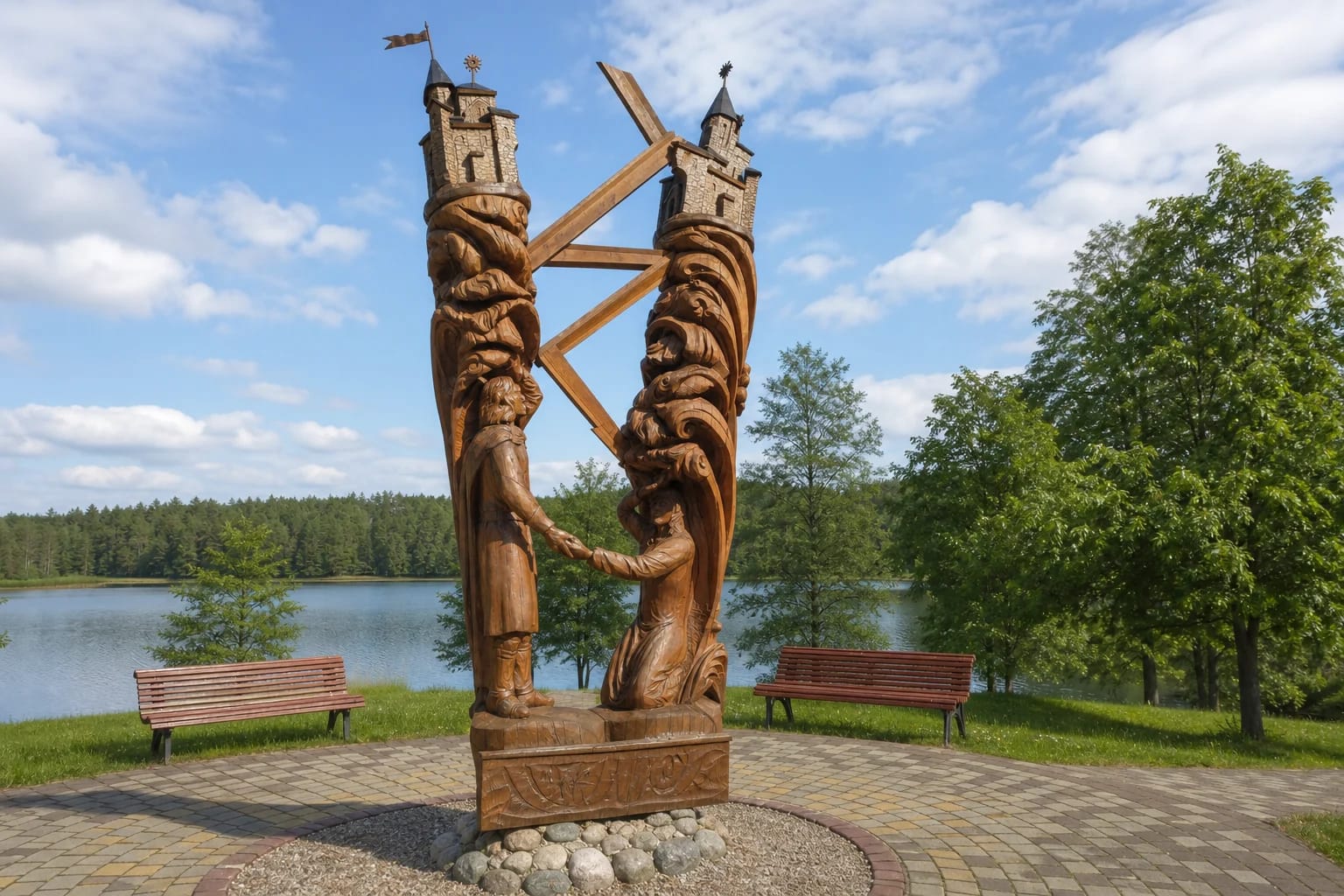
The monument stands in a small circular paved space on the slope above Lake Paplovinis. Its approximately five-metre composition consists of two vertical oak carvings crowned by forms resembling city towers. Much of the centre remains open, with horizontal and diagonal wooden beams connecting the two sides.
Seen from the path, Ignas stands on the left in a long carved garment while Lina kneels on the right. Their outstretched hands meet, surrounded by large, flowing relief ornaments. The diagonal braces and upper forms represent Perkūnas's lightning and buildings rising above the lovers, but this is a symbolic composition rather than a reconstruction of a historical castle.
The work's name is carved into its lower section, while the reverse carries a short version of the Ignas and Lina story. It is worth walking all the way around: the lakeside face is not merely a repeat of the front silhouette but another informative and sculptural side of the work.
The sculpture now on the 1993 site was newly carved in 2016
The first sculpture by Gintaras Černius was installed beside Lake Paplovinis on June 16, 1993. It became one of Ignalina's most recognisable landmarks, but decades outdoors left the oak badly damaged by time and weather.
For Ignalina's 150th anniversary, the old work was not simply cleaned or repainted. In 2016, a newly carved oak version by the same artist was placed on the site. It retains the two-part design, the lovers, lightning, and tower motifs, but it is not a millimetre-perfect copy of the earlier carving.
Both dates are therefore correct only when their meanings are explained: 1993 marks the arrival of the first monument, while 2016 dates the physical work visible today. The present oak has not stood unchanged for more than three decades, even though its artist, site, and central idea continue the original.
The legend tells of Lina, the captive Ignas, and a love spared by Perkūnas
The story says that Prince Budrys's castle once stood where Lake Ilgis now lies. Budrys and his nine sons left to fight crusaders who had attacked the land and did not return, leaving his daughter Lina to rule the castle.
Lina fell in love with a captive crusader named Ignas. The people condemned the match and cursed the couple on their wedding day, but the thunder god Perkūnas took pity and allowed the lovers to live at the bottom of the lake. The tale later interpreted Lina's heard lament and a spring on the Lake Ilgis slope as her tears.
The legend derives the town's name from the two personal names Ignas and Lina. The sculpture compresses that narrative into a few legible signs: joined hands, figures at different heights, a lightning zigzag, and towers raised overhead. This is an artistic rendering, so it cannot be used as evidence for crusader dress or the architecture of a supposed castle.
The legend was written down after the war, while municipal history gives a different origin for the name
Ignalina District Municipality records that the first known text of the legend was written after the Second World War by traveller, local historian, and teacher Liudas Alseika. During the one or two years he taught in Ignalina, he drew on stories told by residents of Budriai about a castle submerged in Lake Ilgis. Ignalina teacher Marija Čepulėnienė later created a verse version.
Tangible local finds may have helped the story grow. Before the Second World War, teachers and pupils from Ignalina's Polish school excavated the Budriai barrows and the Rudakampis peninsula in Lake Ilgis, finding burnt material, a stone axe, and a rusted iron sword. These finds point to an older past but do not prove that Ignas, Lina, the curse, or life beneath the lake were historical events.
The same municipal history explains the town's name through the Ignalinka estate, associated with Ignas Kaminskis, the owner of Vidiškės Manor. VLE links the documented beginning of the town to the railway station built in 1862. The monument therefore embodies an important civic legend, not confirmed linguistic proof of how the name Ignalina arose.
The monument is at Lake Paplovinis, while the castle and Lina's Tears belong to Lake Ilgis
The most common geographical confusion involves two different lakes. The sculpture stands on the Lake Paplovinis shore in Ignalina, beside Mokyklos Street. The legend's events, the submerged castle, the Rudakampis peninsula, and the spring called Lina's Tears are associated with the separate Lake Ilgis. The monument does not mark the supposed castle site.
The maintained waterfront took shape in stages. A 2010-2011 municipal project reconstructed the embankment and boat-landing area, footbridge, paths, and lighting; added spaces for outdoor events, skateboarding, and children's play; renewed planting; and improved the setting around the sculpture. The weathered wooden work itself was then replaced in 2016.
The lake, trees, benches, and footbridge are now essential to the experience of the sculpture, although they are not scenery from the legend. A quick visit can remain within the monument's small square, while a more relaxed stop can continue along the shore and onto the bridge for a view back toward the tall oak silhouette above the path.
Visiting is free, but the coordinate marks the sculpture rather than a parking place
The monument is in an open public waterfront space and has no separate ticket or object-specific opening hours. Daylight makes it easier to see the relief, tower details, and the carved account on the reverse. Allow 15-30 minutes for the sculpture alone, or about an hour with the Lake Paplovinis shore and footbridge.
The coordinate 55.344830, 26.160389 marks the work itself in the circular square, not a car park. The final approach is paved, but the checked sources do not provide a formally audited step-free route with gradients, kerb heights, or designated accessible parking. Wheelchair users and visitors with reduced mobility should assess the most practical approach on site.
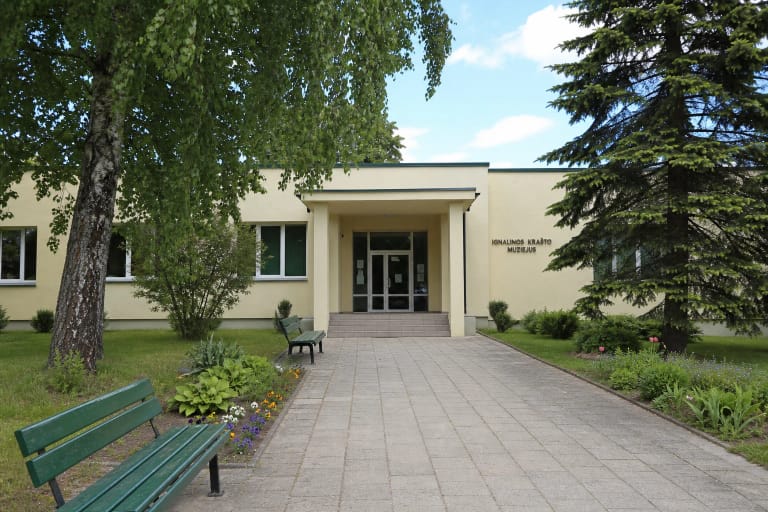
The deep oak relief is best observed without climbing on the base or placing hands between the connecting beams. The square and sloping paths may be slippery after rain, ice, or snow. The story can be continued at Ignalina Regional Museum, but its current opening hours and admission should be checked on the museum's official website before travelling.