- Place
- Vilnius City Municipality
- Region
- Vilnius
- Type
- National Museum of Lithuania branch with changing history exhibitions, a specially accessed ethnographic store-display, and a layered historic building complex
- Address
- 3 T. Kosciuškos Street, Vilnius; entrance from the inner courtyard
- Coordinates
- 54.68959, 25.29626
- Visit duration
- 1-1.5 hours for one exhibition; 2-3 hours for two exhibitions and a slower look at the building
- Best time
- a weekday morning for the changing exhibitions, or a published time for the Ethnography Store-Display; check that day's exhibitions, tickets, and holiday schedule before visiting
Istorijų namai, LNM Istorijų namai, House of Histories Vilnius
The House of Histories is a National Museum branch, not one unchanging exhibition
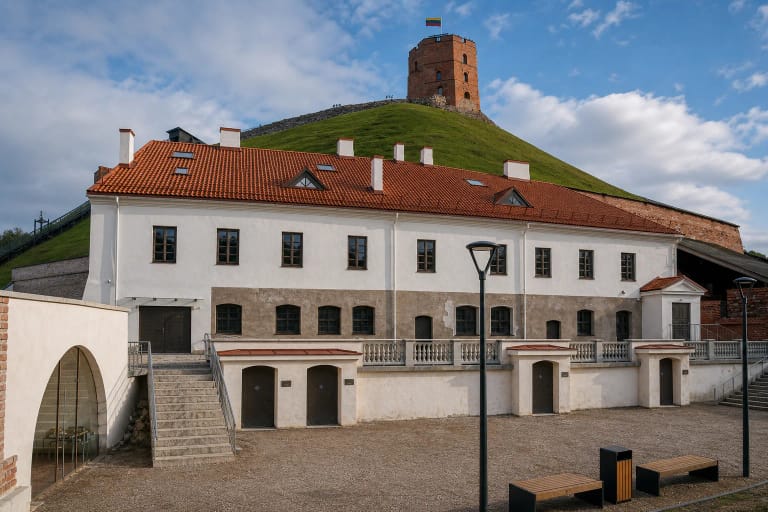
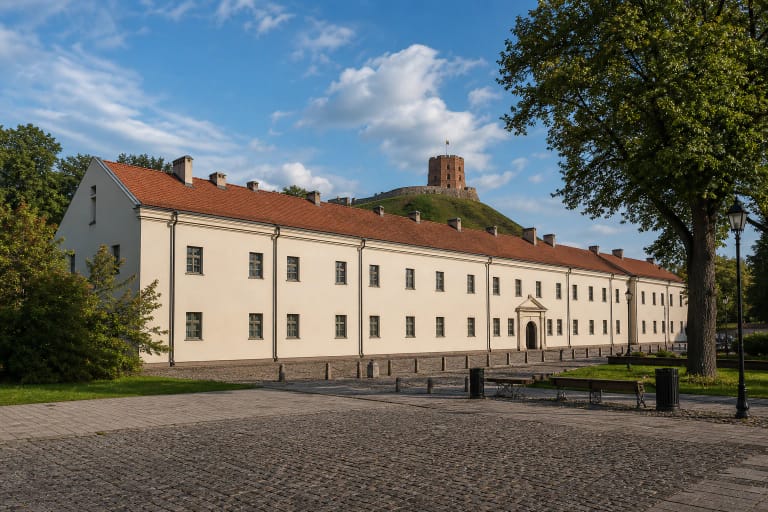
The House of Histories opened to visitors on 6 May 2021 at 3 T. Kosciuškos Street, beside Kalnų Park and the Vilnia River valley. It is a separate branch of the National Museum of Lithuania, so its entrance and ticket are not automatically shared with Gediminas Castle Tower, the Castellan's House, or museums in the Old and New Arsenal buildings.
The first floor is arranged for the larger exhibition and the second for a smaller one. Both hold changing presentations on Lithuanian and wider regional history, archaeology, ethnography, or memory. Titles, closing dates, and conditions for particular events change, so an older review or photograph does not establish what will be on view when you arrive.
The principal visitor entrance is not on the street facade but inside the courtyard. From T. Kosciuškos Street, pass through the metal gate, follow the rising courtyard towards the building, and look for brown doors beside the section marked by vertical timber cladding. This page's coordinates, 54.689595, 25.296258, mark that main entrance rather than a parking space.
The Ethnography Store-Display reveals collections usually kept behind the scenes
The Ethnography Store-Display on the lower-ground floor combines collection storage with public interpretation. It presents models and details of vernacular architecture from the late eighteenth to the first half of the twentieth century, together with rural interior objects, furniture, vessels, tools, and other records of everyday life.
This is not simply a third gallery open for unrestricted circulation all day. The National Museum lists special visits and tours, and on the final Sunday of each month publishes free sessions every 30 minutes for groups of no more than twelve. Capacity and arrangements can change, so visitors particularly interested in the store-display should confirm its schedule and registration conditions in advance.
The store-display format helps explain how a museum cares for a collection much larger than any single selective exhibition. Objects are arranged partly by function and material, so the visit feels more like an introduction to the structure of a collection than a single chronological narrative with a fixed beginning and end.
The site developed from the Horainas property through imperial barracks to a long museum conversion
In the second half of the eighteenth century the property belonged to the Horainas family and contained an inn as well as masonry and timber structures. After the 1831 uprising it was nationalised and absorbed into the infrastructure of the Vilnius fortress. Some earlier buildings were removed, although a layer associated with the old masonry inn survived within later development.
Around 1880, the site acquired structures known as the Holy Trinity, or Troickije, Barracks. They formed part of the military and prison infrastructure concentrated here, and their architecture reflects a type used in imperial Russian military complexes. Military use continued until around 1950; a boarding school later occupied the buildings.
By 1990 the complex had been emptied. It then passed through years of incomplete works and neglect before transfer to the National Museum of Lithuania and adaptation for exhibitions. Cultural Property Register code 27977 describes the protected building known as Horainas House at this address. That individual record should not automatically be treated as the legal description of the entire former barracks complex used by the House of Histories.
Verified 2026 hours and tickets depend on whether you choose one or two exhibitions
On 21 July 2026 the official page listed opening hours of 10 am-6 pm Tuesday-Sunday, extended to 8 pm on Wednesday, with Monday closed. Final tickets were sold 30 minutes before closing. A separate holiday timetable applies, so check the museum's latest notice before travelling.
On the same date, admission to one exhibition cost €5 for an adult and €2.50 with a concession. Family tickets cost €8 for one adult with one to four minors and €13 for two adults with one to four minors. For two exhibitions the corresponding prices were €8, €4, €12, and €20. Prices, concessions, age definitions, and free-admission categories can change.
On the final Sunday of the month, the Ethnography Store-Display was listed as free under its separate timed-access arrangement, while a ticket covering the two temporary exhibitions received a 50 per cent discount. This does not mean that every House of Histories exhibition is automatically free throughout that day. The museum also publishes standing free-admission categories, which may require proof of eligibility.
A lift and accessible toilets support the museum visit, but the approach is not equally accessible
The museum states that its exhibition areas and toilets are adapted for visitors with mobility impairments and that a spacious lift serves the second floor. Individual requirements differ, however, so it is sensible to contact the museum in advance about a particular route, staff assistance, or space for a mobility device.
There is no continuous tactile guiding surface from the Kalnų parkas public-transport stop to the museum. In its official accessibility information, the museum offers to meet and escort a blind or partially sighted visitor by prior arrangement. The courtyard route rises uphill, and the edges of the steps beside the door do not have strong visual contrast.
The nearest stops are Kalnų parkas and Karaliaus Mindaugo tiltas. The official page lists paid parking at 1A T. Kosciuškos Street, but capacity and city parking-zone rules are not part of museum admission. Personal photography is generally permitted without flash or tripod, although an individual exhibition may impose additional restrictions. Audio guides are advertised as free, but available languages and exhibition-specific content should be confirmed on site.