- Place
- Vilnius City Municipality
- Region
- Vilnius
- Type
- National Museum of Lithuania branch in the historic administrative house of the Vilnius castellan
- Address
- 1 Arsenalo Street, Vilnius
- Coordinates
- 54.68723, 25.28733
- Visit duration
- 1.5-2 hours for the exhibition and architectural layers; about 2.5 hours for a slow visit using the audio guide
- Best time
- a Tuesday-Friday morning for a quieter visit, or a scheduled tour if you want a closer explanation of the cellars and building history
Pilininko namas, Vilniaus pilininko namas, House of the Vilnius Castellan
The Castellan's House is both a new museum and an authentic Vilnius castle site
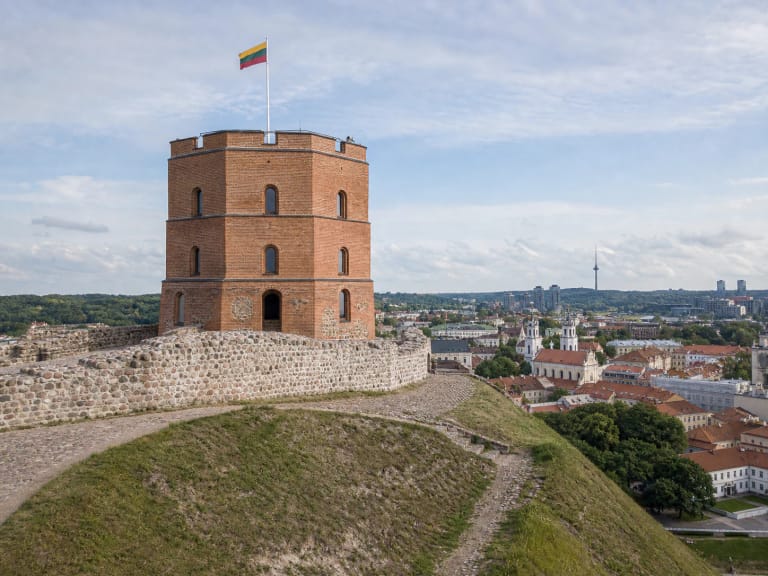
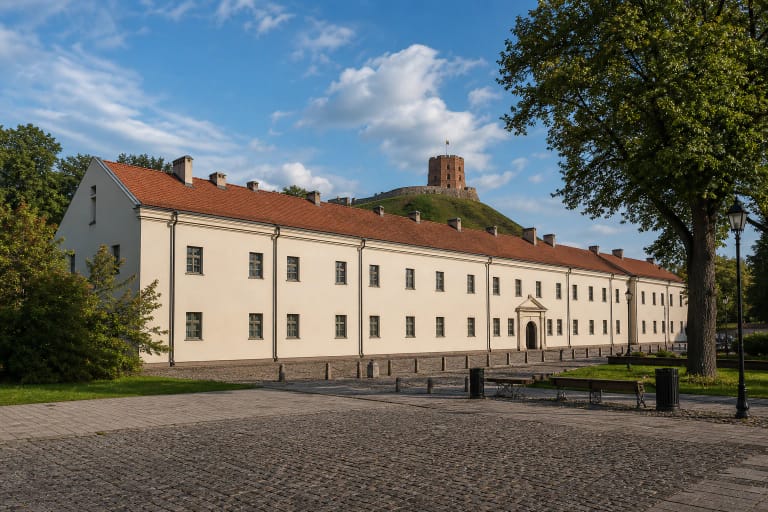
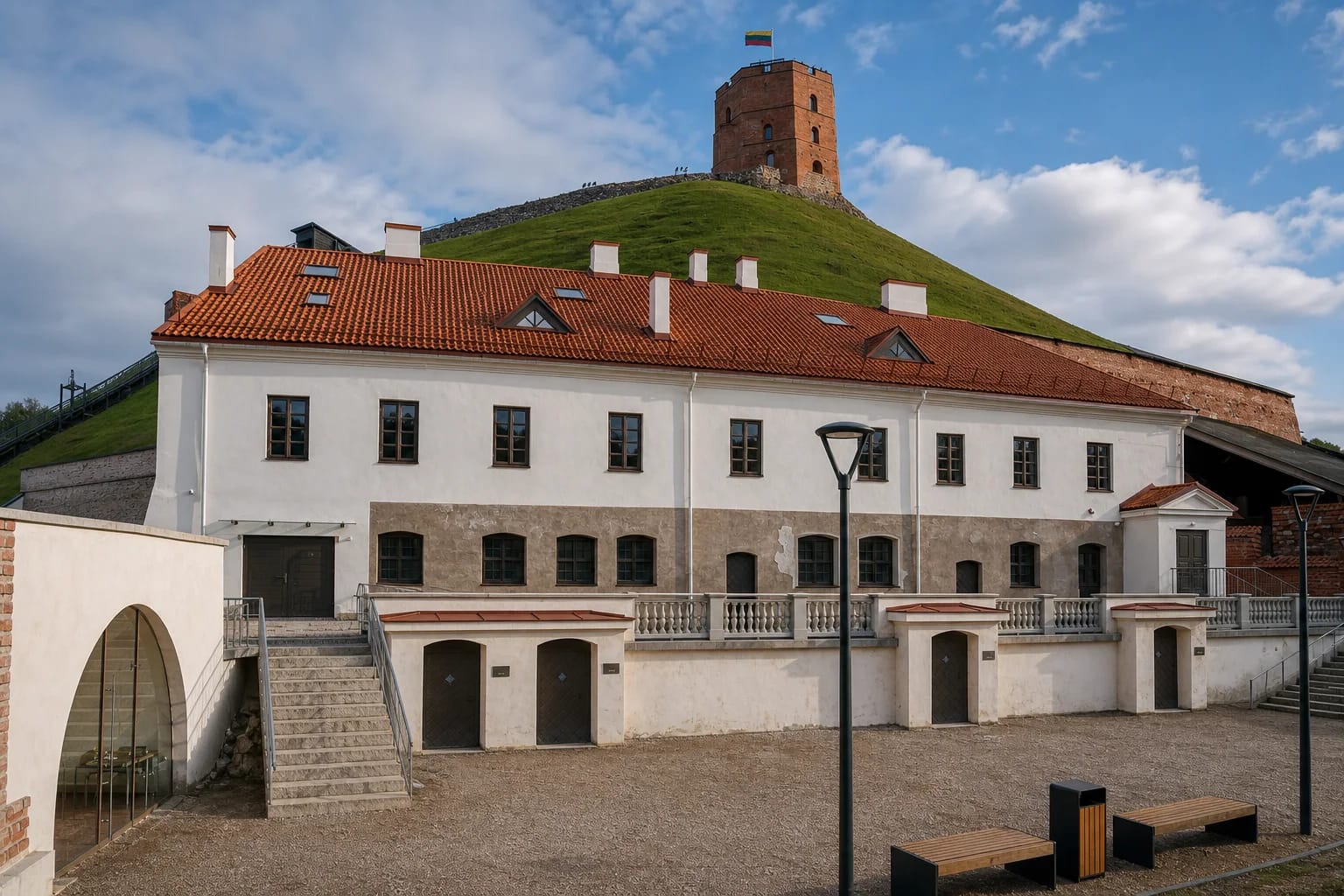
The museum is at 1 Arsenalo Street, in an inner courtyard at the foot of Gediminas Hill. The map embedded in the National Museum of Lithuania's official page places the site at 54.6872286, 25.2873341. This coordinate marks the whole building, not a particular door, accessible parking bay, or coach drop-off. Look for the entrance from the courtyard rather than the street frontage.
The Castellan's House opened to visitors on 27 March 2024 after research, restoration, and installation of a new exhibition. It is the National Museum of Lithuania's newest exhibition branch, but it is not housed in a neutral new gallery: it occupies one of the oldest well-preserved buildings in the former Vilnius castle estate.
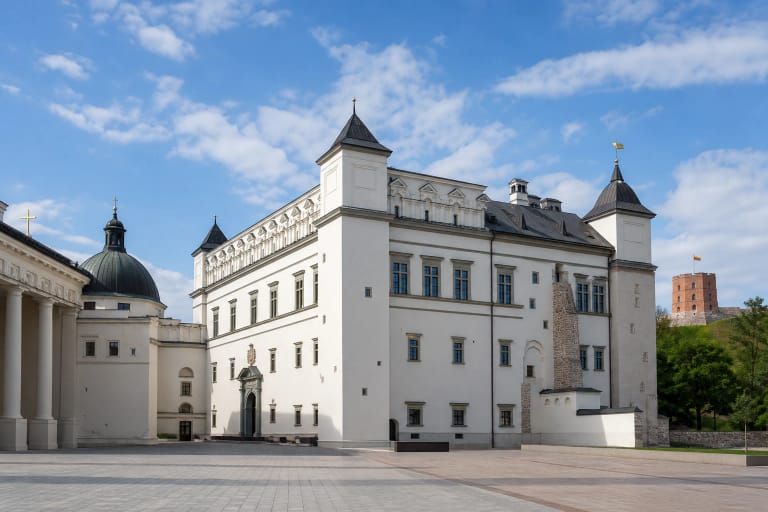
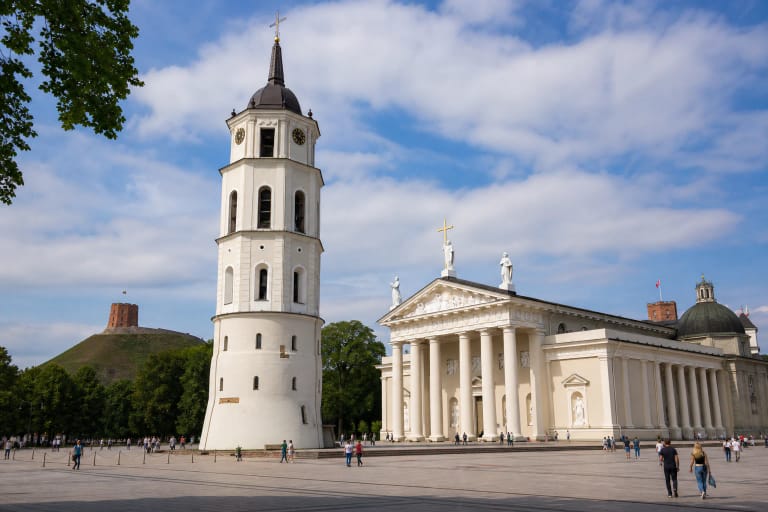
Do not confuse it with Gediminas Castle Tower, the Palace of the Grand Dukes, or the Old and New Arsenal. They stand close together and belong to the same historic castle landscape, but operate as separate museums or branches with different entrances, tickets, and exhibitions.
Understanding Lithuania uses six themes instead of a single chronological route
The principal exhibition develops the country's story across six rooms: Creativity, Beliefs, Struggles, Turning Points, Global Connections, and Faces. Each brings together a series of concise episodes ranging from the earliest periods to the present. The same century can therefore reappear in several rooms, and the route is designed to explain ideas that shaped Lithuanian identity rather than train visitors to memorise one sequence of dates.
Creativity places amber networks, Baroque art, Čiurlionis, ANBO aircraft, and Kaunas modernism in one conversation. Other rooms examine religious coexistence, warfare and struggles for freedom, rapid political and social shifts, movement between Lithuania and the wider world, and people who helped shape the country. This approach is useful for comparison, but visitors should not expect a comprehensive chronological encyclopaedia of Lithuanian history.
QR codes provide audio-guide material for individual themes. The cellars extend the main route with the castellan's office and profession, stonemasonry, and Vilnius about two centuries ago. Events, education, and thematic tours change, so a one-off programme should not be mistaken for a permanent part of the display.
The castellan managed far more than the building itself
The office of Vilnius castellan, also called horodniczy in historical sources, emerged in the mid-fifteenth century. The ruler of the Grand Duchy of Lithuania appointed the official, normally for life. Museum research has preserved the names of 39 men who held the post.
The castellan's responsibilities went well beyond guarding a gateway. He supervised construction and repair at the castles and grand-ducal palace, administered mills and land, collected taxes, and settled disputes among people living within the castle estate. The house contained a chancery, administrative and court records were kept there, and decisions were issued in the ruler's name.
The modern name does not mean that the entire surviving structure began as one castellan's private residence. The Cultural Heritage Department records foreign craftspeople working on the grand-ducal palace and members of Queen Elizabeth of Austria's court in an earlier phase, followed by a military garrison. The castellan and his administration occupied the building from the mid-seventeenth century.
Four cellars and a retaining wall explain the house's unusual architecture
The Cultural Property Register lists the Castellan's House as code 24707 within the Cathedral, Lower Castle, and Upper Castle complex. The register gives the broad date of the late sixteenth to early seventeenth century, while the latest museum and heritage interpretation connects the present house with construction after the Vilnius fire of 1610. These formulations do not justify one exact construction day: the sequence is reconstructed through architectural and archaeological evidence.
The house was built against the western retaining wall begun earlier at the foot of the hill, and its south-eastern wall helps support the slope. Four vaulted cellars with thick walls sit below the irregular two-storey volume. Each had its own courtyard entrance, making the reconstructed row of short cellar passages one of the facade's most distinctive features.
Look beyond the objects inside. The ground floor exposes vaulted spaces and Renaissance segmental door and window openings, together with surviving fragments of later painted decoration. The upper floor retains rectangular openings from the Neoclassical period and historic timber frames. Restoration therefore reveals several periods instead of turning the whole building into a single-age stage set.
Military use and archaeology separate documented tunnels from legend
The house was rebuilt after the destruction of 1655-1661. It became part of the Vilnius Arsenal in 1797, and the galleries and stables enclosing its courtyard were demolished in 1799. During the nineteenth century it contained gunpowder stores, arsenal workshops, accommodation, a garrison dining room, and a bakery. From 1958 it held collections and offices of the History and Ethnography Museum, and from the early 2000s it housed the National Museum of Lithuania's Restoration Centre.
Archaeological work in the courtyard and interior from 2018 to 2020 exposed the fourth cellar, long filled in, as well as stove-tile fragments, pipes, stone door and window surrounds, and paving. These finds help reconstruct a seventeenth-century interior and the working environment of stonemasons associated with decoration for the grand-ducal palace and the Chapel of Saint Casimir.
Researchers found unfinished underground passages in the northern cellars and part of a tunnel beneath the retaining wall. That is genuine archaeology, but it does not prove the popular story of one long secret corridor joining the castles and other Vilnius buildings. Scholars cautiously suggest that such structures may have inspired the legends. A thematic museum tour can reach places closed on the standard route, but its content and dates must be checked separately.
Verified 2026 hours, admission, and a detailed accessibility package
On 19 July 2026 the Castellan's House opened Tuesday-Sunday 10 am-6 pm and closed Monday. Adult admission was €7, reduced admission €3.50, a small-family ticket for one adult and one to four minors €11, and a large-family ticket for two adults and one to four minors €18. The €15 Historical Triangle ticket covered the Castellan's House, Old Arsenal, and Gediminas Castle Tower. The museum recommended choosing a date and time online. Always recheck prices, free-admission rules, and holiday hours on the official page.
The exhibition occupies three levels, with a lift to the upper floors and accessible toilets on every floor. Wheelchair circulation may be tight in the Struggles room on the second level. An accessible parking space is provided beside the museum, approached through the Palace of the Grand Dukes inner courtyard, but it is sensible to confirm the exact vehicle-access procedure and any staff assistance before arrival.
Tactile floor indicators, touchable replicas with Braille information, and an audiovisual guide available at the ticket desk support blind and partially sighted visitors. A sign-language electronic guide is provided for Deaf visitors, while a visual social story helps families prepare for an unfamiliar museum environment. Personal photography is generally permitted without flash or tripod unless a particular gallery says otherwise.