- Place
- Vilnius City Municipality
- Region
- Vilnius
- Type
- Vilnius viewpoint and memory monument
- Address
- Kalnų parkas, prie T. Kosciuškos g., Vilnius
- Coordinates
- 54.68690, 25.29750
Three Crosses, Bald Hill, Crooked Hill
Vilnius panorama above Kalnų Park
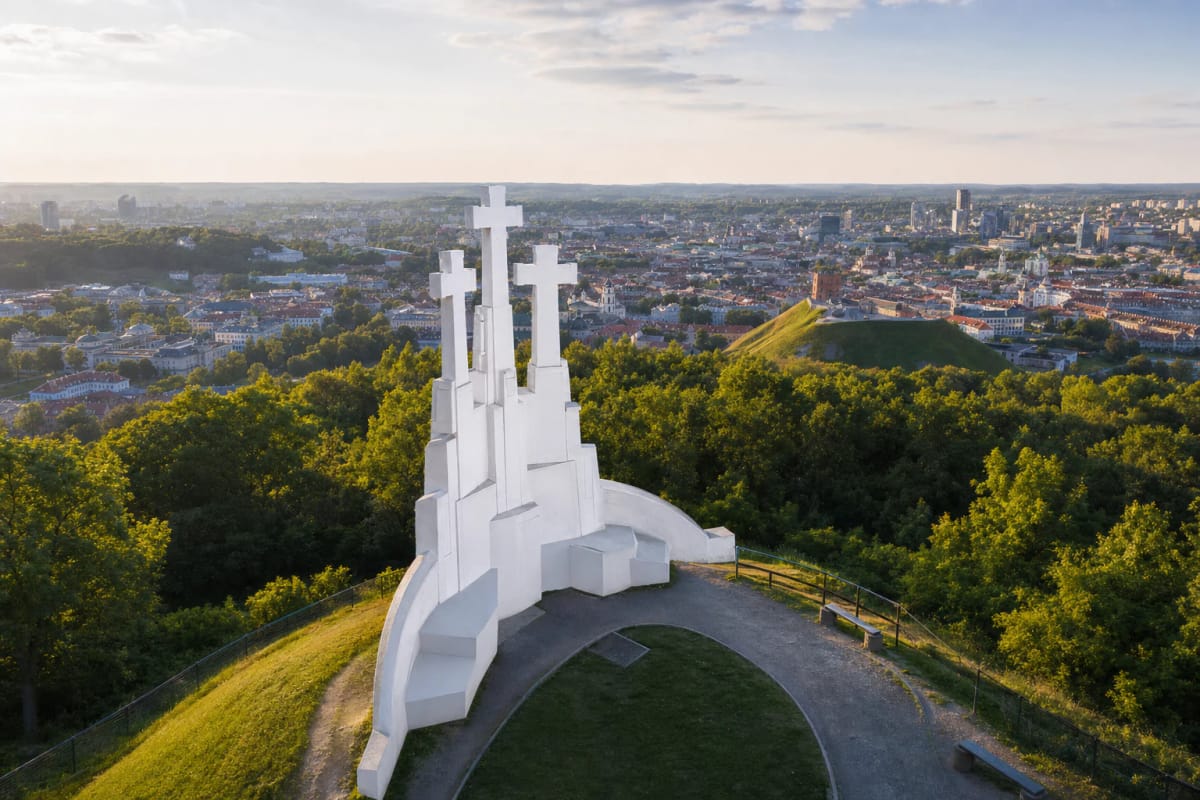
The Hill of Three Crosses is one of Vilnius' clearest viewpoint places. From the hill you see the old-town roofs, church towers, Gediminas Hill, the Neris valley, and newer city districts.
The monument stands in Kalnų Park, reached conveniently from T. Kosciuškos Street. It is not an isolated monument but part of a wider network of Vilnius green hills, paths, and viewpoints.
The martyr legend
VLE describes the Three Crosses as a monument to legendary Christian martyrs in Vilnius, on Bald Hill, also called the Hill of Three Crosses. Several legends explain the origin of the crosses.
One tradition tells of two Franciscans from Bohemia killed in Vilnius in 1341 on the order of Grand Duke Gediminas; another tells of fourteen Franciscan martyrs from Algirdas' time, seven of them supposedly crucified at the present site. These stories should be read as a layer of Christian memory rather than as one fully verified historical event. VLE adds that in the mid-seventeenth century the Bishop of Vilnius Jurgis Tiškevičius began the martyrs' canonization case, and three wooden crosses were then erected.
Wooden crosses and the 1916 concrete monument
VLE notes that three wooden crosses stood here in the seventeenth century, perhaps between 1613 and 1636. From the second half of that century, the Three Crosses often appeared in Vilnius iconography and plans.
After the wooden crosses collapsed, Russian imperial authorities did not allow them to be rebuilt in 1869. During the First World War, Vilnius intellectuals raised funds, and in 1916 a reinforced-concrete Three Crosses monument designed by Antanas Vivulskis was built. VLE notes that Vivulskis (1877-1919) was a Lithuanian architect and sculptor who studied architecture in Vienna and sculpture in Paris, and who also created the monument to the 500th anniversary of the Battle of Grunwald in Kraków and the Šiluva chapel.
Destruction and restoration
On May 30, 1950, the monument was blown up by order of the Soviet authorities. That is why the hill today is not only a beautiful viewpoint but also a place of memory about prohibition, loss, and the destruction of city symbols.
In 1989, on the initiative of Sąjūdis, the monument was restored. VLE states that the restoration project was by Henrikas Kęstutis Šilgalis, the sculptor was Stanislovas Kuzma, and the unveiling and blessing took place on June 14.
How to climb the hill
Most visitors climb on foot from Kalnų Park or combine the hill with a route from Bernardine Garden, Užupis, Gediminas Hill, or Cathedral Square. The climb is not long, but stairs and slope paths can be steep.
After rain or in winter, take care because stairs and paved paths can be slippery. For photography, morning or evening is usually best; at midday the white monument and city roofs can be highly contrasted.
What to see nearby
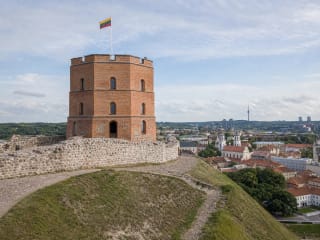
The Hill of Three Crosses works well with Gediminas Castle Tower, Bernardine Garden, Vilnius Old Town, Užupis, and Kalnų Park paths. It is one of the easiest points for starting or ending an old-town walk.
If you have only one evening in Vilnius, a route from Cathedral Square through the Gediminas Hill area, Bernardine Garden, and the Hill of Three Crosses gives many city layers quickly: rulers' residence, park, old town, river valley, and memory monument.