- Place
- Vilnius, Vilnius City Municipality
- Region
- Vilnius
- Type
- Upper Castle tower, museum, and Vilnius viewpoint
- Address
- Arsenalo g. 5, Vilnius
- Coordinates
- 54.68680, 25.29060
Gediminas Tower, Upper Castle Tower
Gediminas Castle Tower as the sign of the Vilnius castles
VLE describes the Vilnius castles as a complex made up of the Upper, Crooked, and Lower castles. Gediminas Castle Tower, often casually called Gediminas Castle, is today the most recognizable surviving part of the Upper Castle and one of Vilnius' strongest visual symbols.
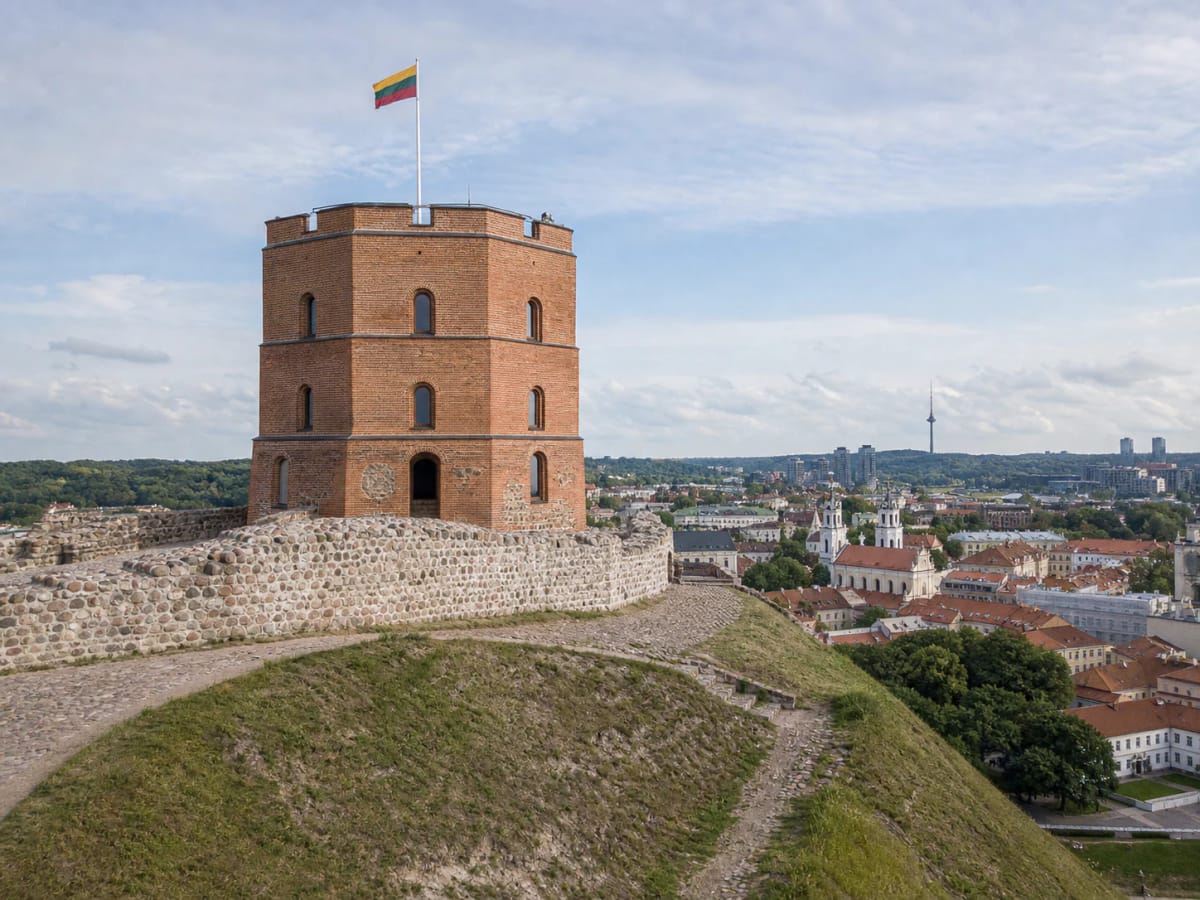
The surviving western tower is three storeys high with a semi-basement, octagonal, and Gothic in character, with a viewing platform and crenellated parapet above the third floor. It matters not only as a viewpoint but as a material marker of the political and defensive centre that once stood above the old town. Castle Hill and the old town are part of the UNESCO-listed Vilnius historic centre.
Castle Hill and the Vilnius panorama
The tower stands on Castle Hill, looking over the old town, Cathedral Square, the Neris valley, and newer parts of the city. From here the strategic value of the hill becomes obvious: it controls views over the rivers and the historic urban core.
For first-time visitors, this is one of the best places to assemble the city mentally. The Lower Castle area, church towers, old-town roofs, and later city expansion can all be read in one view.
Why the tower is called Gediminas Castle
VLE notes that Castle Hill was inhabited already in the first millennium BC. A wooden castle may have stood here in the late thirteenth or early fourteenth century, and in 1323 the place was first mentioned as Vilnius Castle. A masonry castle was built in the second half of the fourteenth century, encircled by a wall with three towers, with a two-storey ruler's palace standing at the eastern end of the courtyard.
After a fire in 1419, the castle was rebuilt under Vytautas the Great in 1419-1422 and named Gediminas Castle in honour of Vilnius' founder. The name and the legend of Gediminas' dream explain why the hill became a symbol of the capital's beginning, even though the visible masonry belongs to later layers.
Gediminas Castle Tower as a museum
The Lithuanian National Museum runs an exhibition in the western tower about the Vilnius castles and city history. VLE adds that the museum was installed in the tower in 1960, after the tower, damaged in the 1944 fighting, had been restored in 1948-1950 to a design by architect E. Budreika.
Among the key exhibits are fourteenth- and fifteenth-century Teutonic assault projectiles, one of the two crossbow bolts with a head found in Lithuania, a ritual horn axe with Baltic swastika signs, and facsimiles of Gediminas' 1322-1323 letters to Pope John XXII and European merchants. The exhibition is reinforced by a model of the castle complex and a Baltic Way installation.
The tower itself tells the story of defensive Vilnius; the museum connects that story to statehood symbols and twentieth-century memory.
Castle Hill landslides and slope works
In the twenty-first century, Castle Hill became a heritage-conservation and engineering issue. In 2016 and 2017, thawed and waterlogged slopes began to slide, and for safety the hill and tower were closed for periods.
Works organized by the Vilnius Castles State Cultural Reserve and the Lithuanian National Museum strengthened the most dangerous north-western slope with gabions, drainage, conservation of an underground tunnel opening, and a monitoring system. The north-western slope works alone cost about EUR 3 million and carried a guarantee of up to ten years. The story turned Gediminas Hill into a visible example of how heritage, geology, and city tourism meet.
The flag on Gediminas Tower
The Lithuanian tricolour flies from the top of Gediminas Tower. For many visitors that image makes the tower a statehood symbol, not only an architectural monument.
VLE notes that the tricolour was raised on the western tower on January 1, 1919, in October 1939, and on October 7, 1988, marking independence, the return of Vilnius, and the national revival. The tower is a medieval remnant; the flag is a later political and civic layer.
How to visit Gediminas Castle Tower
Plan at least an hour to climb the hill, visit the tower, pause for the panorama, and walk through the exhibition. For city photography, early morning or evening often gives better light.
You can reach the hill on foot, by the funicular installed in 2003, or by a free lift to the Panorama Square when available. Museum hours, ticket prices, and funicular operation change by season, so check the Lithuanian National Museum page before travelling.