- Place
- Vilnius, Vilnius City Municipality
- Region
- Vilnius
- Type
- art museum in the restored Old Arsenal Palace of the Lower Castle
- Address
- Arsenalo g. 3A, Vilnius
- Coordinates
- 54.68700, 25.28900
Applied Art Museum, Old Arsenal, Taikomosios dailės ir dizaino muziejus
A museum in the Old Arsenal Palace
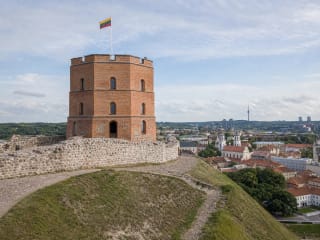
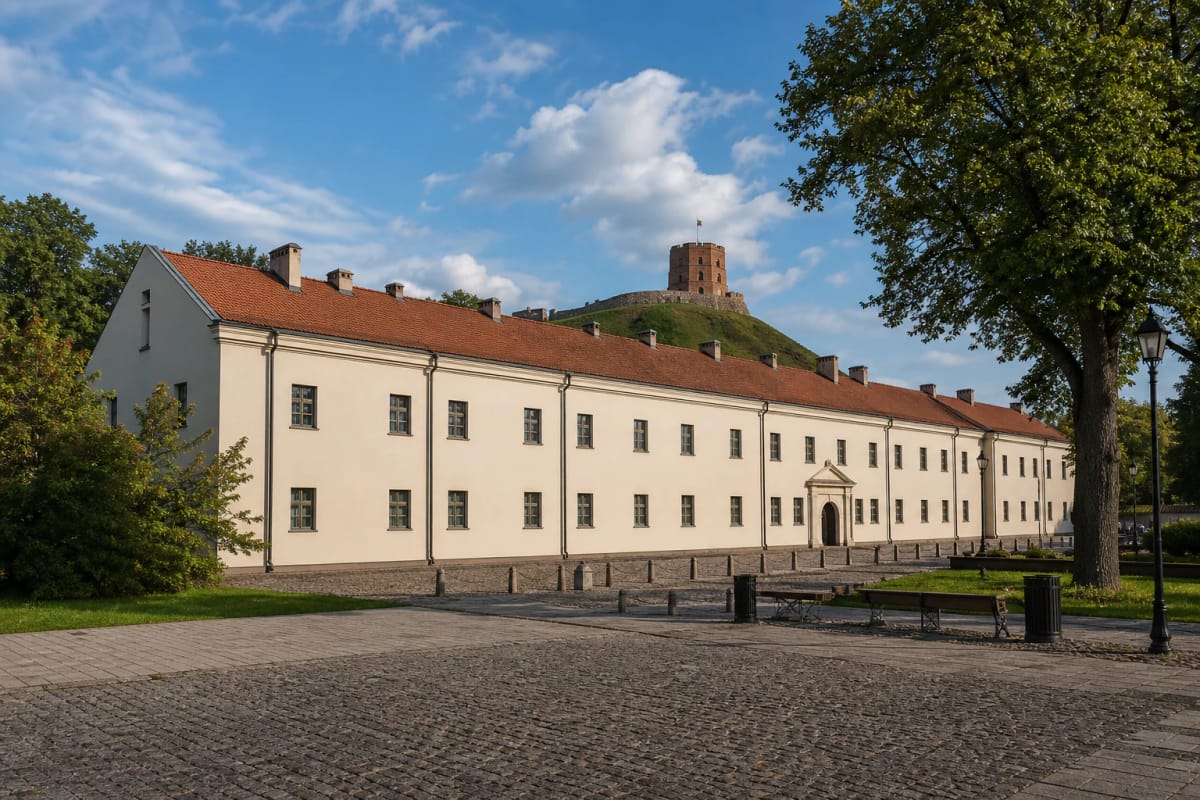
The Museum of Applied Arts and Design stands at the foot of Gediminas Hill, in the restored eastern, or great, wing of the Old Arsenal of Vilnius Lower Castle. It is a branch of the Lithuanian National Museum of Art, or LNDM, so it should be distinguished from the Lithuanian National Museum operating in neighbouring arsenal wings, where the archaeology exhibition Lietuvos priešistorė, Lithuanian Prehistory, is shown. That is a separate institution and a separate ticket.
The museum was founded in 1987. Until 2016 it was called the Museum of Applied Art; later the name was expanded to include design. The space itself is also interesting as a heritage object: on the ground floor and in the basement, visitors can see remains of authentic sixteenth-century arsenal walls.
History of the Old Arsenal
The Old Arsenal was built in the mid-sixteenth century under Sigismund the Old and Sigismund Augustus, with construction led by architect J. Breitfus. It was one of the largest arsenals in the region, the main warehouse for weapons and ammunition of the entire state. The building's history is also linked with the residence of the young queen Elizabeth of Austria.
The arsenal was damaged during the mid-seventeenth-century war with Muscovy, rebuilt in 1670, later damaged again, and the western wing burned in 1944. Architectural and archaeological research began in 1972 under architect S. Lasavickas. In 1986 the eastern wing was rebuilt to a design by architect Evaldas Purlys, restoring the late-Gothic sixteenth-century spatial structure with early-seventeenth-century Renaissance facades.
What you can see in the exhibitions
Over its history, the museum has held significant applied-arts exhibitions: Taikomoji baroko dailė Lietuvoje, Applied Baroque Art in Lithuania, ran in 1996-1999; until 1999 there was a permanent fourteenth- to twentieth-century applied-arts display; and in 1999-2004 the famous exhibition Krikščionybė Lietuvos mene, Christianity in Lithuanian Art, was shown here. Works acquired for the restored Palace of the Grand Dukes were also exhibited here.
Those permanent displays should now be understood as museum history. Today the museum mainly hosts changing applied-arts and design exhibitions, educational activities, and concerts, and since 2017 there has been a permanent presentation of the building foundations. Before visiting, it is worth checking which exhibitions are open at that specific time.
Opening hours, tickets, and access
During research, the official LNDM page listed the museum hours as follows: Tuesday, Wednesday, Friday, and Saturday 10:00-18:00; Thursday 10:00-20:00; Sunday 11:00-16:00. The museum is closed on Mondays and public holidays, and last visitors are admitted 30 minutes before closing. Tickets were listed at roughly 6 Eur full price and 3 Eur reduced.
These details can change over time, so opening hours, ticket prices, and current exhibitions should be checked on the official LNDM page before going. The museum is accessible for visitors using wheelchairs.
How to plan a visit
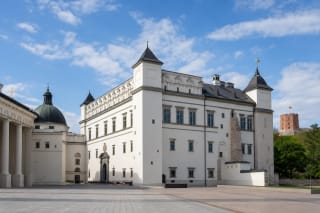
The museum is convenient to combine with neighbouring Lower Castle sites: the Palace of the Grand Dukes, Gediminas Castle Tower, and Cathedral Square. A visit usually takes 1-1.5 hours, depending on how many exhibitions are open.
Because the museum is located within the Vilnius Castles State Cultural Reserve, the whole setting is a heritage territory. It is worth extending the walk through Cathedral Square and the foot of the hill.