- Place
- Anykščiai Eldership, Anykščiai District Municipality
- Region
- Aukštaitija
- Type
- a municipality-protected botanical natural-heritage object
- Address
- Paelmio village, Anykščiai Eldership, Anykščiai District
- Coordinates
- 55.57019, 25.15283
- Visit duration
- 30-60 minutes; longer if you arrive by bicycle or join a Regional Park route
- Best time
- a dry, bright season; the forest road and root area can be muddy after rain
Elmė Oak, Elmė Six-Trunk Oak
Elmė Oak grows at the edge of a forest reserve
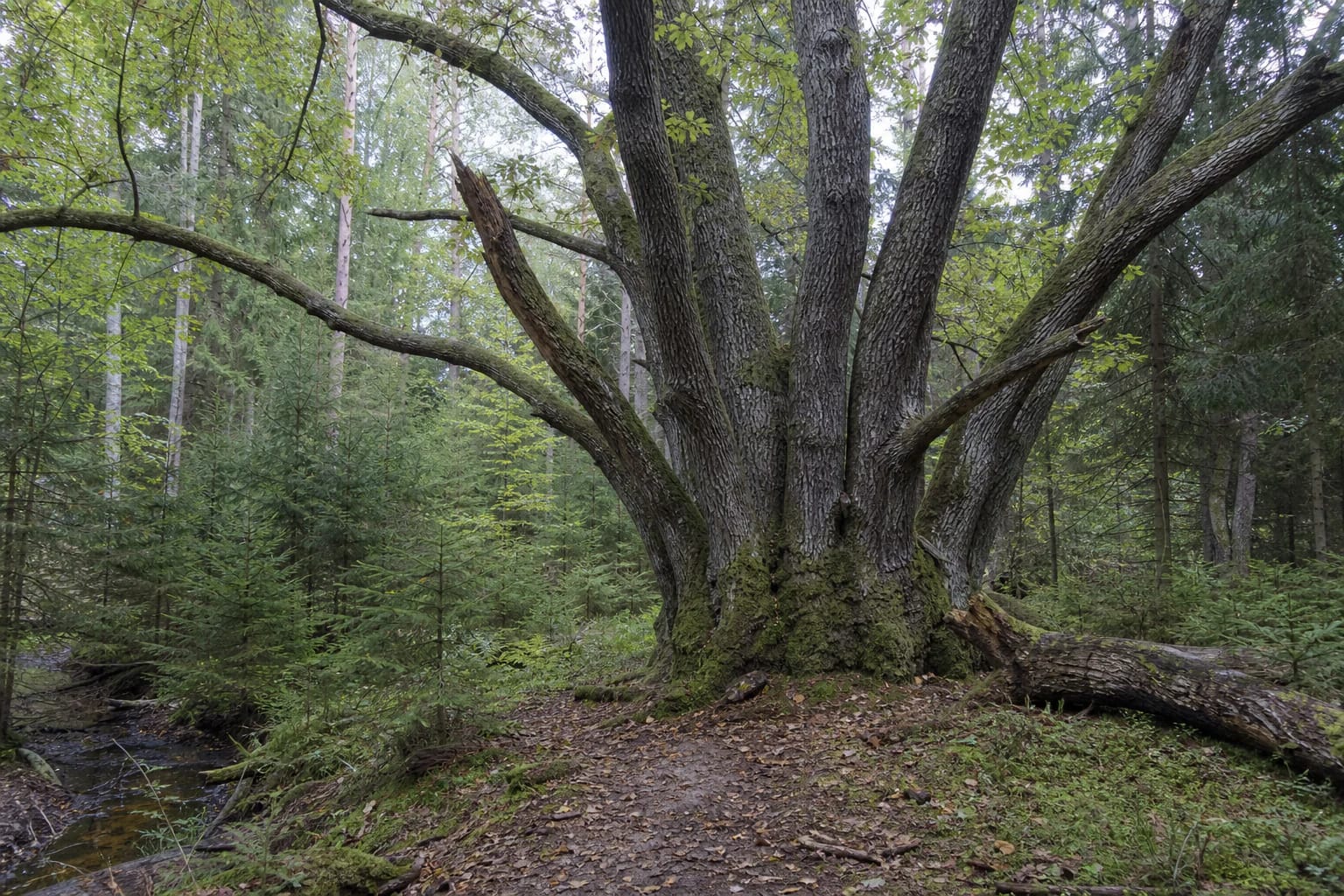
Elmė Six-Trunk Oak grows in Paelmio village, Anykščiai Eldership, within the Elmė Landscape Reserve. It stands at the edge of a dense young spruce stand near a tributary of the Elmė stream, so the site feels more like a woodland discovery than a landscaped park with a broad forecourt.
Saugoma publishes the rounded point 55.570, 25.153, while metadata for an exact-place photograph gives 55.570194, 25.152827. The coordinate on this page marks the tree itself, not a road turn or convenient parking place.
The oak is one of Anykščiai Regional Park's visitor objects, but the last part of the journey uses forest roads. Assess the weather, vehicle clearance, and the fact that navigation to a forest clearing does not guarantee easy access in every season.
Why this oak stands out
The Elmė tree is multi-trunked from its root base: several substantial trunks rise from one broad foundation and divide the crown into bouquet-like parts. This form, more than height or girth alone, creates the surprising sight in the dense woodland.
Saugoma gives a height of about 26 metres and says the total circumference of all six trunks once reached 7.66 metres. The official old-oak inventory contains older measurements as well, so figures from different years should not be combined into one current metric.
The tree's exact age is not known. Older official data give an estimate of around one hundred years, but that is a period assessment rather than a biological clock updated every year.
The six-trunk name and the 2023 storm
The name survives from the period when the tree was described as six-trunked. In early autumn 2023 a storm broke two trunks, so today's visitor sees a changed crown and trunk structure. The historic name helps identify the object in sources, but should not be read as a promise that all six limbs remain healthy.
Specialists, rather than visitors, should decide how fallen wood is handled in a protected woodland landscape. Do not move broken branches, climb into splits, or test whether a trunk is stable by leaning on it.
After the storm the oak is more sensitive to wind and visitor pressure. Observe it from several steps away, avoid walking across the root base, and do not let children climb between the trunks even if the tree appears sturdy.
A protected botanical natural-heritage object
In 2003 Elmė Six-Trunk Oak was declared a natural-landscape object protected by Anykščiai District Municipality. Its value lies in the rare multi-trunk form, striking shape, reserve setting, and combination of living wood and woodland habitats.
Other trees, young spruce, moss, and leaf litter surround the oak, while a tributary of the Elmė and traces of a dried channel lie nearby. This is not an ornamental lawn that can be trampled from every direction: the forest floor and roots are part of the ecological setting too.
An information board has been mentioned beside the tree, but official descriptions stress that there are no reliable road signs and the object is hard to find. If the board or signs are no longer visible, do not solve the problem by driving through the woodland or cutting across young trees.
How to reach Elmė Oak
The official Anykščiai Regional Park route from the visitor centre to Elmė Oak is about 14 kilometres one way and uses a wooden path, paved road, gravel road, and forest lanes. From the centre it heads towards Niūronys and Lašiniai, then turns onto a forest road and keeps right at a forest clearing.
The Aukštaitija protected-areas guide says that it is convenient to walk from the forest clearing to the oak and to lead a bicycle. Road signs are not reliable, so save the coordinates and route rather than relying only on a phone signal at the forest edge.
The official sources checked here do not list admission, a ticket desk, or opening hours. This is an outdoor natural-heritage object, but the practical visit depends on road conditions, forestry work, moisture, and any access restrictions on the day.
Respect for the tree and woodland
After a storm, do not stand beneath broken or hanging branches or touch trunks that appear unstable. The condition of an old tree can change, so barriers, directorate warnings, and visible hazards matter more than earlier photographs.
Do not climb into the crown, tread on roots while embracing the trunks, nail signs, or hang objects from branches. Do not strip moss, disturb the forest floor, light fires, or drive to the tree when the forest road is not suitable.
Visit this tree as a living, changed organism rather than a static decoration. A few quiet minutes beside the path, listening to the Elmė water and woodland, reveal not only the number of trunks but the whole reserve setting.