- Place
- Anykščiai, Anykščiai District Municipality
- Region
- Anykščiai District
- Type
- hillfort and living-history space
- Coordinates
- 55.54500, 25.14000
Šeimyniškėliai Outcrop, Šeimyniškėliai Hillfort, Voruta Hillfort
Officially a hillfort, not an outcrop
Although the slug and older search context sometimes use an outcrop name, official sources call this place Šeimyniškėliai or Šeimyniškėliai (Voruta) Hillfort. Visitors should understand it first as an archaeological and historical site near Anykščiai.
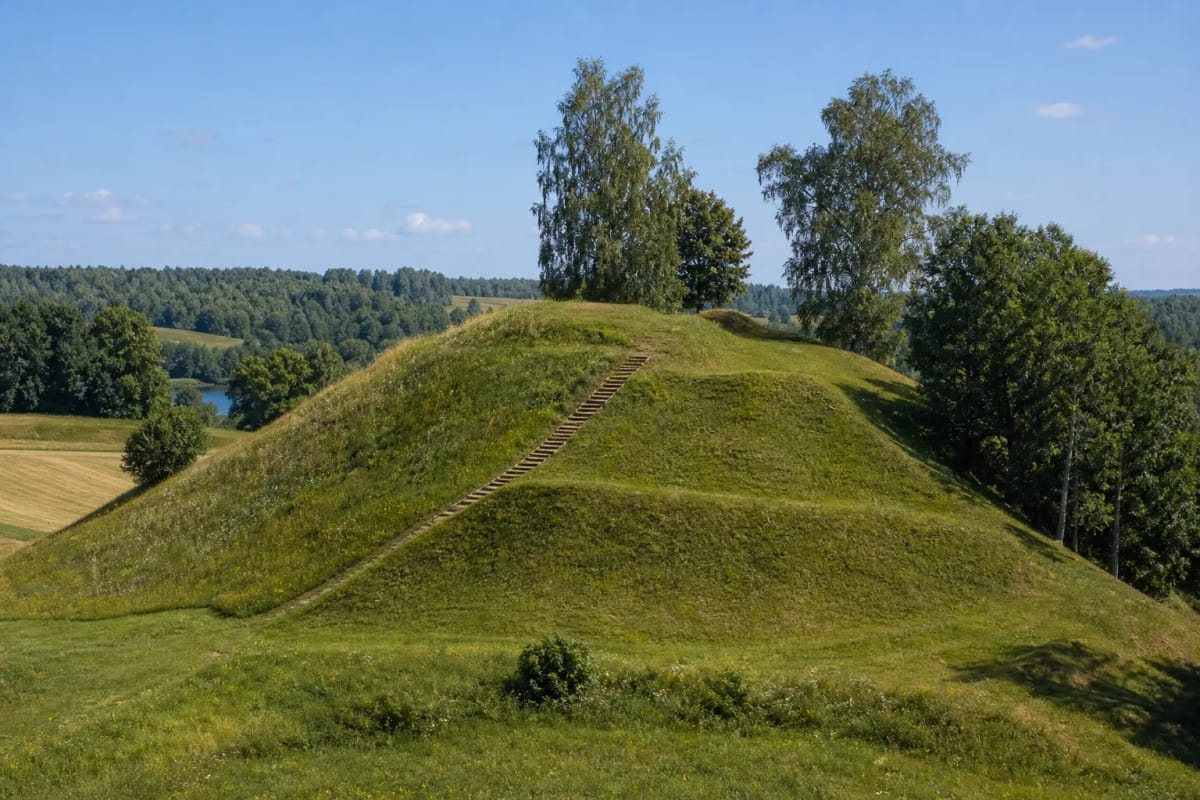
The hillfort stands near Naujieji Elmininkai, in the setting of Anykščiai Regional Park. It is surrounded by two deep valleys, where the Vorelis and Volupis streams flow, so the defensive relief is clear even without specialist preparation.
Ramparts, ditches, and platform
VLE gives a platform of about 23 x 80 m and slopes up to 15 m high. Ramparts and ditches complete the defensive structure; on the south-eastern side, a 5 m high rampart and a ditch 20 m wide and 6 m deep are mentioned.
This is one of those hillforts where earthworks are visible as architecture. While walking, it is worth watching not only the view from the top but also the passages, slope logic, and former castle approaches.
The Voruta question and a thirteenth-century castle
Saugoma.lt writes that in the mid-thirteenth century a state wooden castle stood here, protecting the northern border of the Lithuanian state. The place is linked with the possible site of Mindaugas' Voruta castle, but this should be presented as a historical interpretation, not a finally proven fact.
That caution matters because it lets the place be presented strongly and accurately. The confirmed archaeology, landscape, and research data are interesting enough without overstating the case.
One of Lithuania's most researched hillforts
From 1990, archaeologist Gintautas Zabiela and his teams researched the hillfort for 19 seasons. Because of this work, Šeimyniškėliai is often described as the most extensively studied hillfort in Lithuania and one of the most researched in the eastern Baltic.
The research context is especially important for visitors: this is not only a beautiful hill, but a space of archaeology and education where castle history is told through research, models, examples of finds, and reconstructed infrastructure.
Living-history space
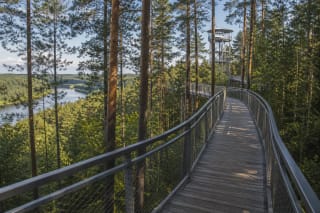
For visitors, a bridge, steps, towers, gallery, and outer-bailey yard have been installed. The official description mentions a castle model, examples of archaeological finds, historical games, and education programmes, making the site especially suitable for a family trip through the Anykščiai area.
The surface includes gravel and steps, so comfortable footwear is needed. Use built paths and stairs, do not climb steep slopes, and protect the ramparts, because the archaeological relief is the site's core value.