- Place
- Anykščiai District Municipality
- Region
- Anykščiai District
- Type
- boulder, geological natural-heritage object, and memorial site
- Address
- Dvaronys village, Anykščiai elderate, Anykščiai District Municipality
- Coordinates
- 55.48417, 25.05861
Dvaronys Stone
A boulder that became a sign of memory
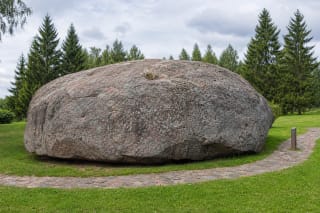
Puntukas Stone is not Lithuania's largest boulder, but it is one of the most recognizable. Its strength lies not only in its size: Ice Age geology, the Anykščių šilelis landscape, legends, and the memory of Darius and Girėnas meet here.
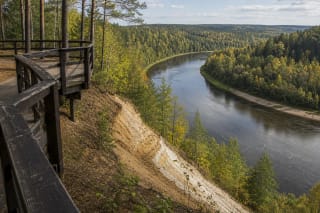
VLE states that Puntukas is in Dvaronys village, about 5 km south of Anykščiai, near the left bank of the Šventoji. Because it is close to Anykščių šilelis and the Tree Canopy Walk, it often becomes not a separate stop but the centre of the whole Anykščiai nature route.
Size and geology
Puntukas is the second-largest boulder in Lithuania. VLE gives the exact dimensions: 7.54 m long, 7.34 m wide, 5.70 m visible height, and 21.39 m circumference. Its shape is higher and more vertical than Barstyčiai Stone, so in person Puntukas often feels more monumental.
Geologically it is rapakivi-type granite, carried by a glacier from the Vyborg rapakivi massif on the Finnish-Russian border. VLE states that the massif rock itself formed from a granitic intrusion about 1.62-1.65 billion years ago, while the glacier brought Puntukas in the Pleistocene, about 15,000-24,000 years ago. The boulder's mass is estimated at about 400 tonnes. This detail explains why such rock appears in the Anykščiai region: it was carried not by local processes, but by a continental glacier.
Darius and Girėnas bas-relief
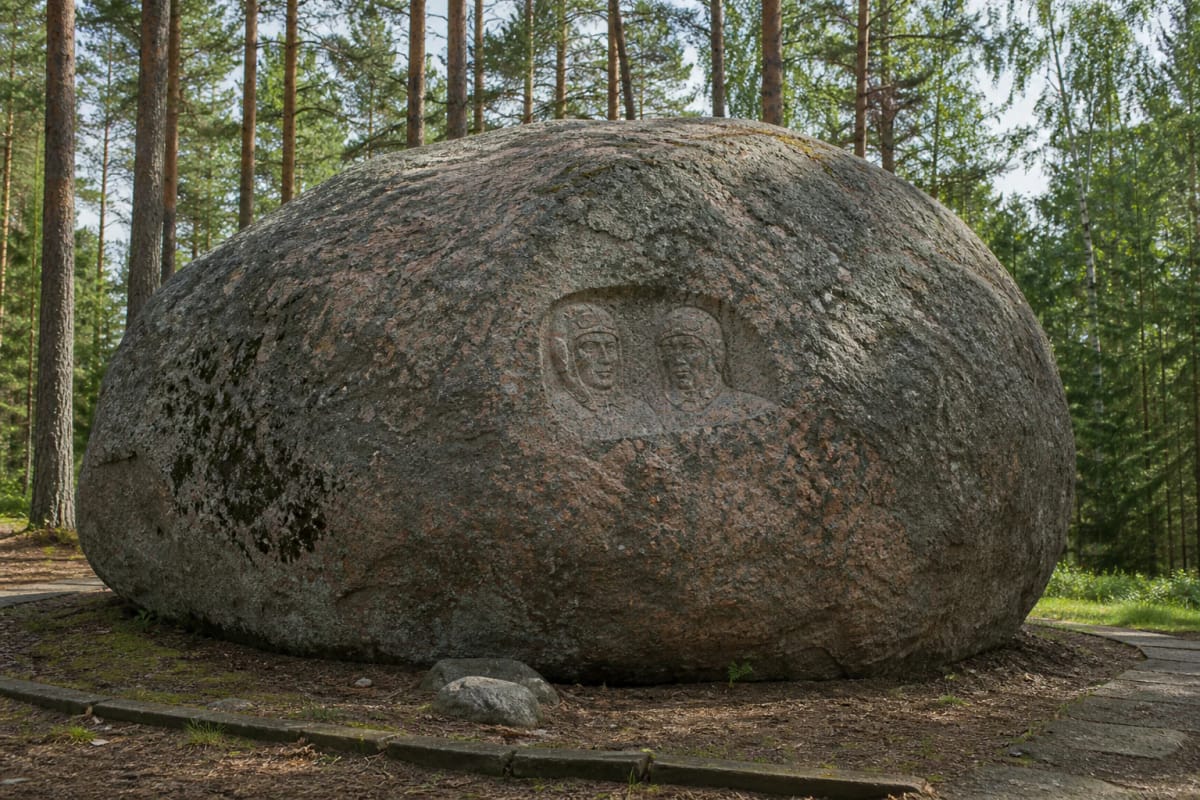
In 1943 sculptor Bronius Pundzius carved a bas-relief of Steponas Darius and Stasys Girėnas into the southern side of Puntukas. VLE states that it measures 1.17 x 1.44 m; beneath it are the pilots' names, an excerpt from their testament, and the date of their flight. From then on, the boulder became a place of memory for the pilots, linked with the transatlantic flight, national memory, and a cultural gesture made during wartime. In 1945 the bas-relief was shot at by Soviet collaborators, and in the mid-1960s it was restored.
This layer changes the rhythm of a visit. At Puntukas, it is worth not only taking a photograph, but quietly looking at how the natural stone surface and the memorial relief are joined. For that reason, do not touch or scratch the carving.
Archaeological signs
VLE notes that the top of Puntukas has six cup-marks about 5 cm in diameter and 1 cm deep, characteristic of the Bronze Age to Early Iron Age, and that Mesolithic flint artefacts were found near the boulder in 1930-1940. These signs allow discussion of an older relationship between people and the stone, but they need to be presented carefully: the most reliable point is the fact of the cup-marks, while sacred-site interpretations should be separated from proven data. Because of its archaeological and memorial value, Puntukas has also been protected as an archaeological and art monument since 1972.
Because of these signs and the bas-relief, Puntukas is not a place for climbing. Even if the surface looks durable, every climb or rub affects both the stone and its cultural marks.
Legends about Puntukas
In Lithuanian legends Puntukas is often linked with the devil, who was carrying the stone to destroy Anykščiai church but dropped it when the roosters crowed. In other stories the name is connected with a warrior or strongman named Puntukas.
These stories do not explain the boulder's origin geologically, but they do explain why the stone entered local imagination. Puntukas is a strong example of how the same place can be read scientifically, memorially, and folklorically.
What to see nearby
Puntukas Stone is part of the Anykščių šilelis route. It is most often combined with the Tree Canopy Walk, views of the Šventoji valley, and a walk in the forest itself. If you are visiting for the first time, plan at least an hour so you do not simply stop in the car park and leave immediately.
A good route is to first look at Puntukas and the bas-relief, then walk toward the canopy walk, and on the way back see the stone again from another side. This helps you understand its place in the landscape.
How to visit responsibly
Do not touch the bas-relief, do not climb on the stone, and do not look for shortcuts through sensitive areas. Visiting is simple, but the object has several layers: natural monument, memorial, and archaeological marked surface.
For photographs, take two frames: one wider view with the forest setting and one closer view of the bas-relief field. That way, in a travel album or page, Puntukas appears not as a random stone but as one of the most important places in Anykščiai.