- Place
- Anykščiai, Anykščiai District Municipality
- Region
- Anykščiai District
- Type
- restored historic timber building with below-grade creative studios, exhibition space, and event hall
- Address
- 53 J. Biliūno Street, Anykščiai
- Coordinates
- 55.52925, 25.12003
- Visit duration
- 45 minutes to 2 hours; longer for an exhibition, workshop, or event
- Best time
- for a specific exhibition or event, after checking studio access on a weekday
Anykščių menų inkubatorius - menų studija, AMI
This is a working arts incubator, not Anykščiai Art School or a museum
Anykščiai Arts Incubator - Art Studio operates at 53 J. Biliūno Street, on the old Anykščiai manor site beside the Anykšta stream. Its role is to bring artists and art-related businesses together, provide studios and services, and show the creative process to the public. What matters here is therefore not one permanent collection, but a living rotation of residencies, exhibitions, workshops, and events.
Do not confuse this address with Anykščiai Art School, the Angels Museum, or the narrow-gauge railway station. The incubator is a separate public institution, although its building carries the history of a former school and all these places belong to the wider cultural route through Anykščiai. The map point marks the building site and visitor area, not a specific doorway.
A former school became a creative-industries building in 2014
The public institution was established in October 2008, while the building is presented as the result of a 2014 project adapting a historic cultural object. The earlier building was a school, identified in sources as the second building of Anykščiai's old gymnasium; Antanas Vienuolis-Žukauskas once worked there.
The intervention was not simply a school renovation. It aimed to preserve the spatial character of the old manor site, adapt the building for creative work, and add contemporary studios, halls, and exhibition areas. The result brings together documented school memory, the manor-site landscape, and a new cultural use.
Public descriptions give different resident counts: an older institutional description names 13 artists, while later presentations mention 17. Because the community changes, it is more accurate to describe a network of resident studios than to present one fixed current number.
A traditional timber silhouette conceals 1,504 square metres of below-grade infrastructure
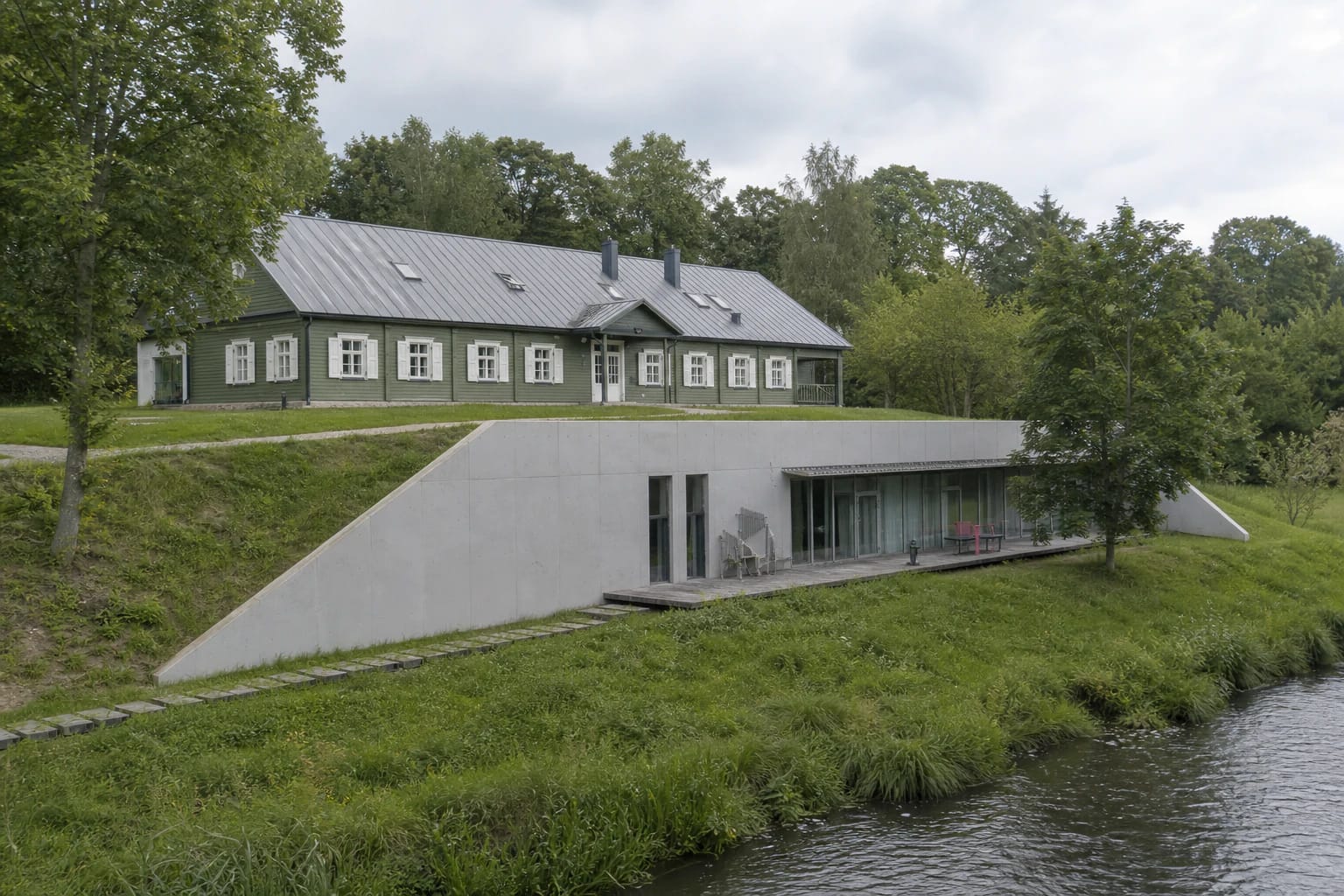
The solution by architects Valdas Klimavičius, Elvyra Klimavičienė, and Andrius Daujotas deliberately avoids placing a large modern mass on the green manor-site slope. The main facade recalls restrained traditional Lithuanian timber architecture: a pitched volume, rhythmic windows, white surrounds, and a central entrance framed beneath a small canopy.
The existing timber building was dismantled and restored to its earlier silhouette after the below-grade level was built. The change in terrain allowed the main rooms to be set into the slope, with a glazed wall opening towards the Anykšta. From above, visitors see a familiar wooden house; from the stream, glass, a terrace, and creative rooms hidden in the earth become visible.
Archmap gives the total area as 1,504 square metres and the completion year as 2014. Those figures explain why this is more than a small gallery: the building contains studios, halls, exhibition space, a gallery, and rooms adaptable for events, although some are primarily workplaces rather than casual visitor areas.
What visitors can see and do
The institution's own description invites visitors to enter resident studios, learn about the creative process, visit the gallery or shop space, join educational programmes, and attend exhibitions, concerts, film screenings, and other events. This is a place not only to look at art, but to see how it is made, taught, and developed into craft or a creative business.
The studio mix depends on the residents and the programme. Public descriptions mention ceramics, textiles, photography, graphics, design, leather, wood, weaving, glass, and other crafts, while workshops invite participants to try materials and techniques. Do not assume that every studio or workshop is open every day: artists are working, and some activities are limited to registered participants.
The incubator also rents larger and smaller halls for conferences, training, creative workshops, and events. On an event day the whole building may feel visitor-facing; on a quiet working day only an exhibition or shop area may be open to casual visitors.
The exhibition and event programme changes the meaning of a visit
There is no single permanent display that can be viewed independently of the date. The programme includes temporary exhibitions, creative-industries activities, workshops, concerts, festivals, and meetings, while some sessions are arranged for a particular group or registered participants. The most reliable plan is to choose a specific event or exhibition first, then build the rest of an Anykščiai route around it.
The 2026 municipal cultural overview describes the incubator's work as exhibitions, creative-industries festivals, a design week, training, makers' fairs, educational activities, and unusual events. Read this as the range of the institution rather than as a guaranteed one-day schedule. Check the official website for the current exhibition, registration, and hall-use conditions.
Hours, tickets, and access need checking before you travel
The official website lists institutional hours of Monday-Thursday 08:00-17:00 and Friday 08:00-15:45, with a lunch break from 12:00 to 12:45. These are the published operating hours of the institution, not a promise that every resident studio or event hall is open to visitors then. Check the specific programme and contact the venue before travelling.
No general permanent admission ticket was found on the official website. An exhibition, workshop, concert, or booked activity may have its own registration and price, so neither free entry nor a standard tariff should be promised without checking the information for that date.
The official sources reviewed do not publish a complete step-free route through all studios and halls, a single general photography policy, or a visitor parking plan. Ask the institution in advance about wheelchair access, groups, photography, cars, and the particular exhibition. On 15 July 2026, the exact Google Maps card showed a rating of 4.7 out of 5, but that platform figure can change.