- Place
- Druskininkai, Druskininkai Municipality
- Region
- Druskininkai
- Type
- historic spa garden with formal avenues, a mineral-water pump room, sculpture, and access to the Nemunas embankment
- Address
- Spa Park between the bathhouses and the Nemunas embankment, Druskininkai
- Coordinates
- 54.02121, 23.97784
- Visit duration
- 45-90 minutes for the park, pump room, and riverfront; approximately 1.5-2 hours if you wait for a Musical Fountain show and descend to Grožio Spring
- Best time
- early May for tulips or a warm-season evening for the fountain; choose a bright weekday morning for a quieter historical walk
Gydyklų parkas, Senųjų gydyklų parkas, Old Spa Park, Druskininkai Old Town Garden
Spa Park and Old Spa Park are the same 6.77-hectare garden, but neither is Karolis Dineika Park
Current town material uses the name Gydyklų parkas, or Spa Park, while the 2012 Druskininkai municipal green-space plan calls the same central garden Senųjų gydyklų parkas, or Old Spa Park. The plan records an area of 6.77 hectares, with trees and shrubs covering 2.69 hectares. Those are figures from a 2012 inventory rather than a guarantee of the park's current cadastral boundary.
The garden occupies the historic resort centre between the approaches to the bathhouses and Vilniaus Avenue and the Nemunas embankment. Gates do not mark every outer edge on the ground. The coordinates 54.021210, 23.977836 consequently identify a representative point in the central park rather than a single entrance or the geometrically calculated centre of an official boundary polygon.
Do not confuse this garden with Karolis Dineika Wellness Park on Sausoji Street. That separate site developed from the sunlight, air, movement, and water therapies associated with Eugenija Levicka and Karolis Dineika. The 2012 municipal document lists both green spaces separately and assigns 16.17 hectares to the Wellness Park. Spa Park is the older representative garden beside the bathhouses and Nemunas.
A compact circuit joins the Musical Fountain, pump room, sculpture, 1881 gauge, and Grožio Spring
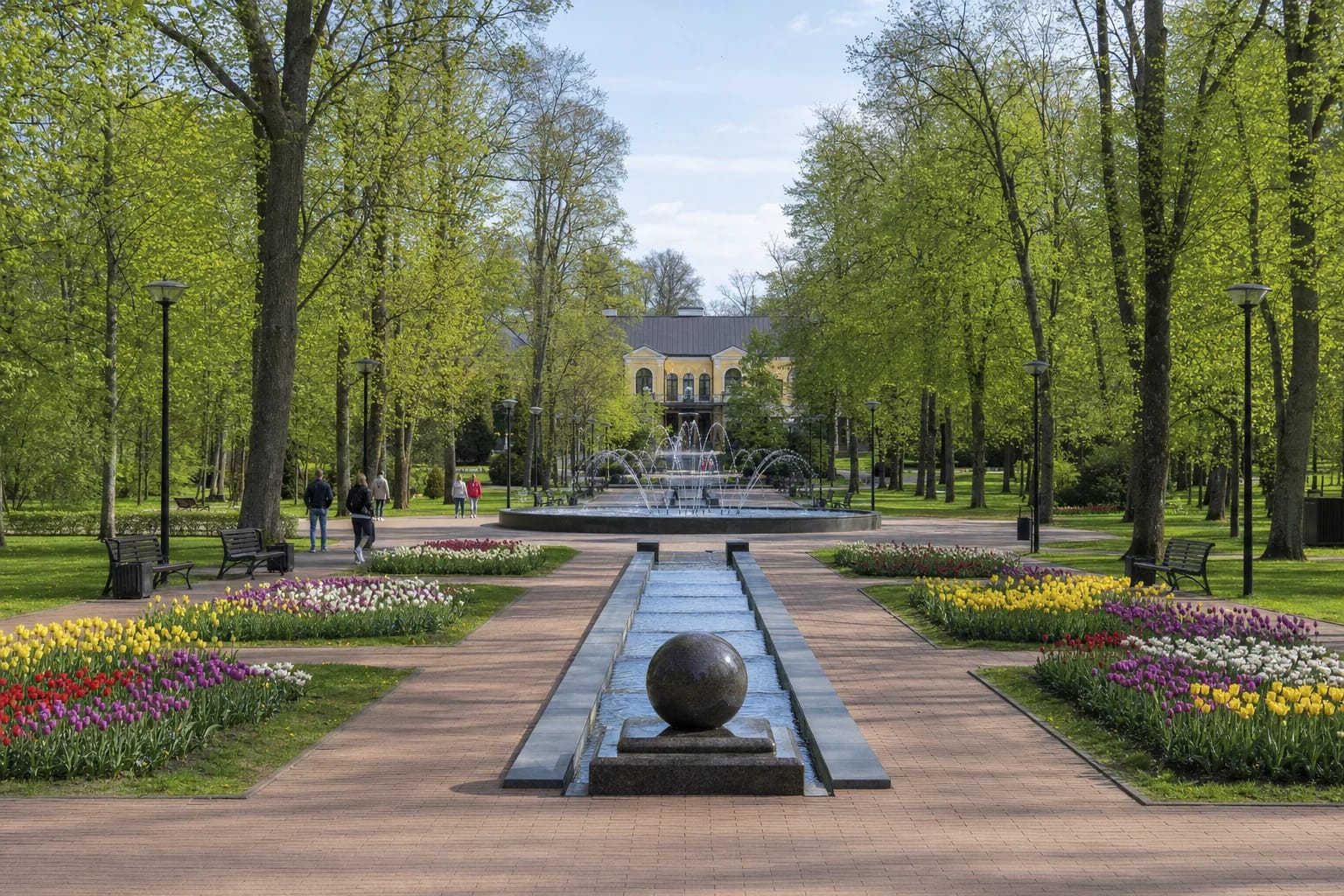
Begin on the central avenue at the Musical Fountain. Its polished granite sphere, long low water channel, and circular main bowl form one composition framed by symmetrical flowerbeds. Do not remain only on that straight line: turn into the shaded, winding side paths as well. Together they reveal the park's double structure, formal display at its centre and looser English-garden movement around the sides.
The central mineral-water pump room is the next important stop. Its windows contain stained glass by Kazys Morkūnas inspired by the tale Eglė the Queen of Serpents. Water intended for drinking is offered there under the rules currently in force. Do not confuse it with Grožio Spring lower down on the Nemunas embankment: the latter is exceptionally saline, and drinking from it is not recommended.
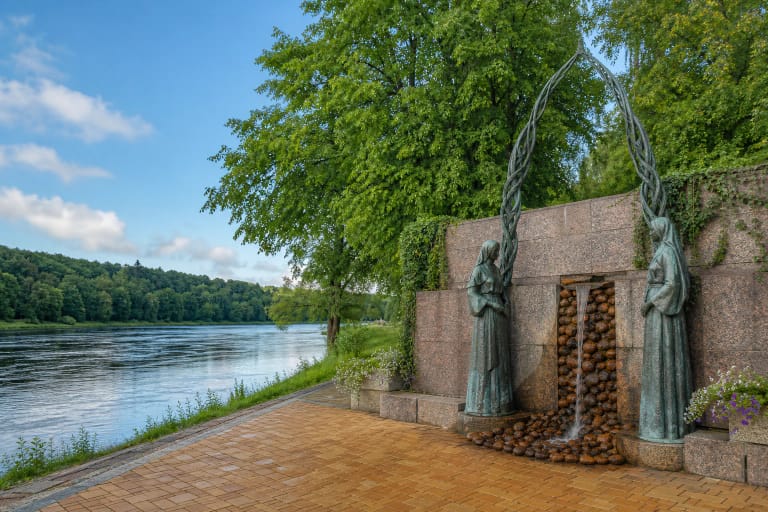
Look for Juozas Kėdainis's 1959 sculpture Poilsis, meaning Rest, and Jonas Stravinskas's 1965 Prie šaltinio, or At the Spring. Official park material also identifies an 1881 river-water level gauge as a historical feature. No separate modern pin or detailed online wayfinding was found for it, so treat it as a small detail to seek on the Nemunas side rather than a conspicuous viewing structure.
The garden grew with the nineteenth-century bathhouses, mineral-water gallery, and Kurhaus
Ignacy Fonberg published his analysis of Druskininkai mineral water in 1835, a plan to establish the resort was approved in 1837, and a state bathhouse opened in 1838. Municipal and VLE sources disagree over the initial number of baths. The reliable visitor-level conclusion is the chronology itself: the park did not appear beside an already completed town but developed with its first permanent resort infrastructure.
Cultural heritage material records that buildings for a bathing complex beside the Nemunas were being designed in 1841, linked by a straight road to the settlement near Lake Druskonis. Physician Jonas Pileckis made an especially important contribution, and his efforts brought a park, mineral-water gallery, and bathing facilities by the middle of the century. The present central avenue therefore preserves more than a pleasing vista: it echoes an early organising axis of the resort.
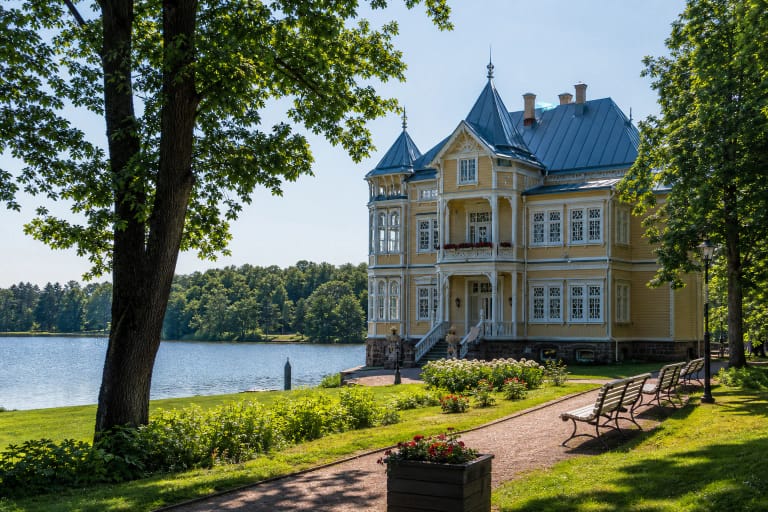
The old garden combined a symmetrical plan with paths laid out in a winding English style. The Kurhaus beside the baths concentrated much of the social life that accompanied treatment, incorporating a bookshop and library, confectionery, and theatre hall. A nineteenth-century guest could move between procedures, music, reading, meetings, and a promenade, so the park served as the social centre of the spa rather than merely a green backdrop.
The interwar park of a thousand roses charged for orchestra concerts and enforced a strict public code
The First World War caused severe damage in Druskininkai, and the City Museum names the Kurhaus among the significant buildings that burned. Recovery was gradual. From 1929 to 1939, Spa Park was once again maintained as a showpiece, while visitors nicknamed its celebrated rose garden the park of a thousand roses.
An orchestra brought from Grodno or Białystok played throughout the summer season. It performed twice each day, in the morning and evening, and accepted specially requested pieces for an extra charge. The practice offers an intriguing parallel with song requests at today's Musical Fountain, although an interwar live orchestra and a modern programmed water display are not one continuous institution.
Admission to the park was charged during the orchestra programme. The museum's account says that drunk or poorly dressed people and visitors with dogs were refused entry. This presents the garden as a regulated stage for resort society, where music, clothing, behaviour, and meticulously maintained flowers all contributed to a deliberately cultivated atmosphere.
Soviet pump-room buildings and sculpture were followed by the 2011-2012 renewal and another layer of planting
The Soviet period brought a central mineral-water pump room and other buildings intended for drinking water. The current pavilion is distinguished by Kazys Morkūnas's stained glass based on Eglė the Queen of Serpents, while mid-twentieth-century sculpture shows how modern Lithuanian art entered the historic spa garden. These works are a distinct later layer, not reconstructions of a nineteenth-century appearance.
The municipal green-space plan associates the recent reconstruction with new walking and cycling paths, benches, lighting, lawns, planting, flowerbeds, a completely redesigned setting for Grožio Spring, and reinforced slopes on the Nemunas embankment. It records an investment of 6.2 million litas. Town sources date the works to 2011 and the public opening of the renewed Old Spa Park and Musical Fountain to 2012, two stages in completing and presenting the same project.
The 2012 inventory counted 102 species and forms of trees and shrubs, 78 of them introduced. It described a grey poplar with a trunk diameter of 138 cm as the largest tree. These figures should not be treated as an unchanged present-day list, but they explain why the park rewards more than an evening fountain stop: mature trees and varied planting are central to its historic spatial character.
The park has no separate ticket timetable, but each attraction within it follows its own operating pattern
No separate Spa Park ticket, gate, or weekly opening schedule was found in the official sources checked. It is a public outdoor space, but that does not mean every service within it operates around the clock. The Musical Fountain has a warm-season programme, the pump room keeps its own opening arrangements, and cruises, cafes, and seasonal events publish separate hours and prices. Recheck the relevant operator before travelling.
The main central area is paved and relatively level, but the park descends towards the Nemunas. No official accessibility audit covering the complete circuit was found. Wheelchair and pushchair users should favour the wider paths and allow for a longer sloping approach to Grožio Spring. Wet leaves, winter ice, and damp paving by the water can alter conditions even where the surface is otherwise well maintained.
Hundreds of tulips define the central axis in early May, the fountain becomes the main evening draw in the warm season, and a Christmas-tree park is installed before the end of the year. These are seasonal rather than permanent states, so check the programme for your dates. Allow 45-90 minutes for an unhurried circuit, share the paths carefully with bicycles and scooters, and do not climb onto the wet stones at Grožio Spring.