- Place
- Druskininkai Municipality
- Region
- Dzūkija
- Type
- a captured highly saline mineral spring and artistic outlet on the Nemunas embankment
- Address
- Nemunas embankment beside the Spa Park, Druskininkai
- Coordinates
- 54.02287, 23.97694
- Visit duration
- 15-30 minutes; about 45-75 minutes together with the Spa Park and nearby pump room
- Best time
- daylight from spring to autumn, when wet paving and the riverfront are easier to assess; the outlet is also interesting in winter, but surfaces beside the water may be icy
Sūrutis, Druskininkai Mineral Spring, Druskininkai Beauty Spring
The real outlet is on the Nemunas embankment, not at the centre of Google's pin
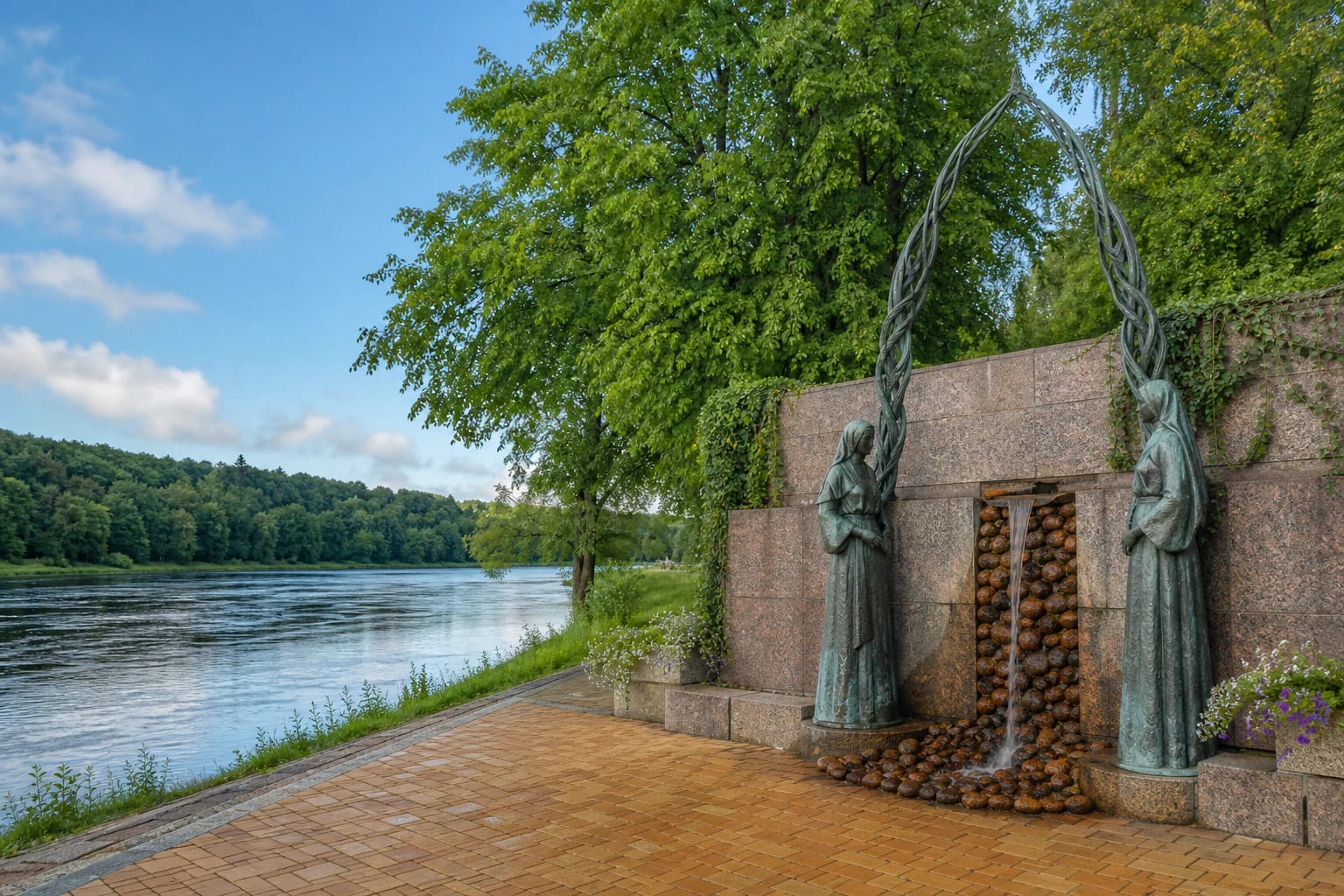
Grožio Spring is set into a low wall on the Nemunas embankment beside the Spa Park. The Lithuanian Geological Survey places it about 20 m from the river, while the published object point is 54.022874, 23.976937. A cascade lined with rounded stones opens from a grey wall beside a broad brick-paved space, with the Nemunas immediately to the west.
On 15 July 2026, the exact Google Maps listing Grožio šaltinis, place ID ChIJ2VWSComb4EYR575evpCxFHo, marked 54.0210451, 23.9779938. That point is roughly 215 m south-east of the visible sculptural outlet. The listing establishes the 4.7 rating but is unreliable for the final approach. Walk towards the Nemunas and look for the arch formed by the two bronze figures on the embankment itself.
This is not the drinking-water pump room in the middle of the Spa Park. That pavilion is a separate place where mineral water intended for drinking is offered according to the rules in force. The highly saline Grožio outlet is lower down beside the river, and drinking its water is not recommended.
The 2015 geological study records brine, iron, and a slow continuous flow
A 2015 description by Z. Zanevskij and K. Kadūnas of the Lithuanian Geological Survey classifies Grožio as an ascending tectonic-fissure spring. It gives a continuous regime, low discharge of 0.1 l/s, and a water temperature of 9.8 C. Slight bubbling from escaping gas and iron-rich deposits were observed at the outlet, so the colour and smell around the stones are not merely features of a decorative cascade.
The sample contained 43,259 mg/l, or 43.259 g/l, of dissolved mineral matter. It was classified as sodium-calcium-magnesium chloride water: chloride measured 23,026 mg/l, sodium 12,570 mg/l, calcium 3,567.41 mg/l, sulphate 2,626 mg/l, and magnesium 1,093.49 mg/l. Total iron reached 17.5 mg/l, while pH was 6.54.
Those exact figures belong to one dated geological account, not a daily test at the outlet. Resort information often connects Grožio with a borehole around or beyond 300 m deep and quotes salinity values of 50-56 g/l. Because dates, samples, and descriptive purposes differ, a reliable visitor guide should state who measured what and when instead of promising one eternal salinity value.
An arch of river spirits turns the captured spring into a recognisable Druskininkai artwork
Water descends across a cascade of rounded fieldstones between two vertical granite planes. A pair of elongated bronze women stand on either side, leaning towards one another. Their hair joins high overhead in an openwork arch, so the composition can resemble both a gateway and two guardians of the water. Green bronze patina contrasts with the pink-grey wall and wet brown stones.
This is Laumės, a roughly 240 cm high bronze sculpture created by Klaudijus Pūdymas in 2011. Official resort descriptions sometimes shorten the artist's name to K. Pūdymas, which makes it easy to misidentify him. The artistic frame belongs to the twenty-first-century redesign of the park rather than being an archaeological reconstruction of an ancient spring.
Step back into the embankment space to read the whole composition: the arch, cascade, wall, climbing plants, and Nemunas then share one view. Do not climb the wet stones or lean on the sculpture. Paving directly beside the outlet can be more slippery than the dry part of the forecourt.
The resort grew from mineral springs, but today's fountain is not an eighteenth-century structure
VLE states that the therapeutic qualities of Druskininkai's mineral springs were noticed in the eighteenth century. The Vilnius pharmacist Rumel and university chemist Ignacy Fonberg studied the water in the first half of the nineteenth century and recognised its value. A plan to establish the resort was approved in 1837, and a state bathing establishment with twelve baths opened in 1838. Water became the foundation of the town's economy, medicine, and identity.
That history explains why a small riverfront feature is more than an ordinary fountain. Yet the tradition of the early springs should not be transferred automatically to the present wall, pipes, or sculpture. The visible Laumės composition dates from 2011, while the resort's methods for capturing and distributing mineral water have changed repeatedly.
For Druskininkai boreholes as a group, VLE mentions sodium, calcium, chloride, sulphates, and trace elements and gives a mineralisation range of 3.8-53.4 g/l. This demonstrates why different boreholes and pump rooms cannot be treated as one identical water. Grožio is an exceptionally saline stop, not a universal sample of every Druskininkai mineral water.
The duchess's tears are a recorded legend, not the geological origin of the spring
The Lithuanian Geological Survey account records a local story about the ruler of Liškiava Castle. After a successful hunt, a shot falcon supposedly fell into the Nemunas and the duke dived after it. Believing that her husband had drowned, the duchess ran along the bank in tears until he emerged alive with the bird in his hands.
The story says that saline springs rose wherever the duchess's salty tears struck the ground. It is an evocative explanation for the taste of the water and the resort's beginning, but not a documented historical event. Geology describes a tectonic-fissure spring with a measurable chemical composition; legend records the way people gave that water meaning.
The bronze river spirits are not portraits of the duchess. They connect water symbolically with a broader Lithuanian narrative world. When viewing the place, distinguish three layers: the real mineral-water outlet, the 2011 work of art, and an undated legend presented as much older oral tradition.
Do not use the water as self-prescribed treatment, and visit when the embankment is safe
The Lithuanian Geological Survey explicitly says that drinking Grožio's highly saline water is not recommended. Visitors traditionally wash their hands or face with it, while local narratives attribute rejuvenating effects to the water. Treat those claims as resort custom rather than a medical guarantee. Do not swallow the water, protect your eyes, and seek medical advice rather than a travel description for any skin condition or other health concern.
The authoritative sources checked list neither a separate ticket nor lockable-gate hours for the riverfront outlet. The Google listing also displayed no reliable weekly schedule. It is an outdoor feature, but flow, maintenance, and access can change temporarily. Check Druskininkai Municipality updates and all local notices before making a special journey.
The immediate forecourt is broad and paved, but the authoritative sources checked do not confirm one continuous step-free route from every direction in town. From the upper Spa Park, visitors may need to choose between steps and a longer path. Daylight makes it easier to find a suitable descent, see damp bricks, and assess conditions beside the Nemunas.