- Place
- Mosėdis, Skuodas District Municipality
- Region
- Skuodas District
- Type
- memorial doctor's homestead and stone garden
- Address
- 28 Akmenų Street, Mosėdis, Skuodas District
- Coordinates
- 56.16891, 21.57333
- Visit duration
- 1-2 hours; allow longer if you also visit the stone museum
- Best time
- May-September, when the stone compositions and planting are at their most legible
Vaclovas Intas Homestead, Intas Homestead
What the Dr Vaclovas Intas Homestead is
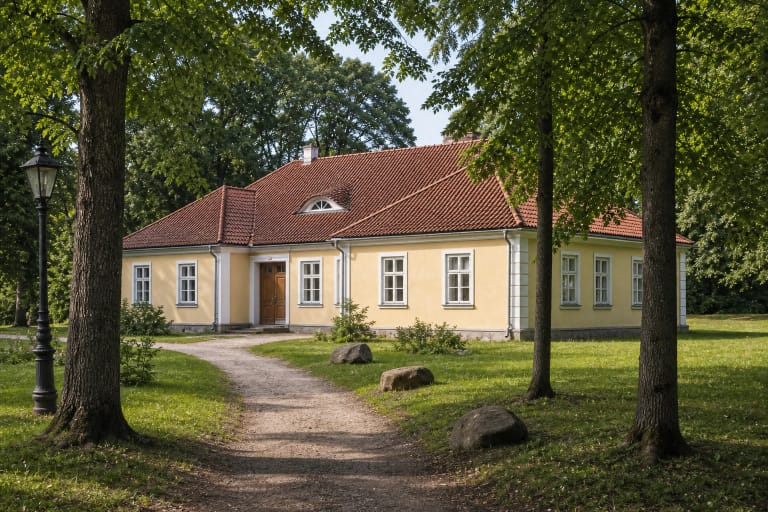
Dr Vaclovas Intas Homestead is on Akmenų Street in Mosėdis, in present-day Skuodas District Municipality. It is a memorial place where the doctor's home, his stone garden, and the quiet scale of a small town meet. The setting feels different from a large museum exhibition, so a visit rewards slow observation of the building among boulders and planting.
Doctor Vaclovas Intas lived and worked in Mosėdis from 1957 to 2007. The homestead preserves the traces of long work with stones, plants, water, and local relief, and is a distinct stop that combines easily with the neighbouring Mosėdis Stone Museum.
Vaclovas Intas and the beginning of the landscape
Vaclovas Intas arrived in Mosėdis in 1957 to lead the new hospital. The municipal account says that, while visiting a patient, he found a stone weighing about 50 kilograms and brought it back by bicycle. The episode became a symbolic beginning for the work that grew into collecting, marking, and arranging stones.
Stones for the homestead and the wider park landscape came from around Mosėdis, Lithuanian fields, and farther away. The garden includes stones from Ukraine, Kazakhstan, and Karelia, but the place is not defined only by unusual provenance. Intas's effort to turn ordinary boulders into a considered garden is just as important to what visitors see.
Stone compositions, ponds, and planting
The homestead landscape contains compositions with different characters. The description names Castle Towers, Pagan Temple, Volcano Crater, Mountains, and Piggy Bank. These names are more than decorative labels: they show how Intas used stones, relief, and plants to make a landscape that visitors can read as a sequence of ideas.
Water and movement also shape the setting. The site has two ponds, while stone steps lead in the direction of Alka Hill. Local and ornamental trees and shrubs alter the view with the seasons. Look for differences in stone size, surface, position, and relationship with grass and trees rather than searching only for the largest boulder.
Heritage protection and the museum connection
The Cultural Heritage Register document records the complex on 27 August 2009 under unique code 32860. It separately identifies the residential house, code 32866, and the stone park, code 32867. This legal distinction explains why the homestead should not be treated as simply another name for the whole Mosėdis museum.
The neighbouring Vaclovas Intas Stone Museum grew from the same creative environment, but its exhibitions and visitor story cover a wider area. At the homestead, focus first on the relationship between memorial house and garden; at the museum, continue with the larger stone collection in the Bartuva valley. The two nearby places complement rather than replace one another.
Before visiting the Mosėdis homestead
The address is 28 Akmenų Street, Mosėdis, and the mapped point marks the homestead itself rather than a general town centre. Before travelling, check how access to the memorial grounds is organised at the time of your visit, since museum hours and access to the separate homestead may be communicated differently.
Allow 1-2 hours for a first visit, wear practical shoes, and do not touch or rearrange the stone compositions. Check access to the homestead and museum hours before travelling.