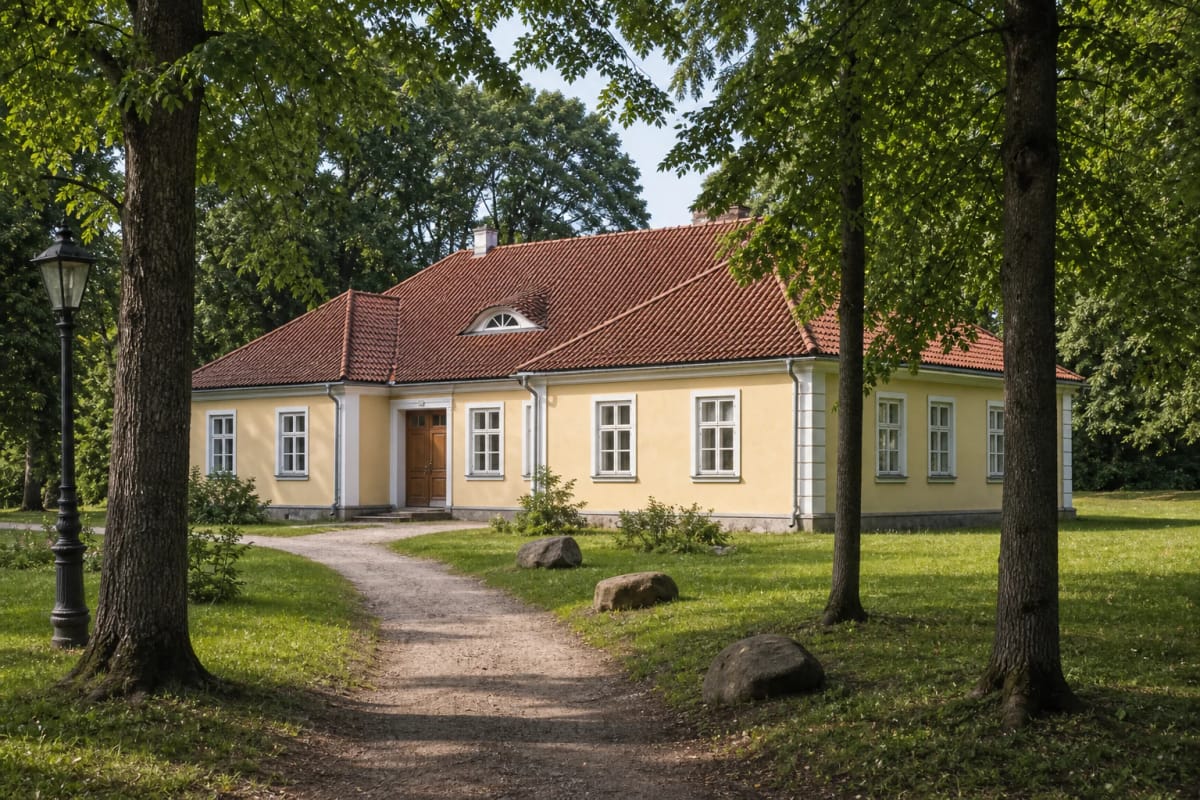
- Place
- Skuodas District Municipality
- Region
- Samogitia
- Type
- regional museum in the historic Skuodas manor site
- Address
- Šaulių g. 3, Skuodas
- Coordinates
- 56.26911, 21.52156
Skuodas Regional Museum
Skuodas Museum: gateway to the Skuodas region
Skuodas Museum is a good starting point for a trip through north-western Samogitia. Skuodas District includes Apuolė, Mosėdis, Šaukliai, and many smaller places, but the museum helps first assemble the context: who lived here, what finds survive, and how the town formed by the Bartuva River and the Latvian border.
Skuodas was first mentioned in 1253 in the document dividing Courland lands, and in 1259 at the Battle of Skuodas the Samogitians defeated the Livonian Order army. The museum helps visitors see this dense historical layer through objects: a hillfort or town square alone often cannot explain why this borderland region is so old and significant.
Museum beginnings and historic manor site
Skuodas Museum was established on 30 December 1991 by decree of the Skuodas District board, and opened to its first visitors in August 1992, when the 420th anniversary of Skuodas self-government was marked. The initiators were Juozas Vyšniauskas, Evaldas Razgus, Vytautas Mačiulis, Rymantė Šmaižienė, and other municipal and cultural figures of the time. Evaldas Razgus became the first director, receiving premises but no inherited collection.
The museum was established in a building of the historic Skuodas manor site, connected with Skuodas under the Chodkevičiai from 1568 to 1622 and the Sapiehas from 1622 to 1831. In the same house, the first Skuodas gymnasium operated in 1918; later there were various cultural institutions, the last of them a music school. According to the museum, a historical and musical spirit remains in the building.
More than 20,000 exhibits
The museum collections contain more than 20,000 exhibits, mostly ethnographic, historical, and folk-art material. The first items were donated by private individuals and by Bartuva Secondary School from its former museum, and the collections grow each year through expeditions and local donations. The institution is registered in the Register of Legal Entities under code 190898695.
This scale matters for one reason: the Skuodas region cannot be explained by one object. It includes Curonian history, borderland position, Samogitian culture, crafts, town memory, and twentieth-century experiences, including the painful 1941 tragedy of the Skuodas Jewish community.
Apuolė and Curonian archaeology of the Skuodas region
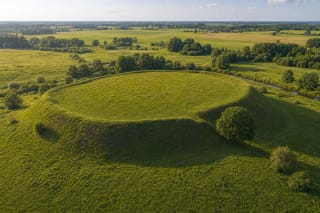
Skuodas Museum is especially important for visitors planning to go to Apuolė Hillfort. The museum has a rich archaeology collection with finds from Apuolė, Klaišiai, Klauseikiai, and other hillforts, burial mounds, and cemeteries, so it helps reveal the density of Curonian history in this region.
Apuolė is often mentioned as one of the most important Curonian places, but the view of the hillfort alone does not always explain the finds and cultural context. The museum fills that gap: before or after the outdoor site, it shows the material side of history through tools, ornaments, and pottery.
Ethnography, folk art, and Samogitian everyday life
Several permanent exhibitions operate in the museum, including Skuodo krašto senieji kaimo amatai ir moterų darbai - Žemaičių troboje and Skuodo krašto tautodailės istorija. This matters because the region's identity does not end in the thirteenth century: Skuodas history continues through everyday objects, holidays, documents, photographs, and local memory.
The collections also include diaspora gifts, for example photographs of Skuodas public life in 1920-1930 by L. Bertašius, donated from Australia by his daughter Dana Binkis, and a woodcut and batik collection by M. B. Stankūnienė from Chicago. Exhibitions change monthly, with participation by teachers and students from Skuodas Art School.
How to visit Skuodas Museum
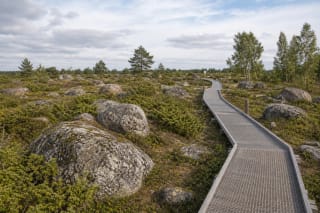
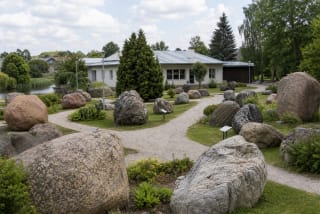
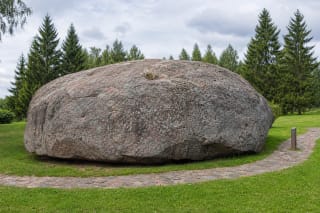
Allow 45-90 minutes. If you are travelling with a specific goal, such as Apuolė or Šaukliai Boulder Field, it is worth visiting the museum before the route, because the exhibition gives outdoor sites more meaning. Usually the museum works on weekdays 8:00-17:00 and on Saturday until 14:00.
Before travelling, check official opening hours, tickets, and education programmes. Skuodas Museum works best not as an isolated stop but as a regional route centre linking Apuolė, Mosėdis, Šaukliai, and Barstyčiai.