- Place
- Skuodas District Municipality
- Region
- Samogitia
- Type
- geology and boulder museum with an outdoor exhibition
- Address
- Mosėdis, Skuodas District
- Coordinates
- 56.16600, 21.57500
Republican Vaclovas Intas Stone Museum, Vaclovas Intas Stone Museum, Stone Museum in Mosėdis
Mosėdis Stone Museum: what kind of museum it is
Mosėdis Stone Museum is officially called the Republican Vaclovas Intas Stone Museum. People still usually call it Mosėdis Stone Museum because the town and stone park are the visitor's main orientation point.
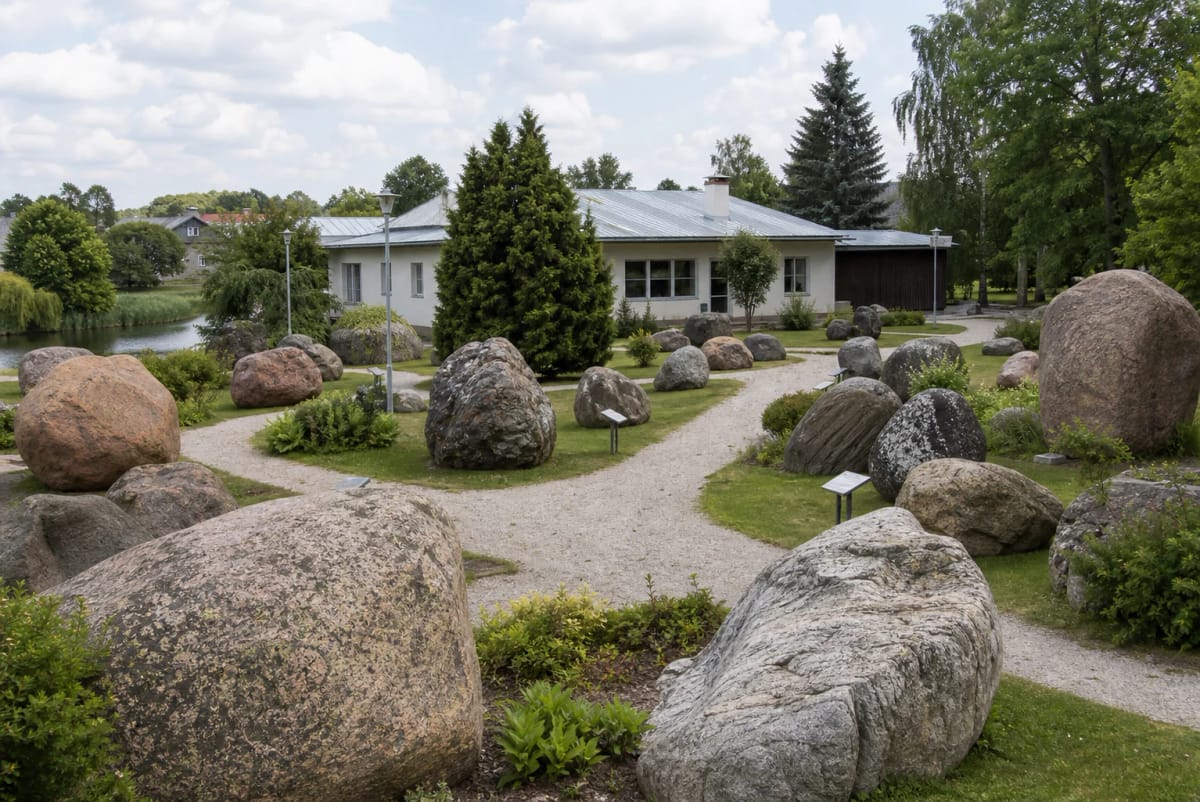
This is not only an indoor mineral display. Much of the museum experience is outside: boulders are arranged in a landscape of park, paths, plantings, and town spaces, so the museum works as a geology garden.
Vaclovas Intas and the museum
The museum's history is inseparable from physician Vaclovas Intas (1925-2007). According to the official museum, from 1957 he began collecting stones from surrounding fields and bringing them to his homestead. In 1972 he began creating a stone park on both sides of the Bartuva River in a scenic 14.5 ha valley, and the museum was officially established in 1979. VLE states that Intas was also the museum's long-time director.
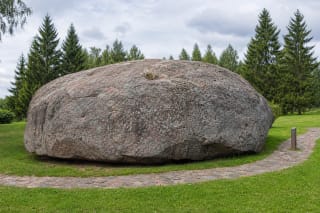
The scale of this personal initiative matters. VLE states that Intas collected about 150,000 stones, from pieces weighing a few grams to the largest boulder, which the official museum gives as 55 tons. The Stone Museum began not as an abstract state project but from a person's long-term work. In 2000 the museum's dendrological collection was declared a state-protected natural object.
What to see outdoors
In the outdoor exhibition, the main values are large boulders, their textures, colours, forms, and arrangement. Some stones look similar from a distance; close up you notice different rocks, crystals, layers, and marks left by the Ice Age.
As you walk, look beyond the largest boulders. Smaller stones, information labels, plantings, and paths help explain that the museum teaches visitors to notice geology in Lithuania's everyday landscape.
Indoor exhibition
The indoor exhibitions complement the outdoor boulder park. They are installed in a more than 230-year-old watermill and display rocks, animal and plant fossils, mineral resources, a sand collection, minerals, and even stones formed in the human body. This is especially useful if you want not only to walk but to understand what you are seeing.
Check official opening hours before travelling, because outdoor and indoor experiences may vary by season, events, or museum rules.
Mosėdis as a stone town
In Mosėdis, stones are not limited to the museum territory. They have become part of the town's identity: parks, homestead surroundings, paths, and public spaces often speak the same language of stone and plants.
For that reason it is worth walking more widely, rather than quickly visiting one exhibition area. Mosėdis is best understood as a stone town where geology has entered everyday landscape.
How to visit
The museum is in Mosėdis, Skuodas District. You will spend much time outdoors, so comfortable footwear and weather matter. After rain paths may be damp, and in summer it is worth having water.
With children the museum works well because the outdoor exhibition is clear and physically engaging. Still, do not allow climbing on protected objects where it is forbidden, and respect the exhibition rules.
What to see nearby
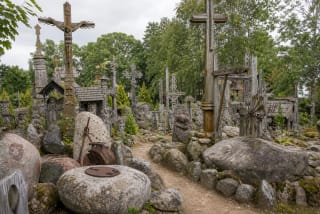
Mosėdis combines very well with Orvidai Homestead and Barstyčiai Stone. Such a route shows three different meanings of stone: geological, artistic-sacred, and the scale of a natural boulder.
If you are travelling through north-western Samogitia, the museum is one of the best sites for adding a natural-science layer, not only history, to the route.