- Place
- Skuodas District Municipality
- Region
- Samogitia
- Type
- historic watermill and the museum's indoor geology exhibition
- Address
- Salantų g. 2, Mosėdis, Skuodas District
- Coordinates
- 56.16512, 21.57423
- Visit duration
- 45-90 minutes for the mill and indoor exhibition; longer for the full stone park
- Best time
- during museum opening hours; visit the building and Bartuva setting in daylight
Mosėdis mill, Mosėdis watermill building
The mill building, not the entire Stone Museum
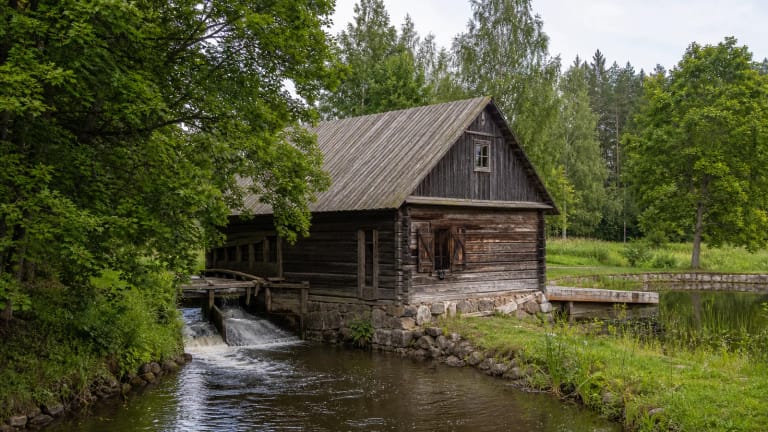
Mosėdis Watermill stands at Salantų g. 2 on the right bank of the Bartuva, beside the dam and bridge. In the Register of Cultural Values it is a separate state-protected property, code 30650; Skuodas District Municipality records its registration date as 18 April 2005.
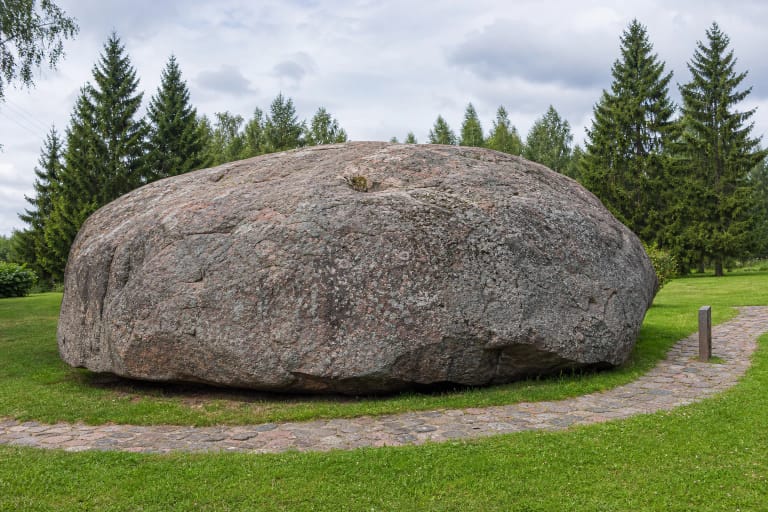
The building now houses the Republican Vaclovas Intas Stone Museum's indoor mineralogical and petrographic exhibition. It should not be confused with the museum as a whole: the large outdoor exhibition extends through the Bartuva valley on both sides of the river, while the mill is its historic indoor space.
A 1792 mill and its last miller
Official heritage and museum sources date the mill to 1792 but do not name its architect or builder. The accessible official descriptions also do not identify the first owners, so the building cannot reliably be attributed to a particular person or family. Its documented industrial purpose was grinding grain.
The last miller, Alfonsas Brasas, worked here from 1951 to 1973. Restoration began in 1975; an earlier heritage description dates the restoration to 1977, while the official museum page gives 1978. The work followed a design by architect Vaidotas Guogis and adapted the building for museum use; the museum in Mosėdis was established in 1979.
Fieldstone walls, tiled roof, and water system
The mill has two storeys, monolithic concrete foundations, fieldstone masonry walls, and a tiled roof; dark timber-clad sections and wooden shutters remain visible outside. Its restrained form is closely tied to the bridge, Bartuva channel, and dam site, so its technical purpose is read from the setting as well as the facade.
Heritage descriptions record a complete set of millstones, an adjustment screw, a vertical shaft with wooden gears and spindle, and a transmission fragment. The water system includes the dam, channel, supports, and retaining wall; the present wooden wheel is restored. This is museum-based industrial heritage, not evidence that the wheel now turns the stones or that every visible element is original.
The indoor exhibition inside the mill
Across three rooms, the museum presents igneous and metamorphic rocks, Lithuania's mineral resources, animal and plant fossils, minerals, and other geological collections. The restored industrial building thus serves as an indoor museum complementing the large outdoor boulder exhibition beyond it.
On 15 July 2026 the official museum website listed daily opening from 09:00 to 19:00 from 1 June. Admission was €4 for an adult and €2 for a school pupil, student, or senior; guided tours are booked separately. Hours and prices can change, so check them again on the official museum website before travelling.
Arrival, surfaces, and the exact map card
The mill is approached along Salantų Street and the bridge. The museum's official FAQ lists parking in the museum grounds, town centre, by the church, and beside the children's playground, as well as a nearby bus stop and bicycle stands. The street-side approach is firm, but the river and wheel side includes grass, uneven stone surfaces, and changes in level. No full accessibility description for the historic building is published, so contact the museum in advance about individual mobility needs.
The Google Maps card checked on 15 July 2026 is named exactly 'Mosėdžio vandens malūnas'. It showed a rating of 4.6/5 and place ID ChIJwy1FQhhB5UYRNJf6_ebhbK4. Its pin at 56.1651233, 21.5742327 marks the mill building itself. A map label presenting the landmark as available around the clock should not be confused with the paid indoor exhibition's opening hours.