- Place
- Ukmergė District Municipality
- Region
- Aukštaitija
- Type
- 55-hectare outdoor memorial park with a Way of the Cross and dozens of remembrance markers from different periods
- Address
- Kadrėnai village, Vidiškiai Eldership, Ukmergė District
- Coordinates
- 55.29477, 24.84282
- Visit duration
- 1-2 hours for the principal crosses and memorials; longer for more of the 55-hectare grounds or a guided visit
- Best time
- a bright, dry half-day; grass slopes and forest paths can be slippery after rain
Mūšios Didžiosios Kovos Partisan District Park, Mūšia Park, Mūšia Monsignor Alfonsas Svarinskas Park, Svarinskas Park, Park of Memory and Peace
One park with several names and no single front door
The current official name is Didžiosios Kovos Partisan District Memorial Park. The same place also appears as Mūšia Park, Mūšios Didžiosios Kovos Partisan Park, Monsignor Alfonsas Svarinskas Park, Svarinskas Park and the Park of Memory and Peace. These are variants for one memorial landscape beside Kadrėnai, not separate attractions.
The municipality and museum describe an area of 55 hectares. That figure conveys the scale of the visitor landscape, not a cadastral boundary reconstructed on this page: wooden crosses and stone monuments are scattered through meadows, slopes and woodland clearings. The larger recreational setting of the Mūšia valley and nearby water should not automatically be treated as part of every memorial zone.
The coordinate 55.294770, 24.842817 marks the principal memorial field inside the park. It is not a verified gate, parking bay or sole trailhead. Use the signed approach from the A6 and Mūšios Street for the final section, and leave a vehicle only where local signs permit.
Alfonsas Svarinskas began the memorial in 1993
The initiator was Monsignor Alfonsas Svarinskas (1925-2014), who was born in Kadrėnai. The LGGRTC biography documents his links with the Didžiosios Kovos partisans, arrest, imprisonment in Soviet camps and later defence of religious rights. The park therefore grew from a personal history of resistance, imprisonment and priestly service rather than from an abstract landscape-design exercise.
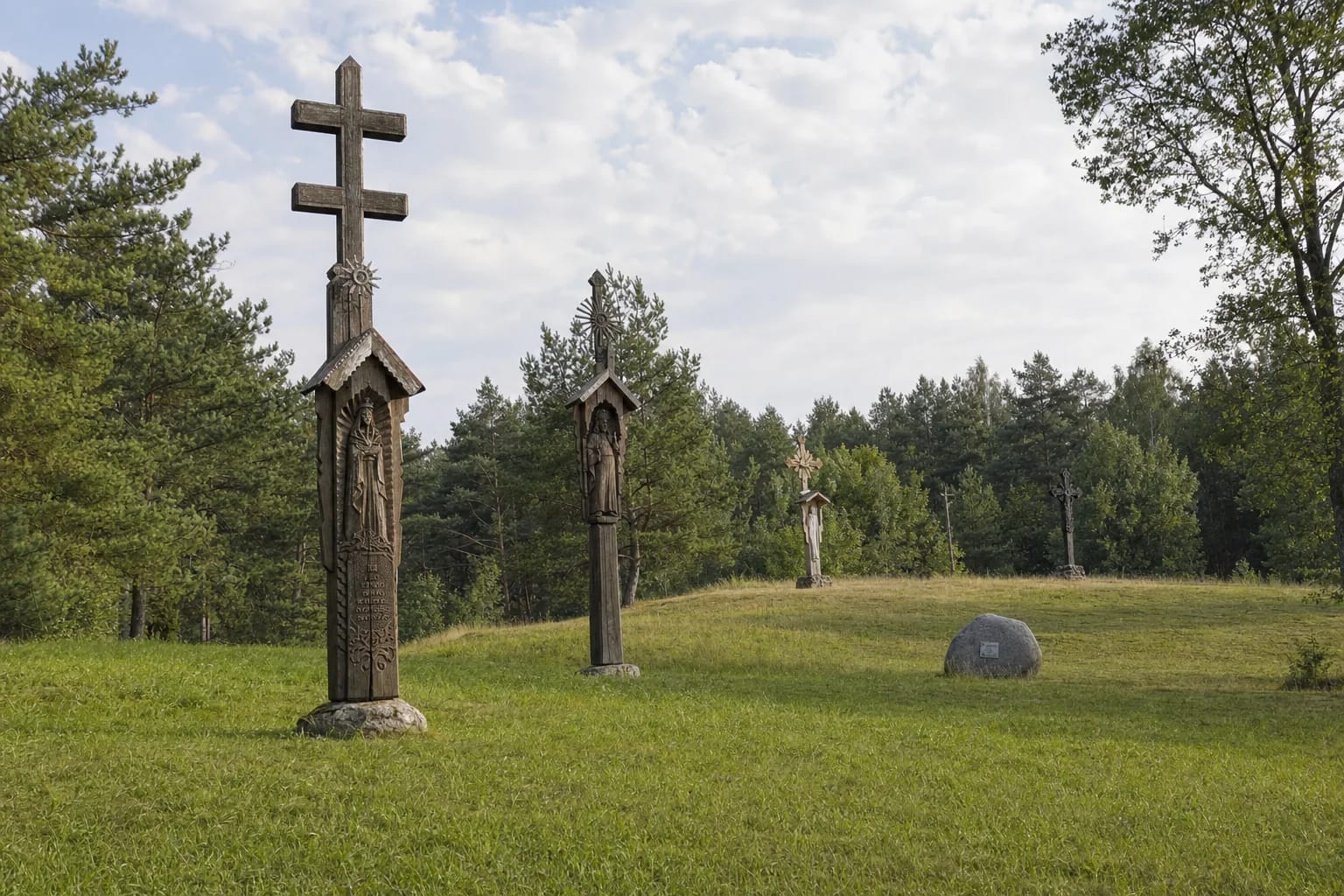
The museum dates the beginning to the first ornamented cross raised on the Kadrėnai cemetery hill in 1993. Between 1993 and 2003, fourteen oak crosses formed a Way of the Cross dedicated to battalions and commanders of the Didžiosios Kovos partisan district. Folk artist Algirdas Jurkėnas made the first cross, while the museum attributes the others to cross-maker Pranas Kaziūnas.
The chronology defines what the site is. Work began almost half a century after the post-war partisan conflict and after Lithuania had restored independence. This is a deliberately created landscape of remembrance, not a surviving headquarters, bunker or documented battlefield covering the entire 55-hectare area.
Fourteen crosses form a route rather than one monument
Tall ornamented oak crosses provide the structural core of the ensemble. They are best read in sequence: individual stations connect the district's organisation, battalions and commanders, while the Christian Way of the Cross supplies the larger form through which their sacrifice is remembered.
The fourteen are not identical objects in a single row. Carving, proportions, inscriptions and surroundings vary, and pine-covered slopes and grass clearings open between them. Current official photographs show some stations standing well apart, so the whole design cannot be understood from a roadside glance.
The museum's present inventory numbers markers through 40 and assigns the letter M to the ministers' memorial. That indexing helps visitors navigate; it does not mean the park holds forty interchangeable monuments. The list mixes crosses, roofed wooden posts, stone compositions and memorials addressed to different groups.
Later markers widened the story beyond one partisan district
Stone monuments began to appear in the north-western part of the park from 2004. The official inventory includes General Povilas Plechavičius, freedom fighters from Kadrėnai and Katlioriai, teachers from Taujėnai, mothers of partisans, people who never returned from Siberia and signatories of the Lithuanian Freedom Fighters' 1949 declaration. Their different dates make this an accumulated memorial landscape rather than a single-period commission.
Separate crosses honour Pope John Paul II, United States President Ronald Reagan and Lithuanian General Jonas Juodišius. A clergy remembrance area includes Alfonsas Svarinskas, Bronislovas Laurinavičius, Juozas Zdebskis, Alfonsas Lipniūnas, Mečislovas Reinys and other church figures persecuted under Soviet rule.
A memorial to government ministers of the First Lithuanian Republic murdered by occupying regimes was unveiled in 2018. Official notices from different years disagree on the number commemorated, so the dedication is more reliable than repeating one count. The monument makes explicit that today's park reaches beyond one partisan district into the broader history of lost statehood, repression and resistance.
A memorial landscape interpreted by a museum
Ukmergė Local History Museum places the park among its branches, maintains the marker inventory and, since 2026, has taken reservations for a guided excursion. The municipality nevertheless calls it an open space. The checked sources do not establish a conventional museum building, ticket desk or exhibition hall at Kadrėnai to which the central museum's general opening hours could simply be applied.
The museum's official historical overview explicitly states that the park monuments are not included in Lithuania's Cultural Heritage Register. That does not diminish their commemorative value, but the ensemble should not be advertised as a registered KVR complex. Municipal infrastructure work, museum interpretation and maintenance of individual markers also do not establish that one institution owns every monument or all the land.
A careful visit separates historical evidence from a later act of commemoration. An inscription records whom its makers wished to honour, but the monument itself is not proof that the event occurred at that exact point. Use the museum inventory, LGGRTC documentation and other historical studies to explore the people and organisations behind the names.
Approach and visit without invented guarantees
In 2025, Ukmergė District Municipality reported that the road section leading from the A6 towards the Kadrėnai park had been comprehensively repaired, surfaced and signed. This confirms the main approach, not a particular parking location or capacity. Let the map pin bring you to the site, then follow signs on the final section.
As of 19 July 2026, no separate permanent park hours, general admission rule or authoritative inventory of toilets, drinking water, lighting and visitor facilities across the grounds was published. The municipality describes an open outdoor space, while the museum's guided excursion must be booked in advance. Check the museum for the current schedule and terms before making a special journey.
Official photographs show grass slopes, woodland floor and uneven paths. No public audit of gradients, surfaces or wheelchair access across all 55 hectares was found. Allow 1-2 hours for the principal memorials on a dry day, wear footwear suited to broken ground, and do not climb monuments or move stones and wooden markers.