- Place
- Vilnius City Municipality
- Region
- Vilnius
- Type
- national drama theatre and modernist architectural ensemble
- Address
- 4 Gedimino Avenue, Vilnius
- Coordinates
- 54.68619, 25.28399
- Visit duration
- 2-3 hours for a performance; 10-20 minutes for the facade and the Three Muses
- Best time
- according to the official repertoire; see the facade and Muses in daylight or after dark when the entrance is illuminated
LNDT, National Drama Theatre, Theatre beneath the Three Muses
From the 1940 production of "Hope" to a national theatre
The institution dates its beginning to 6 October 1940, when Herman Heijermans's play "Hope" was presented at what was then the Vilnius State Theatre on J. Basanavičiaus Street. It was the first performance by a newly assembled professional Lithuanian drama company in Vilnius. The theatre's name changed through the war and post-war years: it was the Vilnius State Drama Theatre from 1944 to 1947, became the Lithuanian State Drama Theatre in 1947, and later carried the title of an academic theatre.
The institution received its present name and the status of a national cultural organisation on 3 August 1998. Successive generations of directors, actors, playwrights, and stage designers have worked here, making the venue more than an auditorium for individual performances. Its repertoire provides a way to follow Lithuanian drama from the mid-twentieth century to contemporary theatre.
The Gediminas Avenue site and the Nasvytis reconstruction
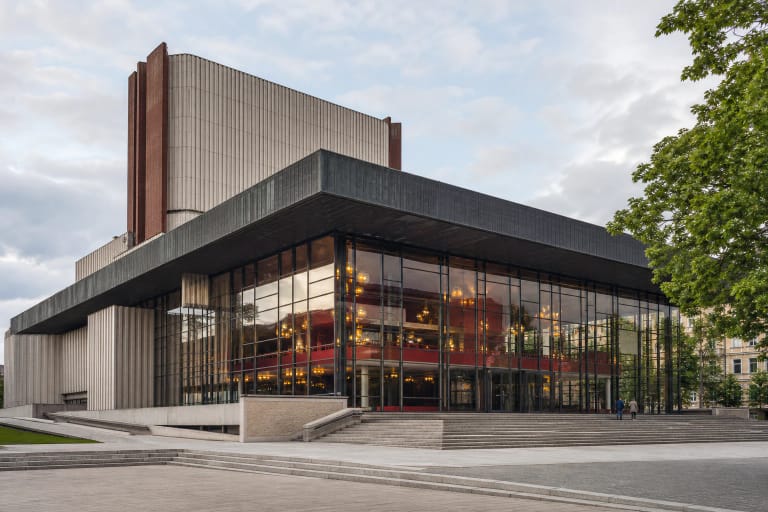
The company moved to 4 Gedimino Avenue in 1951. The site already had links with performing arts: the hall of the Polish cultural society "Lutnia" operated here in the early twentieth century. The entrance and public spaces seen today, however, were largely formed during the reconstruction designed by architects Algimantas and Vytautas Nasvytis between 1972 and 1981.
The architects rotated the theatre stage by 180 degrees and opened a new main entrance towards Gediminas Avenue. Glass doors and a foyer beneath a dark sculptural canopy connected the theatre with the pedestrian life of the avenue. This is not a freestanding monumental theatre palace: its defining feature is a modernist entrance composition inserted into the historic street frontage.
The Three Muses: drama, comedy, and tragedy
The sculptural group above the entrance is formally titled "Festival of the Muses", although most Vilnius residents call it the Three Muses. Created by Stanislovas Kuzma in 1981, its elongated figures are recognisable by their dark metal surfaces and luminous gilded faces. They are identified as Calliope, Thalia, and Melpomene, interpreted here as drama, comedy, and tragedy.
The sculptures are not incidental facade decoration. Their vertical silhouettes complete the low entrance canopy and mark the theatre from a distance along the dense avenue frontage. Inside, the ensemble created by the Nasvytis brothers and collaborating artists includes Kuzma's sculpture "Spring". Together, these works explain why LNDT rewards attention even on a day without a performance.
The 2018-2023 renewal and three auditoria
A major new reconstruction began in 2018. It went well beyond cosmetic refurbishment: stage and engineering systems were renewed, visitor areas were reorganised, a New Hall was created, and the Small Hall was redesigned. The Great Hall reopened to audiences after partial reconstruction on 1 December 2023.
LNDT can now present its repertoire in three spaces of different scales: the Great, New, and Small halls. Check the auditorium shown on your ticket before arrival because entrance routes, seating plans, and the character of a production differ. The foyers and public zones became more open after the reconstruction, but access still depends on theatre hours and scheduled events.
Planning a visit
LNDT is not a theatre museum with unrestricted daily admission. The most reliable way to experience its interior is to choose a production in the official repertoire and buy a ticket. Prices vary with the production, date, and seat, so there is no single general-admission price. Electronic tickets are available through the theatre website, its official ticketing partner, or the box office.
On 25 July 2026, the official page listed summer box-office hours from 1 July to 31 August as Tuesday-Friday 12:00-18:00, with a break from 14:00 to 15:00; on Mondays and weekends it opened one hour before an event when one was scheduled. Hours and prices can change, so check the official website before travelling. Following the reconstruction, all public spaces are accessible to visitors with limited mobility, but wheelchair seating and any assistance are best arranged in advance.
What you can see without a performance ticket
The Three Muses, the dark sculptural canopy, and the glazed entrance can be viewed from Gediminas Avenue at any time. Daylight reveals the materials and proportions more clearly, while evening lighting emphasises the Muses' gilded faces. Ten to twenty minutes is sufficient for the exterior, but crossing to the opposite pavement gives a much better view of the composition as a whole.
Do not assume that the foyer, auditoria, or the sculpture "Spring" will be accessible simply by walking in from the street. Entry depends on box-office hours, events, and the access arrangements in force that day. The Google Maps place named "Lietuvos nacionalinis dramos teatras" marks the theatre at 4 Gedimino Avenue; the coordinates are a site point for the building, not a surveyed centre point of a particular doorway.