- Place
- Barstyčiai Eldership, Skuodas District Municipality
- Region
- Samogitia
- Type
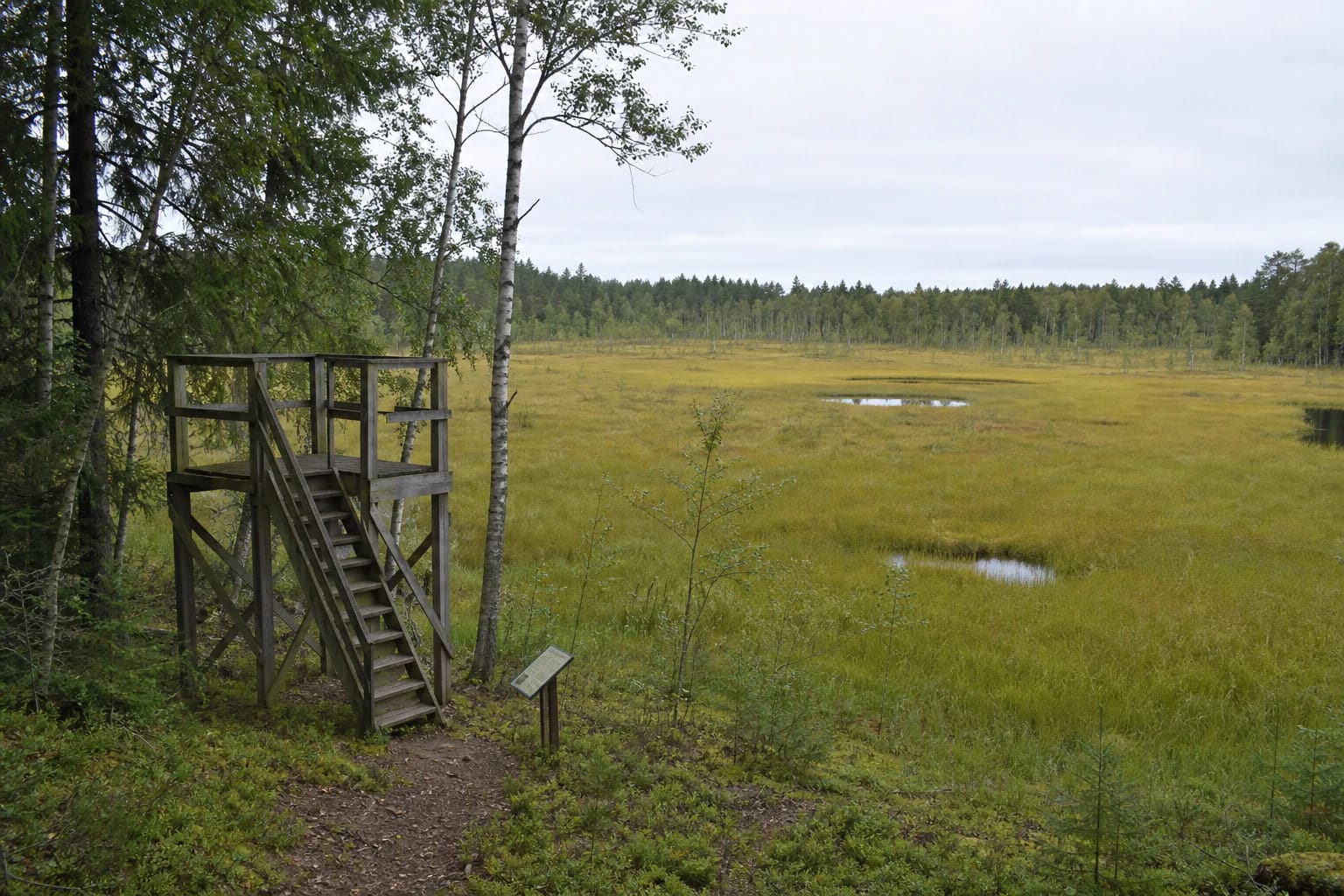
- low wooden viewing platform at a wetland edge
- Address
- Barstytaliai village, Barstyčiai Eldership, Skuodas District Municipality
- Coordinates
- 56.14853, 21.86262
- Visit duration
- 20-40 minutes
- Best time
- in dry weather from spring to autumn, especially morning or evening for birdwatching
Barstytaliai viewing platform
A low platform designed for one landscape
At about 5 m high, Barstytaliai should not be compared with Lithuania's tall metal observation towers. It rises just far enough above the nearest shrubs and young trees: the main subject is the level wetland surface, not towns or lakes many kilometres away.
The wooden deck is compact and reached by stairs. Rather than taking one photograph and leaving, read the view in layers: water and sedges in front, drier islands within the wetland, and the wall of Barstyčiai Forest on the horizon. Climb calmly and follow any access or load limits posted on site.
A mosaic of water, fen, and drier islands
The park directorate calls Barstytaliai one of Žemaitija National Park's largest wetlands and gives an area of about 35 ha. Water, wetland vegetation, and intervening drier islands form a varied fen complex; the platform lets visitors understand that pattern without trampling it.
Barstyčiai Forest encloses the wetland, making the boundary between open wet ground and wooded edge particularly clear. The 35 ha figure describes the protected natural complex, not an area open to walking.
A zoological reserve with no guaranteed sightings
Barstytaliai wetland lies within a zoological reserve. Its stated conservation aims include a black-headed gull colony, habitat for spotted crakes and ruffs, and protection of the fen complex itself. That explains why this is an edge lookout rather than the start of a route across the wetland.
A species named in a conservation document is not a promise of a sighting. Spring and early summer bring greener, busier scenery, while tawny grasses become more prominent in autumn. Morning or evening generally offers quieter listening and less visitor noise; binoculars are more useful here than trying to move closer.
A short approach, not a nature trail
The tower is not easy to see from the approach. A roughly 100 m trodden forest path leads from the visitor sign; an information board and swings stand by the platform. The coordinates mark the tower itself, not a guaranteed parking bay.
After rain the path may be soft and slippery, so wear closed shoes with grip. Although short, the forest surface and tower stairs are not equivalent to a level urban promenade; judge pushchair or mobility-device access by actual conditions. Park only where signs allow and never block the local road.
Watching from the edge is part of protection
Twenty to forty minutes is normally enough. This is a lookout, not a boardwalk across the wetland: do not descend into the wet habitat or create informal tracks.
Sound carries across open wetland. Keep voices low, do not allow dogs to chase wildlife, never feed birds, and take litter away. Use a longer lens from the platform; searching vegetation for nests, chicks, or alarmed birds would defeat the purpose of the lookout.