- Place
- Skuodas District Municipality
- Region
- Skuodas District
- Type
- Lithuania's largest boulder and a geological natural monument
- Address
- Puokė village 98225, Barstyčiai Eldership, Skuodas District Municipality
- Coordinates
- 56.19111, 21.90616
Puokė Stone, Barstyčiai Giant, Great Stone
Barstyčiai Stone: Lithuania's largest boulder
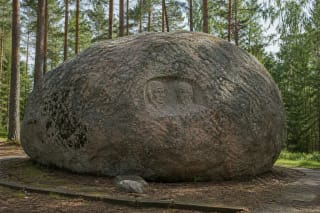
Barstyčiai Stone is also often called Puokė Stone because it stands in Puokė village, near Barstyčiai. VLE presents it as the largest boulder in Lithuania, and the Skuodas tourism context treats it as one of the clearest natural-history stops in the region.
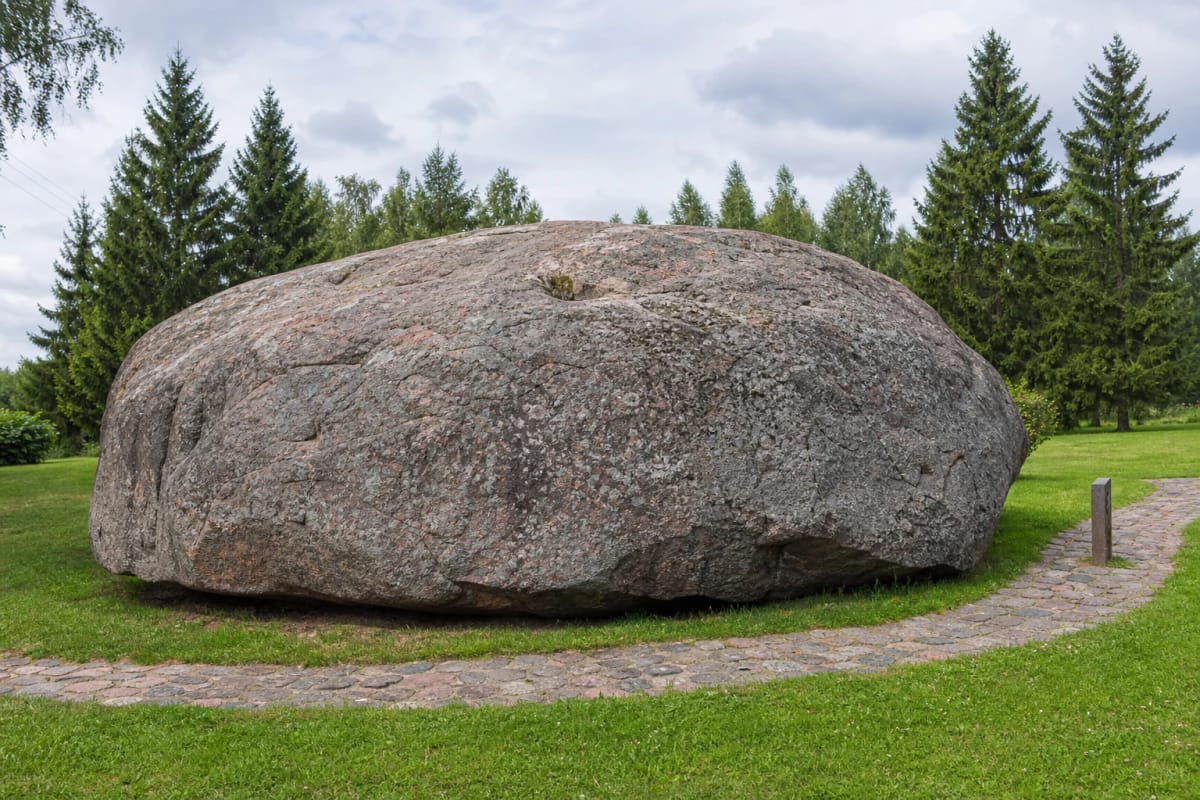
This is not a hill or a sculpture that needs an entrance. The main experience is scale: a low but very broad granite body that shows the force of glaciers and explains how one stone can become a regional landmark.
Dimensions, mass, and rock type
VLE gives Barstyčiai Stone as 13.35 m long, 7.53 m wide, 3.6 m visible height, and about 32 m in circumference. Its mass is estimated at about 680 tons. These numbers explain why even the famous Puntukas is second by size.
The stone is reddish-brown microcline granite with prominent microcline crystals and pegmatite veins; VLE also notes dark biotite plagiogranite-gneiss inclusions at the southern end. This petrographic detail matters because the boulder is not local Samogitian bedrock but a fragment of ancient crystalline rock brought from the north. VLE also notes that the upper part of the boulder's southern end is chipped.
The Ice Age journey of Barstyčiai Stone
The last continental glacier dragged Barstyčiai Stone to its present place. VLE specifies that the boulder came from the Fennoscandian rock massif, so its material is northern in origin. Such boulders are direct witnesses of the Ice Age landscape: ice masses broke them from hard bedrock, carried them, and left them as the ice melted.
That makes the stop more than a photograph. It helps explain that Lithuania's surface is not only a story of rivers, forests, and hillforts. Much of it was shaped by ice, meltwater, deposits, and imported rock.
Discovery in 1958
Barstyčiai Stone became widely known in 1958, when land-reclamation workers uncovered it. Until then, much of the boulder lay underground, so its true scale became clear only during excavation.
Before it was uncovered, the boulder was almost entirely covered with moraine loam, and its real size remained hidden for a long time. After discovery it became an important natural-heritage object. VLE links it with geological natural-monument status from 1968 and states that geologist A. Linčius first described it scientifically in 1989; today it is presented as a geological natural-heritage object and natural monument.
Puokė Stone legend
Like many large Lithuanian boulders, Barstyčiai Stone has a narrative layer. Local tradition tells a legend about a sanctuary, a priestess, and a blow from Perkūnas. Such stories do not explain the stone's origin geologically, but they show how an unusual natural object became a place of imagination and moral storytelling.
It is worth keeping this layer separate from the scientific explanation. The glacier explains how the boulder arrived; the legend explains why people kept giving it meaning.
How to visit Barstyčiai Stone
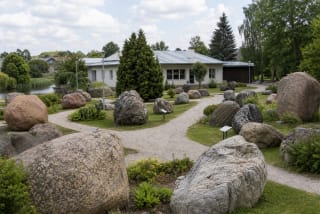
This is a short, clear stop: arrive, walk around the stone, understand its scale, read the information board, and continue through the Skuodas region or Samogitian nature sites. With children, it works well as a simple Ice Age explanation without museum walls.
For photographs, step back enough to include the full shape of the stone and some of its setting. Close views show granite colours, cracks, lichens, and surface irregularities, but a close-up alone does not show why this is considered Lithuania's largest boulder.
A responsible stop
Although the stone looks indestructible, visiting a protected object still has limits. Do not climb on the boulder, scratch the surface, or leave marks. The main value here is not entertainment on the stone but its surviving surface and setting.
If you combine this stop with other Samogitian sites, Barstyčiai Stone is especially strong on a geology route: after it, other boulders, outcrops, glacial relief, and legends about large stones become easier to understand.