- When / context
- From invitations before the wedding through the post-wedding return; each role belonged to particular stages
- Tradition area
- Life cycle
- Themes
- Pirslys, svocia, marsalka, kvieslys, groomsmen, bridesmaids, vainiksegiai, dowry carriers, two wedding parties
A Lithuanian wedding party was a temporary system of duties, not decorative entourage: the pirslys negotiated, the svocia guided and served, the marsalka managed the sequence, and other participants escorted, guarded, carried property, and represented both families.
A Pulkas Was a System of Duties, Not Merely a Decorated Entourage
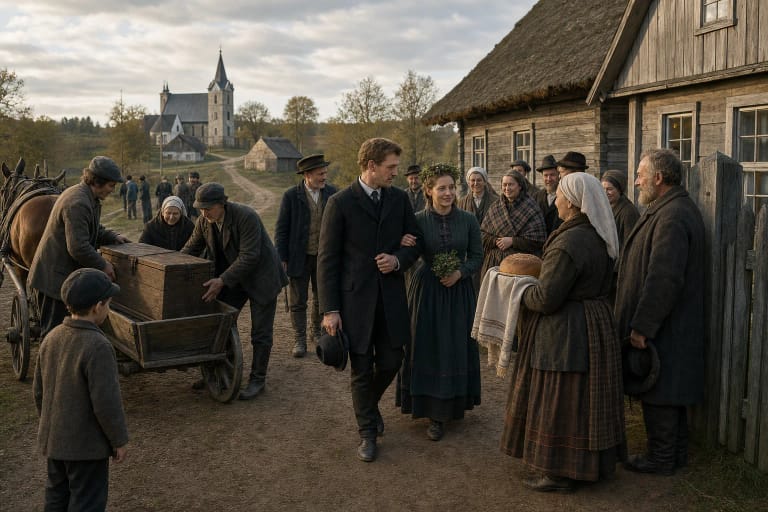
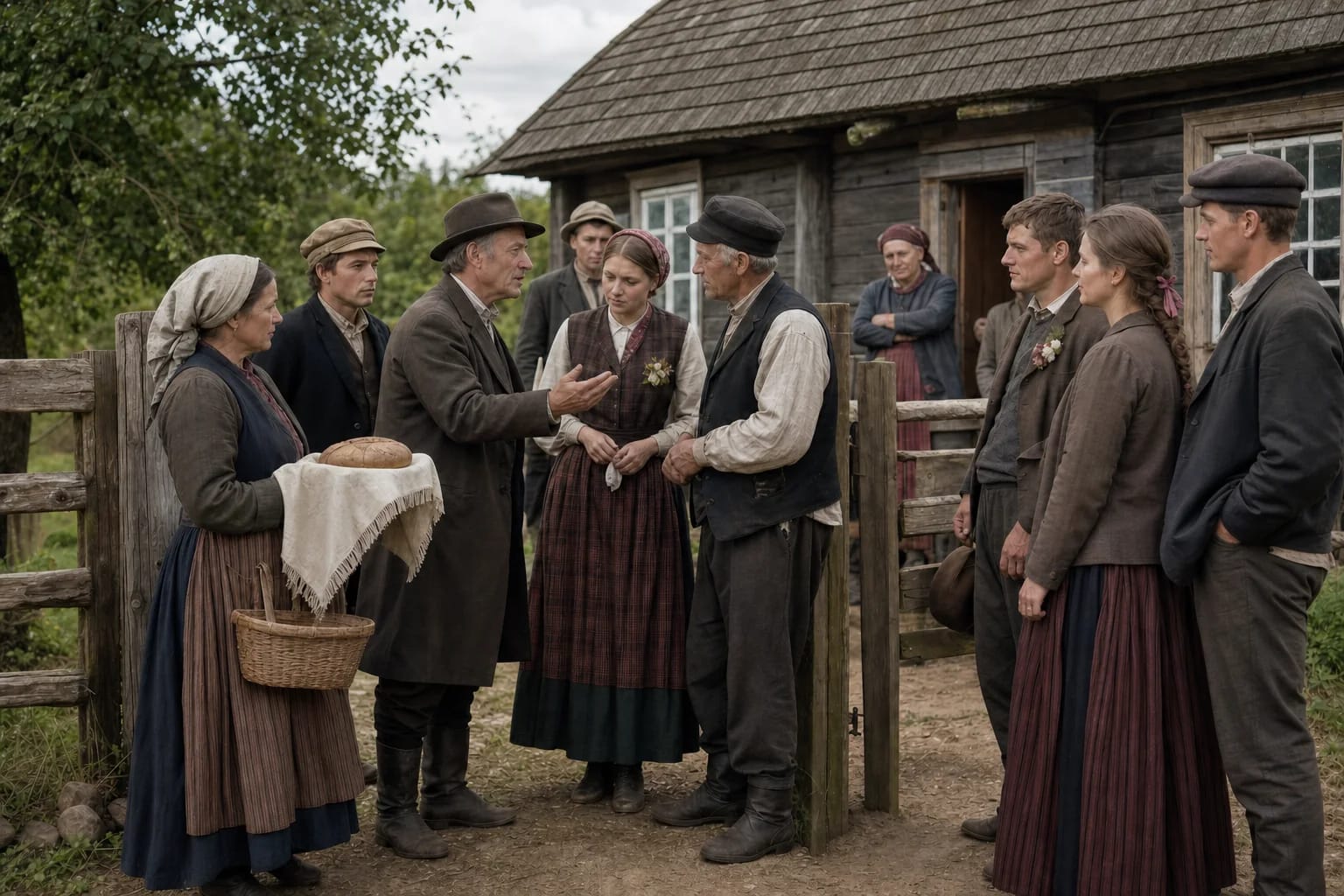
In nineteenth-century rural weddings, the groom's and bride's sides often formed separate groups called pulkai. Close relatives, neighbors, and people appointed to ritual offices represented their household when two groups met, negotiated, and publicly acknowledged new kinship. Closing a gate, defending seats at the table, hiding the bride, or demanding a ransom was therefore not a random joke but ritual language divided among performers.
No list of offices applies to all Lithuania. A pirslys might do what another district assigned to the marsalka; a svocia could be the bride's principal guide, while elsewhere her work was shared by the mother, a vainiksege, and the senior bridesmaid. Titles depended on region, period, and the informant's dialect. Even in the same locality, a substantial farmer's multi-day wedding could appoint more officials than the modest celebration of a servant or poor peasant.
The functions below are tools for reading historical evidence, not instructions for staging an “authentic” wedding. Most detailed information comes from ethnic Lithuanian rural society of the late nineteenth and early twentieth centuries. Townspeople, nobles, the Lietuvininkai of Lithuania Minor, and Lithuania's other religious and ethnic communities organized weddings differently.
The Pirslys: Negotiator, Witness, and Voice of the Groom's Party
Before the wedding, the pirslys mediated between families. He discreetly learned whether the young woman's household would receive a proposal, presented the prospective groom, and helped negotiate marriage, farm, and property terms. A capable pirslys knew local people, spoke vividly, and could steer a difficult exchange without causing offense. The humor concealed a practical responsibility: publicly connecting two households whose interests might not coincide.
At the wedding, the pirslys often became the spokesman for the groom's party. He requested entry at the gate, redeemed seats at the table, introduced the arrivals, delivered orations, and answered mockery from the bride's side. In some places he escorted the couple to church or rode at the front. Elsewhere the marsalka took charge of proceedings, so the two titles cannot be separated into exact nationwide job descriptions.
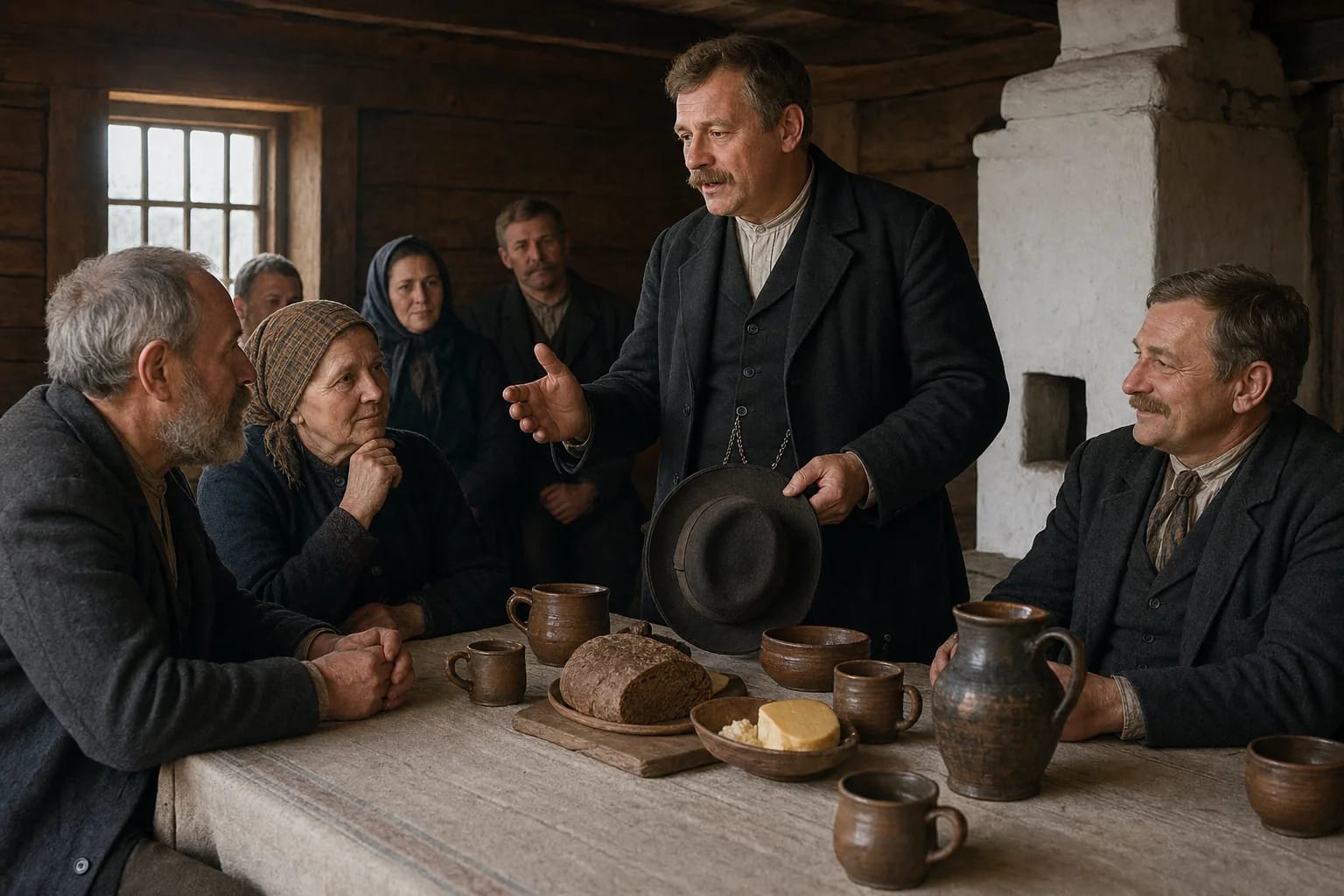
In later wedding play, the pirslys became a comic liar who was tried, sentenced, and subjected to a staged hanging. A “trial of the matchmaker” was first documented in western Lithuania and the north of central Lithuania in the late nineteenth and early twentieth centuries and then spread elsewhere; sources mention the hanging performance earlier too. Evidence from different periods does not establish one equally ancient, unchanged pagan rite across Lithuania. Today the violent image is best understood as theater, not as an obligatory wedding act.
The Svocia: Women's Knowledge, Ceremonial Food, and Guidance for the Bride
The svocia was usually an older married woman trusted by the community and most often a relative of the bride. In eastern and southeastern Lithuania and in Uznemune, two or more svocios might take part, with the second often representing the groom's kin. Her experience of married life equipped her to escort and help the bride and to participate in actions marking entry into the group of married women. Historical svotas is not automatically the title of her husband: the word could mean the parent of a son- or daughter-in-law and, in some local usage, a matchmaker, groom, or other wedding participant.
The svocia's title was especially closely connected with food. She brought baked goods, cheese, or drink, distributed a ceremonial karvojus and, in later custom, a svocia's cake. This was more than kitchen service. Food given in public demonstrated her ability to provide, reward, and draw new kin together. The name and form of the bread varied, while sakotis as a supposedly mandatory “ancient” wedding cake belongs to a much later layer of the festive table.
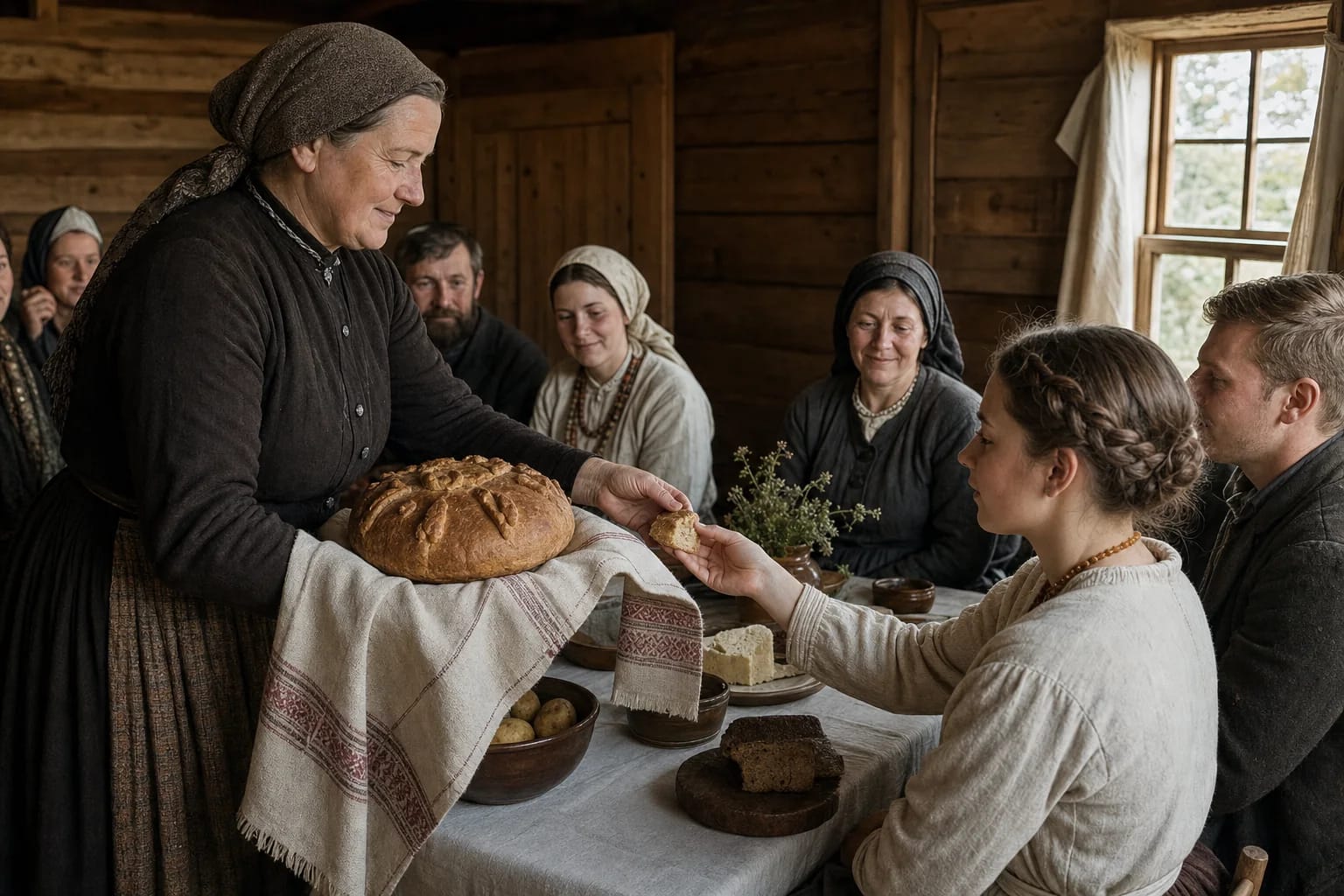
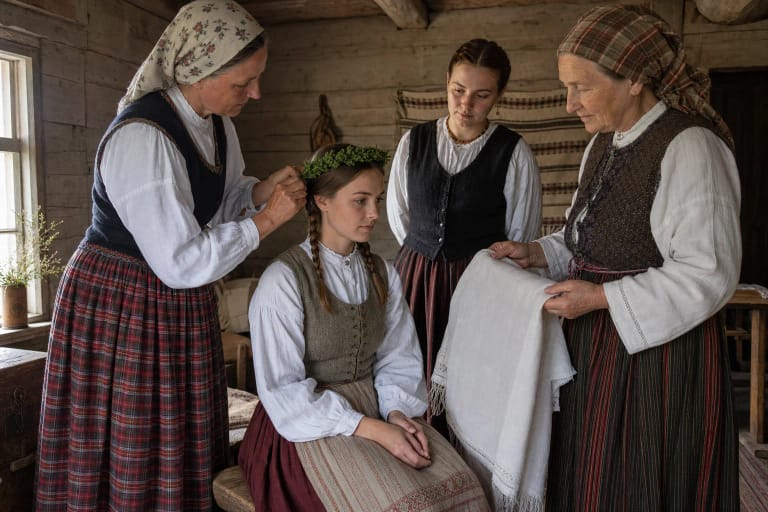
A svocia might lead gaubtuves, assist with receiving the young wife in the groom's home, or escort her around the farm. These tasks cannot be assigned automatically to every svocia: the groom's female kin, a mother, a vainiksege, or bridesmaids changed the head covering in other accounts. Her authority was real but operated within a patriarchal household order in which an older woman also supervised a younger woman's adjustment to her new home.
The Marsalka: A Master of Ceremonies Whose Boundaries Kept Changing
The marsalka was an organizer and orator. He might lead the groom's escort, arrange wagons or mounted riders, announce departure, seat guests, begin dances, give others the floor, and keep the planned actions on time. The borrowed title itself points toward the historical connections of the Grand Duchy of Lithuania, noble estates, and neighboring languages rather than an isolated world of “pure antiquity.”
Sources make his work overlap with that of the pirslys, kvieslys, and senior groomsman. In one place he was a separate officer of the groom's party; elsewhere the pirslys was called marsalka. A modern program in which the pirslys only jokes while the marsalka merely announces toasts is therefore not a reliable model of earlier divisions. The function mattered more than a stable title: someone had to manage a large moving group and address it in intelligible ritual speech.
The Kvieslys: A Personal Invitation, a Journey, and Public Speech
Before printed invitations and rapid communication, the couple and their parents often invited guests themselves, or they appointed a kvieslys. The image of a mounted ceremonial inviter is especially prominent in Dzukija, Uznemune, and Lithuania Minor. He traveled between farmsteads with a staff decorated with ribbons, greenery, and a bell, formally announced the wedding, and delivered a memorized or improvised oration.
His journey did more than transmit a date. A personal visit publicly defined membership in the invited circle of kin and neighbors, while elevated speech turned an everyday message into an occasion. Invitations could follow an order that respected age and relationship. Letters, printed cards, telephones, and digital messages eventually made the office unnecessary, although folk ensembles and themed weddings can revive it deliberately.
Pabroliai and Pamerges: Two Parties, Protection, and Sung Dialogue
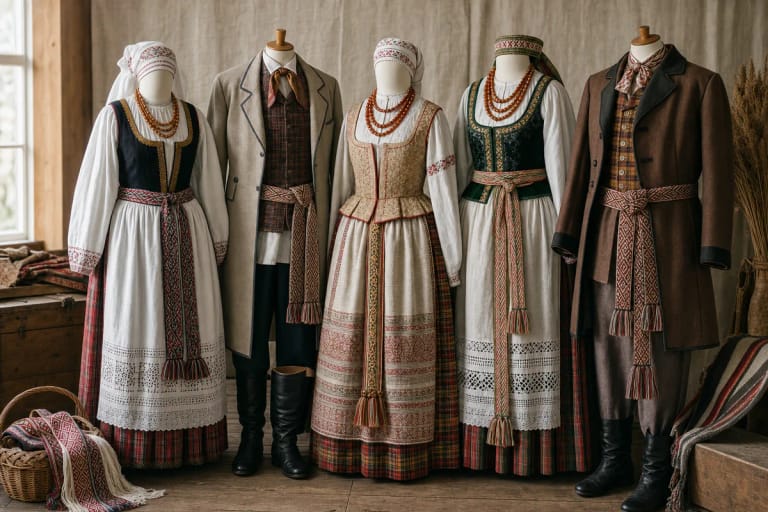
Pabroliai belonged to the groom's side and pamerges to the bride's. The men escorted the groom, helped pass barriers raised by the other party, and negotiated entry, seating, or the bride's appearance. The women decorated the bride's home, made or guarded her wreath, dressed her, answered the arrivals in song, and ritually defended her space. The actions could be comic, but they expressed a real boundary between two families and two youth groups.
Song was part of the office, not background music. Singers on the bride's side might call the arriving party strangers, mock the pirslys, or lament the approaching departure; the groom's side answered with requests, promises, or humor. Through this dialogue, the community voiced what the couple themselves could not always say in public family negotiations.
Today's evenly paired line of bridesmaids and groomsmen is not an unchanged ancient standard. In the late nineteenth century, the groom's party could still be almost entirely male, and pairing pabroliai with pamerges became widespread only in the early twentieth century. The number of pairs, their clothing, and their seating followed local fashion and the means of the families.
Vainiksegiai, Vainikseges, and Escorts to the Marriage Service
In some regions, the couple's principal attendants were called vainiksegiai, vainikseges, or vedliai. The terms connected them with the wedding wreath and escort to the marriage service. They might fasten ornaments, walk beside the couple, hold wreaths, or serve as honored witnesses. A uniform pair of two “witnesses,” however, partly reflects church and civil law and partly later wedding practice.
The procession to the altar shows regional variation particularly clearly. In Suvalkija, bridesmaids might lead the bride and groomsmen the groom. In northern Zemaitija, the groom's brothers led the bride and her bridesmaids led the groom; in southern Zemaitija, sources mention a vainiksegis and a svocia or vainiksege. These should not be treated as frozen rules for whole ethnographic regions: descriptions record a particular period, while parish and household practice continued to change.
Kraitveziai, Palydai, and Mituliai: Property and Protection on the Road
Kraitveziai—usually men from the groom's side with wagons—carried the bride's dowry to his home. Men from her side, known in sources as palydai or by other local terms, accompanied chests, bedding, textiles, clothing, and other goods. They did more than lift heavy furniture: their presence witnessed what the bride brought and protected her family's interest during the transfer of valuable property.
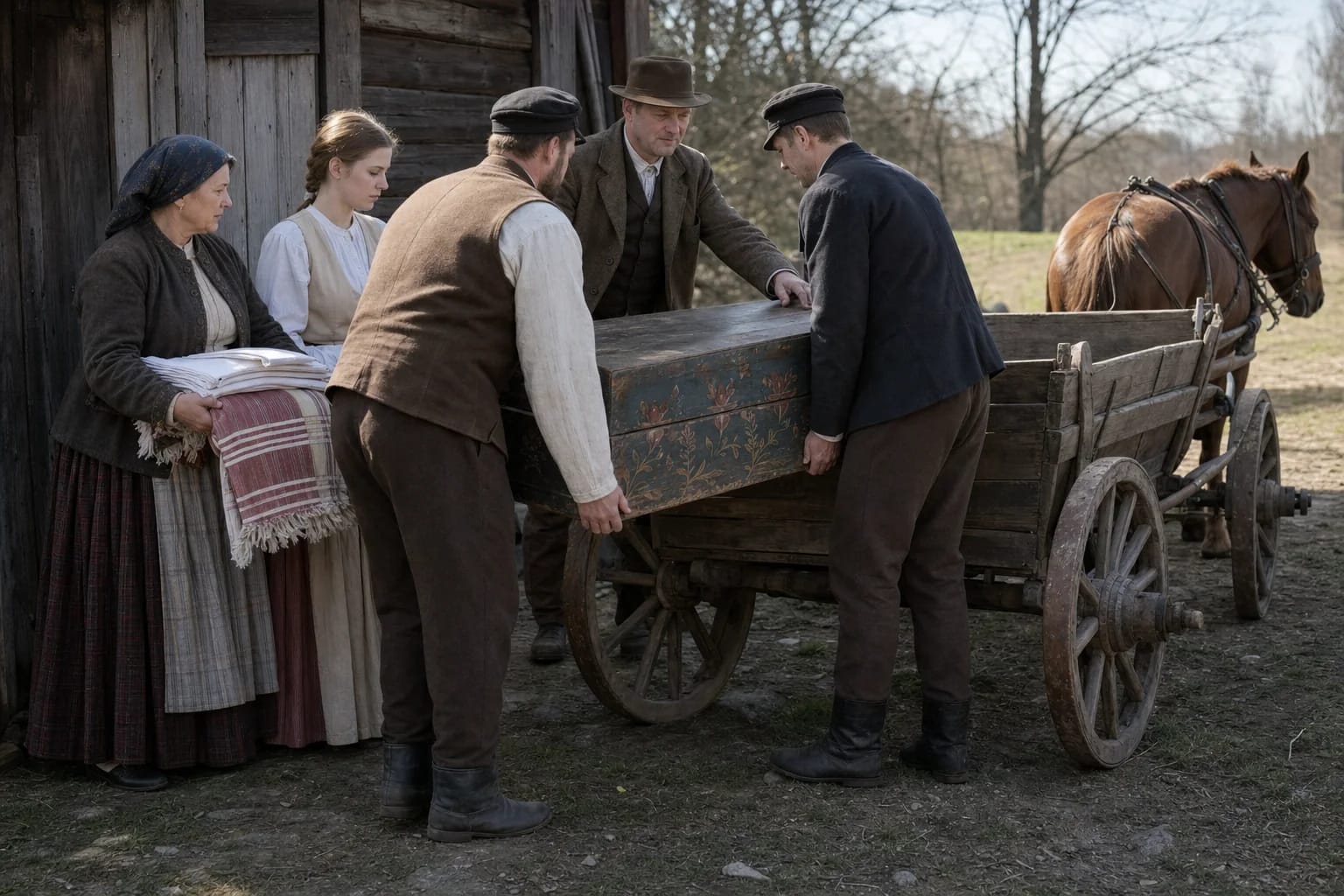
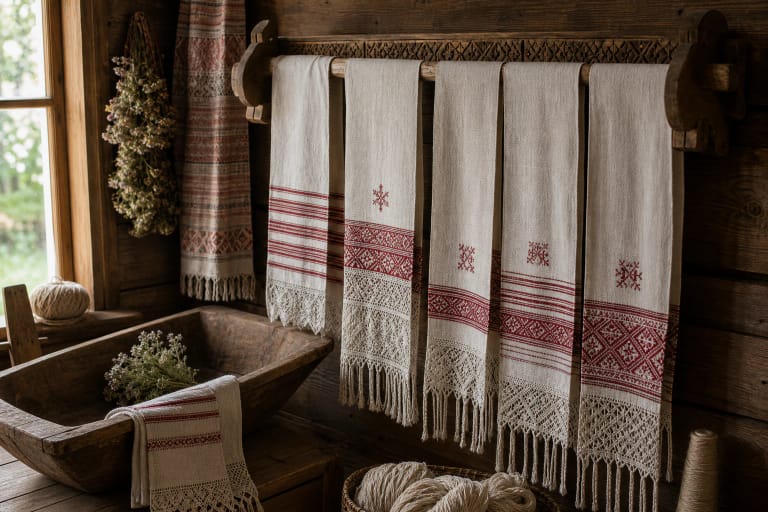
The textile dowry and personal belongings called kraitis should not be confused with the whole property share or pasoga negotiated by the families. Public transport displayed the value of the woman's and her female relatives' work, while the move itself took place within an unequal patrilocal system. When the bride entered her husband's parents' farm, witnesses and protection for her property had economic as well as symbolic force.
Aukstaitian accounts mention mituliai, men sent by the groom who remained in the bride's home after church to guard her until departure. Elsewhere table guards, gate defenders, and other temporary roles appeared for only one segment of the wedding. Such terms are valuable precisely as local evidence; they should not be gathered into one enormous imaginary party said to have existed everywhere at once.
Who Chose the Participants, and What Power Did They Hold?
Families chose trusted, eloquent, and practical people. The pirslys needed to negotiate, the svocia to guide and manage ceremonial food, the marsalka to direct proceedings, and carriers to move property safely. Kin and close neighbors were common choices because a wedding created obligations that lasted after the feast. A place in the party brought honor but also demanded work, travel, food, gifts, and responsibility.
The offices expose hierarchies of age and gender. Older married people negotiated publicly and controlled the sequence; unmarried youth escorted, sang, and carried out tasks; and the bride's voice was often conveyed through women's songs or lament. This does not prove that every marriage was forced, but it prevents the historical model from being portrayed simply as the free celebration of two people in love. Parental will, property, reputation, and dependence on the farm could constrain choice.
Ritual negotiations over the bride, gates, and seats are sometimes described through the language of abduction or purchase. Such readings may be comparative hypotheses, but a nineteenth-century ransom game is not direct proof that its performers reenacted an actual abduction. It is safer to describe the staged conflict between two groups, its negotiation, and the social cost of passage.
From Economic Necessity to Hosts, Witnesses, and the Stage
As weddings shortened during the twentieth century and urban receptions, restaurants, automobiles, and civil registration spread, separate offices merged. The pirslys and svocia became an honorary pair, professional hosts took over some organizing work, and bridesmaids and groomsmen became primarily friends of the couple. Printed and then digital invitations removed the need for a kvieslys; new forms of property replaced dowry chests and the earlier function of kraitveziai disappeared.
Soviet collectivization and the destruction of private-farm life particularly weakened the economic foundation of these roles. Once marriage no longer meant moving a bride and her textile dowry into one specific parental farm, escorts and participants in post-wedding return visits lost their old tasks. Culture houses, ethnographic ensembles, and family celebrations preserved or reconstructed some names, songs, and comic scenes, but reconstruction is not the same as an uninterrupted household function.
Kupiskenai Weddings offer a valuable example of local evidence becoming a protected performance tradition. The first production was staged in 1933; the tradition was revived in 1966 and has since passed to new generations of performers. A viewer should see two layers at once: documented customs from the Kupiskis area and their deliberate selection for a twentieth- and twenty-first-century stage.
How Can Wedding Roles Be Borrowed Responsibly Today?
A couple may choose a pirslys as an eloquent mediator, a svocia as a trusted guide, a kvieslys to perform a personal invitation, or a party of friends to sing and escort them. A historical title does not create meaning by itself. The couple should agree on the person's actual responsibilities, identify the region from which the form comes, and ask whether its humor is acceptable to everyone involved.
A wedding need not reproduce coercion, humiliation, or an unequal division by gender in order to be Lithuanian. The staged hanging can become recognition of the pirslys's speech, ransom can become a sung exchange between families, and food service assigned only to women can become a shared responsibility. A custom explained honestly and remade by mutual consent continues heritage more faithfully than a supposed copy of unchanging antiquity.