- Field
- Ritual folk art and spatial ornament
- Type
- folk art
- Heritage status
- UNESCO heritage
- Context
- Straw tying, spatial geometry, wedding, Christmas, Easter, and house-blessing customs
Sodai, Tradition of straw-garden making, Liktorius, Voras, Dangus, Pasaulis, Rojus, Sietynas, Reketukas
Straw Gardens forms and objects
Two-tier straw garden: A sodas tied from several geometric tiers, in which a vertical axis of world and household order is clearly visible.
Cubic straw garden: A construction based on regular cube and diamond forms, useful for explaining the geometry and rhythm of sodai.
Cylindrical straw garden: A sodas with a rounder chandelier-like silhouette formed from repeated straw segments.
Straw stars and ornaments: Smaller straw works often hung on a sodas, on a Christmas tree, or in festive domestic space.
What Are Straw Gardens?
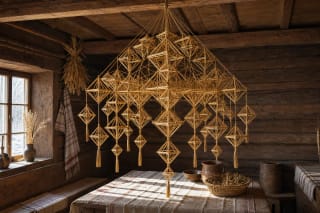
Lithuanian straw gardens are light spatial constructions threaded and tied from straw. They are made from even straw tubes strung on thread and joined into symmetrical geometric forms: diamonds, cubes, pyramids, stars, multi-tier structures, or chandelier-like compositions.
In tradition, a sodas is not merely a hanging decoration. It is understood as a sign of harmony, order, and a consecrated domestic space. In the past it was hung above the table, in the honorable place of the pirkia, at weddings or festive moments; today it often returns as a symbol of Lithuanian identity, handwork, and slow concentration.
On December 5, 2023, the tradition of straw-garden making in Lithuania was inscribed on the UNESCO Representative List of the Intangible Cultural Heritage of Humanity. The inscription protects not only a beautiful object but also knowledge: how to grow or choose straw, prepare it, tie a sodas, understand its purpose, and transmit the craft.
Names: Sodas, Liktorius, Voras, Dangus, Pasaulis
In different parts of Lithuania, straw gardens were called sodas, liktorius, voras, pajonkas, dangus, pasaulis, rojus, sietynas, reketukas, rekėžis, krijelis, aitvaras, and other names. This abundance shows that the tradition was widespread and locally interpreted.
The word sodas here works beyond its everyday meaning of garden. It can suggest an ordered, living, human-tended world. Names such as dangus, pasaulis, or rojus make even clearer that the straw construction was more than decor: it hung above daily life like a small hand-tied cosmos.
The name voras probably relates to a spatial web and hanging. Sietynas recalls light and a suspended center. Such names help modern readers understand that sodai were read through form, movement, light, and place in the home.
What Are Sodai Made From?
Traditional sodai most often use rye straw, as well as wheat, reeds, or other plant stems. The straw must be strong, straight, clean, and fairly uniform. The beauty of a sodas depends not only on the pattern but also on the prepared material.
The straw is cut, dried, cleaned, and trimmed into equal tubes. It must be dry enough not to bend or mold, but not so brittle that it breaks while being threaded. Well-prepared straw shines with a natural golden color, making the sodas look light, bright, and alive.
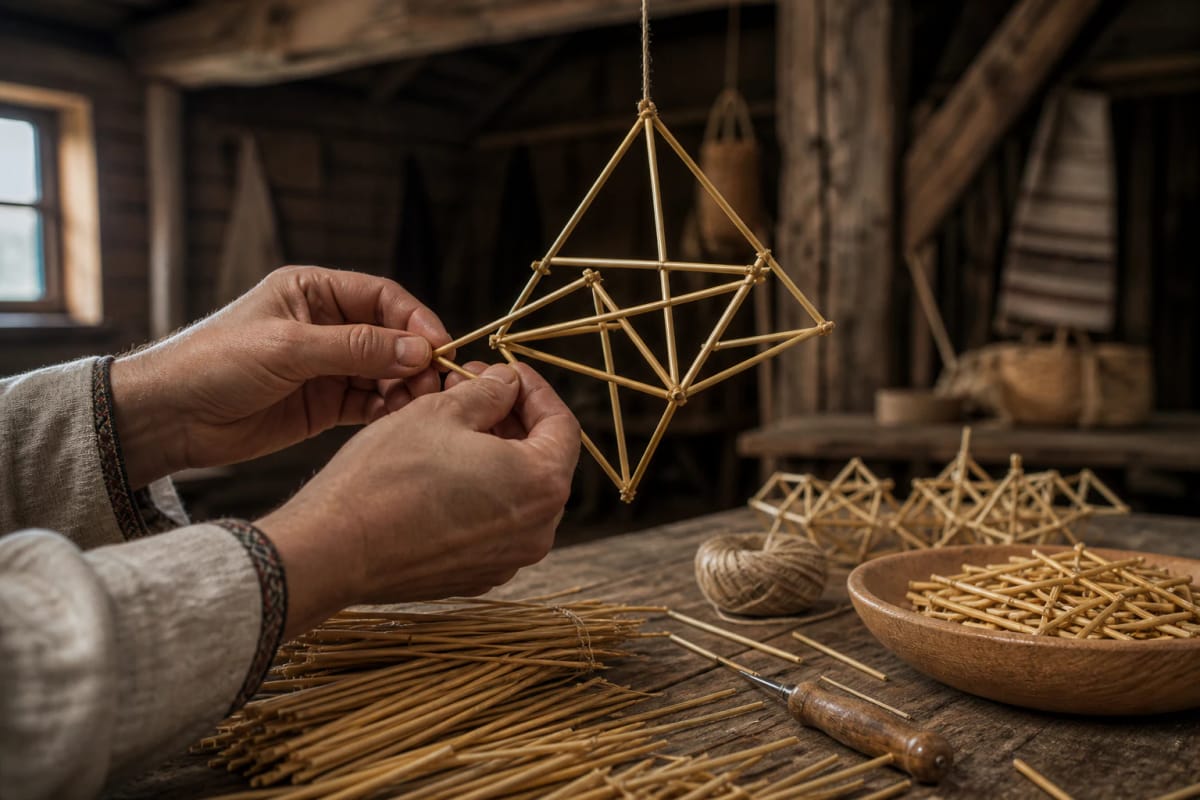
Tying requires patience and spatial thinking. Every knot changes the whole construction, and a small mistake can distort the symmetry. For that reason sodai making is both a craft and a discipline of thought: the hands learn geometry through the material.
Geometry and the Model of the World
Straw gardens are often explained as objects of archetypal geometry. Their structures repeat diamonds, triangles, pyramids, cubes, vertical axes, and multi-tier compositions. These forms create the impression that a small object has its own top, bottom, center, and balance.
For that reason a sodas is often called a model of the world. It hangs in the air, moves with the slightest current, casts shadows, and seems like living order. This movement matters: the sodas does not stand still; it turns, breathes with the house, and responds to human presence.
Geometric order here is not cold mathematics. It has meaning in ethnic culture: orderly straw bonds speak about harmony among person, home, harvest, feast, and the unseen world. A sodas can therefore be both decoration and a wordless form of prayer.
When Sodai Are Hung: Weddings, Christmas, Easter, and the Home
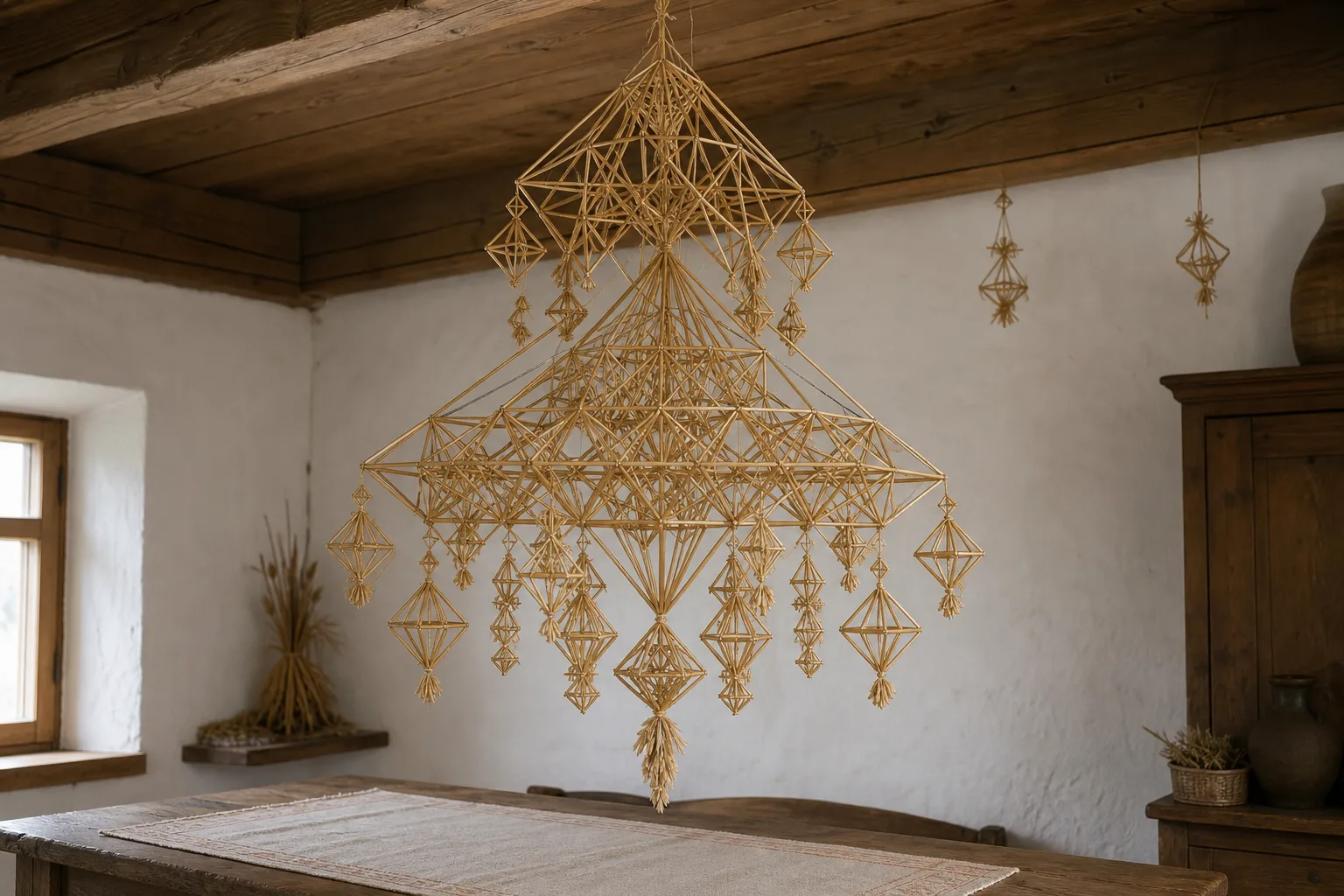
Straw gardens are connected with important moments in the human life cycle and the ritual year. At weddings they could mark the harmony, fertility, prosperity, and blessing of a new family's home. A hanging sodas above the table or festive place gathers the new world into which the couple enters.
During winter holidays, sodai fit the symbolism of straw at Kūčios supper and the waiting of Christmas. Straw ornaments, stars, and smaller constructions now often decorate Christmas trees, but the larger sodas keeps a deeper meaning of household blessing, light, and calm.
In the context of spring and Easter, a sodas may be read as a sign of renewal and the order of life. In every case, the most important point is not one exact date but a moment of transition: a household, family, or community enters a new time and marks it with handmade order.
Makers and Transmission
The tradition of tying sodai was long transmitted within families and communities. Children learned by watching elders prepare straw, cut equal segments, thread the first stars, and join them into larger forms. This school works not through theory but through the rhythm of hands.
Today the tradition is maintained by masters, folk artists, educators, cultural centers, museums, and associations. Workshops are held, instructional publications appear, lessons are filmed, and sodai become not only ethnographic exhibits but also inspiration for contemporary design, architecture, and community education.
Modern adaptation should not empty the meaning. A sodas may hang in a contemporary apartment or exhibition, but its force comes from the material, handwork, geometry, relationship to celebration, and respect for tradition.
How to Recognize a Good Traditional Sodas
A good sodas first has a clear structure. Its parts are proportionate, knots are tidy, and the geometry does not collapse. Even a complex sodas should look light: the viewer sees not a chaotic tangle of straw but a clear spatial order.
Second, material matters. The color of natural straw, even segments, clean cuts, and a lightness that does not hide fragility give the sodas life. Overly shiny, synthetic, or random materials may look decorative but pull the work away from a traditional feeling.
Third, a sodas must relate to space. It reveals itself best when hanging, when it can turn slowly and cast shadows. Placed on a table it becomes an object; suspended above eye level it again becomes a sign of the home's center.
How Sodai Differ from Simple Straw Ornaments
Straw ornaments, stars, garlands, and Christmas-tree decorations are close to the sodai tradition, but they are usually smaller, flatter, or made for a specific decorative function. A sodas is a spatial construction that creates a whole little architecture.
This distinction matters for content and education. A child may begin with a simple straw star, but a sodas requires more geometry, patience, control of knots, and an ability to see the whole. For that reason the sodas often becomes a higher level of straw-work skill.
Still, the smaller works are not lesser. They maintain the same material culture, train the hands in precision, and help the tradition live in everyday settings. Understanding how a large sodas is born can begin with a small star.