- Category
- Home, dowry, and tree-of-life symbols
- Domain
- Chest, dowry, woman's life, home, tree of life, birds, horses, grass snakes, painting
- Source status
- well attested
dowry chest, Lithuanian chest, painted chest, wedding chest
What is a dowry chest?
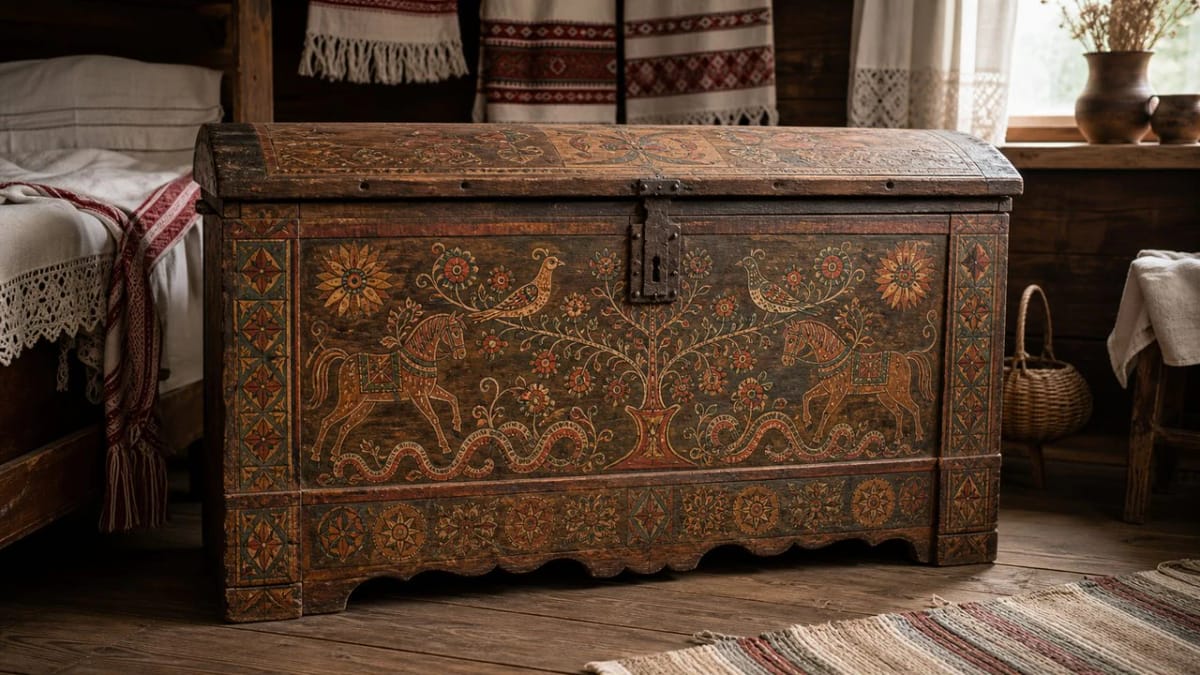
A dowry chest is a piece of furniture in which clothing, valuable objects, and the dowry were kept. In Lithuania, chests as dowry furniture are mentioned in historical sources from the 16th century.
According to tradition, a mother's dowry chest could pass to the eldest daughter. For that reason the chest is not only storage, but also a symbol of the female line, inheritance, and the wedding transition.
Decoration and signs
The Encyclopedia of Lithuania notes that Lithuanian chests were decorated with plant motifs, most often the tree of life, heavenly bodies, and paired animals such as birds, horses, and grass snakes.

This makes the chest one of the richest objects of Lithuanian symbolism: on one piece of furniture, home, sky, animals, the tree of life, and protection meet.
The chest as household storehouse
The chest protects what is valuable: clothing, textile, document, dowry, memory. Its ornaments therefore work not only on the outside but also as signs of the protected interior.
It is a closed container that can be opened at important life moments. Such a form naturally connects with secrecy, keeping, and transition. At weddings, the dowry chest with the bride's linens and textiles was ceremonially carried to the groom's home as a visible sign of the girl's passage into a new life. The most brightly painted chests, decorated with flowers and tree-of-life motifs, are characteristic of Samogitia and the Klaipėda region, so the chest is also an example of regional folk-art style.
The dowry chest today
Today the dowry chest is often seen in museums, educational programs, and ethnographic interiors. Its decoration shows how ornament relates to a household object and its use.
The best explanation combines furniture history, wedding tradition, a woman's life transition, and specific painted or carved motifs.