- Category
- Folk Art and Identity
- Reading time
- 13 min.
- Sources
- Encyclopedic and Lithuanian National Culture Centre sources
Reading National Costume: What the Clothing Actually Shows
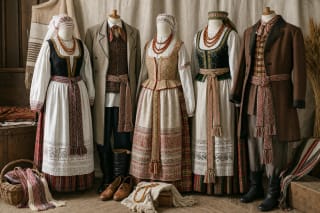
Lithuanian national costume is not one generic "Lithuanian" outfit. It is a system of traditional nineteenth-century rural festive dress from five ethnographic regions: Aukštaitija, Žemaitija, Dzūkija, Suvalkija, and Lithuania Minor. Each region has its own colors, weaving methods, skirt and apron types, sashes, and head coverings. Reading a costume therefore means more than admiring one beautiful detail: it means recognizing whether all the parts speak the same regional language.
Read the costume in sequence. Look at skirt colors and weaving direction, whether the skirt is checked or striped and whether one or several colors dominate; the character of the apron, whether white with a red border, checked, dark, or richly multicolored; the material of the bodice, whether purchased silk or homespun checked cloth; the sash type, whether pattern-woven or plaited; and especially the head covering. Head covering tells three things at once: region, age, and marital status, that is, whether the wearer is an unmarried girl or a married woman.
It is important to separate documented facts from useful generalizations. Ethnographic reality was varied: even parishes, localities, and families within the same region had their own variants, while border areas, such as the Zanavykai of Sūduva and the Samogitians or northern Dzūkija and Aukštaitija, mixed with one another. The typical signs in this guide are therefore recognition guidelines, not rigid rules. The more details match, the more reliable the identification.
Aukštaitija Costume: White Linen, Checked Skirts, and the Nuometas
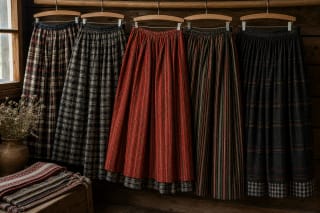
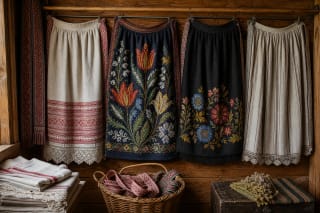
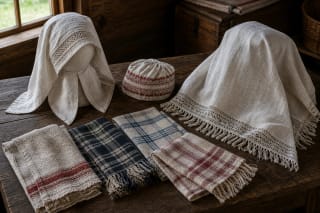
By the nineteenth century, Aukštaitija was already considered the region with the most archaic costume, an impression created by abundant white linen fabrics and nuometai, head coverings reminiscent of medieval forms. Aukštaitian women wore long linen shirts of tunic cut with shoulder pieces; the most decorative part was the sleeve, woven with red geometric ornaments. The region's most typical skirt was wool and checked, often in a distinctive four-color combination: the main large checks in red and green were subdivided by narrow yellow, dark purple, or black stripes. In Aukštaitija, the apron was usually white, with a red band woven along the lower edge.
Head covering is the clearest sign of Aukštaitija. The most formal covering for a married woman was the nuometas: a thin, sometimes almost transparent cloth about 3.5 meters long and 50-70 cm wide, tied in a complex way around the face, neck, and shoulders. Aukštaitian women wore the nuometas for an especially long time; in some places, particularly northeastern Aukštaitija and the Kupiškis area, it remained in use into the early twentieth century. Later it was increasingly replaced by a diagonally folded headscarf tied at the nape. Unmarried girls decorated their heads with gold-colored bands and small crowns with ribbons.
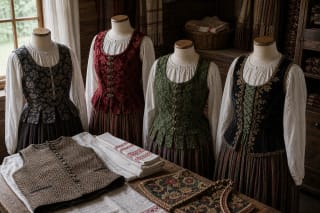
Aukštaitian bodices were often made from expensive purchased fabrics: silk, damask, brocatelle, or velvet, with a liking for red, green, gold, and silver. Sashes were pattern-woven or plaited, and the colors of plaited sashes often matched the skirts. Still, Aukštaitija should not be simplified into a white-and-red scheme. It is the largest region, with differences between eastern and western Aukštaitian clothing, and individual localities had their own checked skirts, bodices, and head-covering variants.
Žemaitija Costume: Bright Colors, Striped Skirts, and Many Scarves
Žemaitija stands out for its colorfulness, abundance of expensive scarves and beads, and the fact that men's outer garments were often colored rather than gray. The main recognition clue is the skirt: Samogitian women especially favored lengthwise-striped skirts woven in false satin, or four-shaft, weave, often with asymmetrical pattern composition and at least five contrasting colors, one of them dominant. In northern Žemaitija the dominant color was usually red; checked skirts were much less common there and appeared later.
Samogitian aprons were also lengthwise-striped, wide, fairly short, and often without strict pattern repetition. The bodices are distinctive: Žemaitija is the only region where women's bodices were more often sewn not from purchased fabrics but from homespun half-wool checked or cross-striped cloth, often with pleated skirts attached above the waist. This raised waistline recalls Empire fashion and has analogues in Scandinavian folk costumes.
A defining Samogitian feature is the culture of scarves. Married women wore square scarves folded diagonally, with a characteristic knot above the forehead and protruding corners; homespun red-and-white checked kerchiefs were especially widespread. Samogitian women differed from other regions by wearing several scarves at once and combining homespun and factory-made cloth; a festive costume is almost unimaginable without shoulder shawls. Because of red checked kerchiefs, aprons decorated with red cotton patterning, and skirts dominated by red, the northern Samogitian ensemble even earned a reputation as an almost entirely red costume.
Dzūkija Costume: Darker Fine-Checked Skirts and Many Sashes
Dzūkija was a poor, forested region where traditional clothing was worn especially long, with some garments still used after the Second World War. The oldest Dzūkian women's shirts strongly resemble those of Aukštaitija: tunic-cut, with red pattern-woven designs on the sleeves, though Dzūkian ornaments are usually finer. Later shirts were short, with collars sewn from thin factory-made cotton and decorated with white openwork. The skirt is a useful key: later Dzūkian skirts are almost always more finely checked than Aukštaitian ones, and the colors are darker, often dark red, blue, or dark purple.
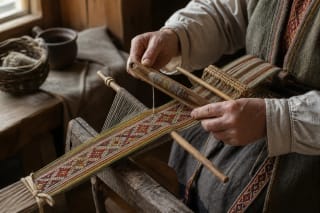
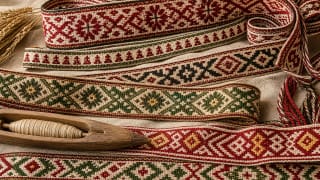
Dzūkian aprons are marked by variety, the colorfulness of homespun cloth, and small-scale ornament. The oldest were checked white and red or white and blue; in northern Dzūkija, much as in Aukštaitija, they were white damask aprons with lace. By the end of the century, checked aprons were becoming increasingly dark. The most complex aprons were woven along the Nemunas and in Užnemunė, with supplementary-weft ornaments already close to those of Suvalkija. Dzūkian women wove especially many sashes, usually pattern-woven, with specific regional designs in two contrasting colors.
Head covering and footwear complete the Dzūkian picture. Girls decorated themselves with flowers, gold-colored bands, especially in Užnemunė, and small crowns; married women wore white or colored caps, placing a kerchief over them. Dzūkian women especially liked fine multi-row coral beads. Because the region was poor, people more often had to make do with homemade footwear: simple leather footwear and crocheted slippers. Keep in mind that northern Dzūkija costume is very close to Aukštaitian costume, while Užnemunė is close to Suvalkija, so borderland identification requires caution.
Suvalkija (Sūduva) Costume: Striped Skirts and Ornate Supplementary-Weft Aprons
Suvalkija, or Sūduva, is the latest-formed ethnographic region, settled after wars by migrants from the other side of the Nemunas: Samogitians in the north, Aukštaitians and Dzūkians in the south. As a result, the costume of the Zanavykai in the north took on Samogitian and Klaipėda-region traits, while that of the Kapsai in the south was closer to Aukštaitija and Dzūkija. The common sign of Suvalkija is order and symmetry: unlike Samogitian women, women of Suvalkija preferred strict, rhythmically repeating ornaments. Skirts were usually half-wool, broad, lengthwise-striped, with one rich, often dark dominant color; dark blue was especially liked.
The brightest and most ornate part of a Suvalkija woman's costume is the apron, so it is the most reliable regional recognition sign. The favorite motif across the region became a supplementary-weft ornament made of four geometrized lily blossoms. The distinction between two subgroups matters here: Zanavykai women grouped patterns in lengthwise bands running down the apron and liked wider aprons with gathered added sections, while Kapsai women grouped ornaments in horizontal bands. Bodices also differed: Zanavykai women wore short bodices, while Kapsai women wore considerably longer ones.
Head covering distinguishes girls from women and Kapsai from Zanavykai. Kapsai girls decorated their heads with wide gold-colored bands, sometimes bent into a cap-like form and adorned with flowers; Zanavykai girls hardly wore such bands, instead decorating their heads with multi-colored bead bands. Married women wore caps and kerchiefs with forehead bands. As a comparatively prosperous region, Suvalkija was known for leather shoes and especially beautiful white openwork knitted stockings.
Lithuania Minor Costume: The Lietuvininkai Delmonas and Darker Fabrics
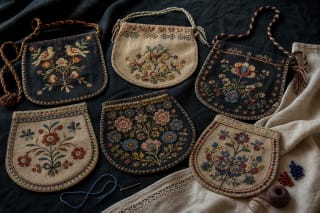
Lithuania Minor, or the Klaipėda region, long belonged to Prussia and Germany, and its inhabitants most often called themselves Lietuvininkai. It is the only Lithuanian ethnographic region where Lutheran faith predominated, and this circumstance, together with the influence of German colonists and urban fashions, shaped a distinctive costume. The defining sign of Lietuvininkės women is the delmonas: a flat, richly embroidered pocket-pouch tied at the waist with a woven cord or sash, used to hold money, a handkerchief, and small items. The delmonas did not occur elsewhere in Lithuania; older women of the Klaipėda region still wore it in the mid-twentieth century.
In the first half of the nineteenth century, the costume of Lietuvininkės women was colorful: white linen aprons with red geometric and plant patterns, short bodices with broad necklines, and dark blue cloth especially favored for jackets. Head covering strictly followed status: girls braided their hair and placed the braids around the head like a wreath; brides wore a crown-like gužė or a tall cylindrical velvet cap; women who had borne children tied on a large white kerchief. Lietuvininkės wore pattern-woven sashes, in some places with woven texts, such as song words or good wishes.
To recognize Lithuania Minor costume, it is essential to know that it changed strongly in the second half of the nineteenth century, not only because of urban fashion but also because of the religious fellowship movement known as surinkimininkai. Colors and exotic headgear declined, while dark colors, especially black, came to be considered signs of good taste and pious life. A so-called juodinė even appeared: a costume sewn entirely from black cloth. When we see a dark, modest Lietuvininkė costume, we are reading not only region but also a specific period and religious culture.
Head Coverings, Sashes, and Footwear: Precise Recognition Keys
Head covering is the most important single recognition key because it marks both region and marital status. Unmarried girls kept their heads uncovered and decorated themselves with wreaths, flowers, ribbons, and gold-colored bands; married women were required to cover their heads. A thin, long tied nuometas is an Aukštaitian sign; a tall cylindrical bridal cap and gužė point to Lithuania Minor; a red-and-white checked diagonally tied kerchief with a knot above the forehead is Samogitian; a cap with a kerchief drawn over it was widespread in Dzūkija and Suvalkija.
The sash and apron help confirm the region. Pattern-woven sashes with complex designs were widespread everywhere, but were woven especially abundantly in Dzūkija and Suvalkija; plaited sashes whose colors match the skirts are typical of Aukštaitija; sashes with woven texts belong to Lithuania Minor. The apron is often the fastest readable sign: white with a red border for Aukštaitija; fine-checked and dark for Dzūkija; ornate, multicolored supplementary-weft patterns with lily motifs for Suvalkija; wide lengthwise stripes for Žemaitija; white with red geometric patterns, later dark, for Lithuania Minor.
Footwear and jewelry refine the picture, though alone they do not identify a region. Leather shoes were considered the best footwear everywhere, while poorer people wore simple leather footwear, bast shoes, or wooden clogs on feast days. Beads also have a regional cast: amber is more frequent in Žemaitija and western Aukštaitija, coral in Dzūkija and Suvalkija, and glass and amber in Lithuania Minor. When reading a photograph, judge not an isolated detail but whether all the parts form one logical regional system.
The Nineteenth-Century Discovery: How Traditional Dress Became National Costume
Traditional rural dress and national costume must be clearly distinguished. Traditional festive clothing was living dress of the nineteenth century and earlier: people wove it, sewed it, wore it, repaired it, inherited it, and changed it according to fashion, wealth, age, and work. National costume is a later form of that dress, consciously selected and adapted for representation. The term "national dress" itself emerged in the Romantic period, when rural clothing began to retreat from everyday life and its details became signs of national identity.
In the late nineteenth century, during the national revival, elements of traditional dress became symbols, and in the early twentieth century and interwar period the desire grew to create an orderly, region-based national costume. Men's costume was modeled more actively in this process than women's, because rural men's clothing adopted urban forms earlier and was less well documented. For that reason, women's costume has remained the more precise ethnographic source.
This distinction matters because it helps avoid confusing a museum reconstruction, a stage costume for an ensemble, a family relic, and an actual nineteenth-century rural garment. During the Soviet period, stylized stage costumes spread, simplifying regional diversity and intensifying colors; the late twentieth-century folklore movement brought attention back to museum examples. Classic works in the field include Stasė Bernotienė's Lietuvių liaudies moterų drabužiai (1974), the Lietuvių liaudies menas volume Drabužiai (1974), and Teresė Jurkuvienė's Lietuvių tautinis kostiumas (2006).
Short Checklist: Reading a Costume Photograph
When reading a costume photograph, proceed consistently. First, look at the skirt: is it checked, more often Aukštaitija or Dzūkija, or lengthwise-striped, more often Žemaitija, Suvalkija, or Lithuania Minor? Which color dominates, and are the checks large, as in Aukštaitija, or smaller and darker, as in Dzūkija? Second, look at the apron, often the clearest sign: white with a red border points to Aukštaitija, ornate multicolored supplementary-weft lilies to Suvalkija, broad stripes to Žemaitija, and fine dark checks to Dzūkija.
Third, read the head covering, which also tells age and marital status: a wreath or gold-colored band indicates a girl, while a covered head indicates a married woman. A long thin nuometas points to Aukštaitija, a red checked kerchief with a knot above the forehead to Žemaitija, and a tall cap or gužė to Lithuania Minor. Fourth, look for a delmonas: if a flat embroidered pouch hangs at the waist, it is almost certainly Lithuania Minor. Fifth, check the bodice: homespun checked cloth similar to the skirt points to Žemaitija, while expensive purchased silk is more common in Aukštaitija and Suvalkija.
Finally, check whether all the parts belong together. If an Aukštaitian head covering is combined with a Suvalkija apron and a Samogitian scarf, this is no longer one region's costume but an eclectic combination. It may look colorful, but it no longer tells a clear cultural story. Remember the borderland caveats as well: northern Dzūkija is close to Aukštaitija, Užnemunė Dzūkians are close to Suvalkija, and Zanavykai are close to Samogitians and the Klaipėda region, so in individual photographs it is better to rely on several matching details rather than one.