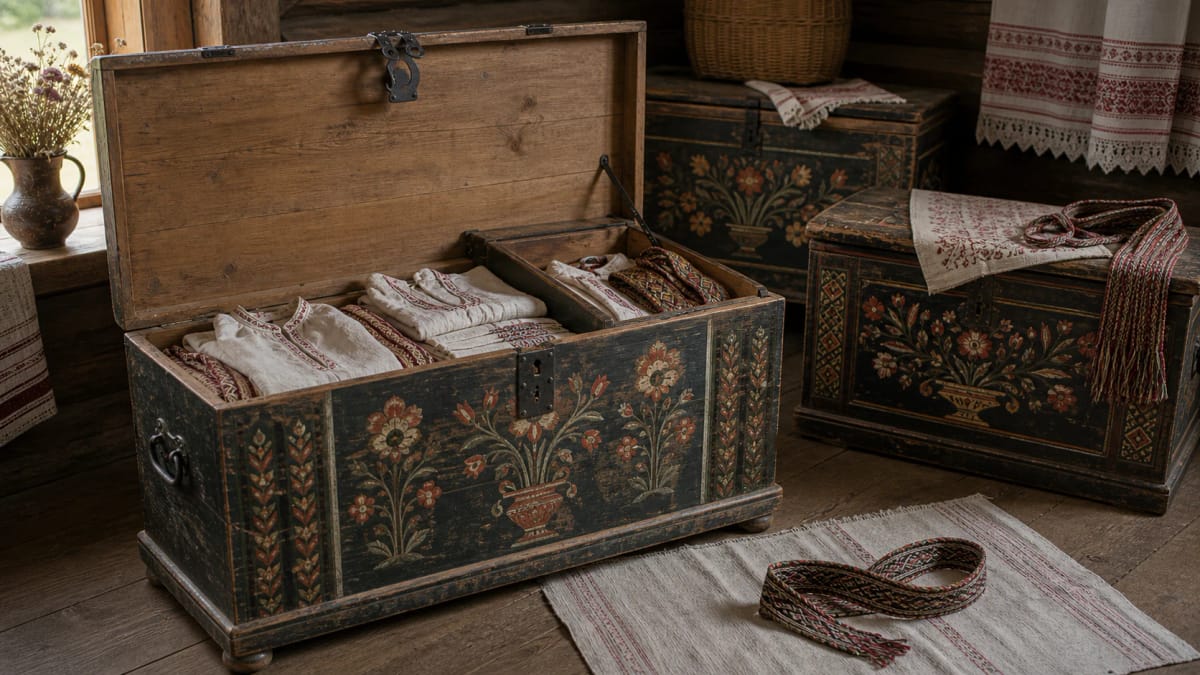
- Field
- Lithuanian dowry furniture, painted wood folk art, and family textile storage
- Type
- folk art
- Heritage status
- well attested
- Context
- Dowry chest, chest, kuparas, dowry, prieskrynis, painting, flowerpots, iron fittings, dowry textiles, weddings, inheritance, Lithuanian folk furniture
Dowry chest, Chest, Kraičio skrynia, Kuparas, Kraitkubilis
Dowry Chests forms and objects
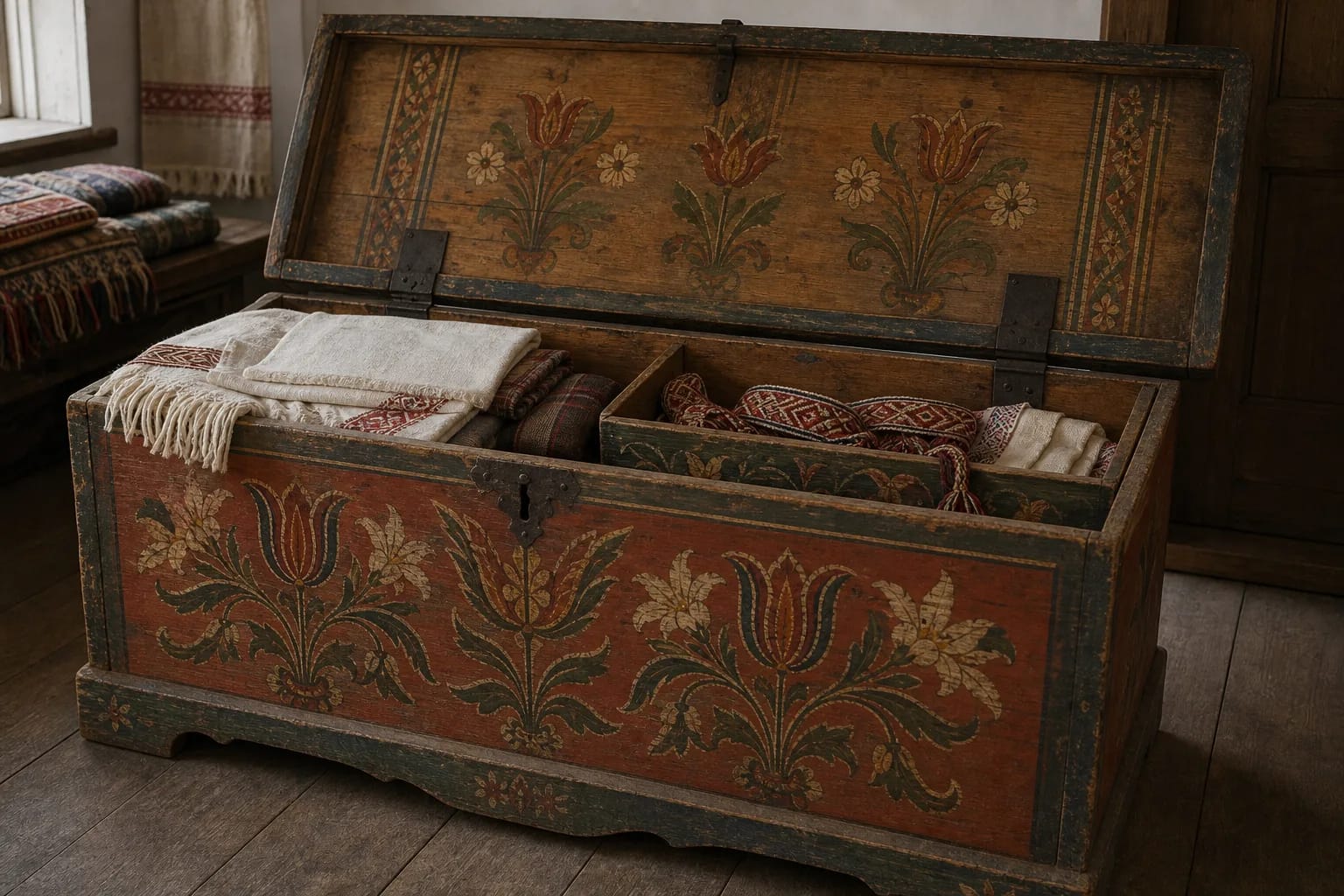
Painted dowry chest: A wooden chest with painted flowerpots, plant motifs, geometric frames, a dark or colored ground, and iron fittings.
Kuparas: A storage or travel-related chest form often marked by a curved or convex lid, close to the chest but different in construction.
Chest with a prieskrynis: A chest with a smaller box or compartment inside for smaller valuables, documents, jewelry, or sashes.
Kraitkubilis: An earlier dowry-storage form, a tub-like vessel or container that was later replaced in many places by plank-built chests.
What is a dowry chest?
A dowry chest is a wooden rural household item used to store the dowry: fabrics, clothing, sashes, towels, tablecloths, jewelry, and other valuables. It was practical storage and at the same time an important sign of a young woman, her family, and wedding culture.
The chest stood in the home as a visible sign of wealth, labor, and preparation. The textiles inside did not appear quickly: flax had to be grown, processed, spun, woven, sewn, embroidered, or otherwise prepared. The chest therefore held many years of work.
A dowry chest is not merely a beautifully painted piece of furniture. It is a social institution: it shows what was considered valuable, how a family prepared a daughter for marriage, how textile was transferred, and how objects became memory.
Skrynia, kuparas, and kraitkubilis
In everyday speech, skrynia and kuparas are sometimes confused, but their construction can differ. A skrynia is usually a plank-built chest with a flatter lid, while a kuparas often has a convex or curved lid and features related to travel or storage forms.
Earlier dowry-storage forms include kraitkubiliai, tub-like or larger vessel-type containers. Historical sources mention chests as dowry furniture in Lithuania from the 16th century; in the second half of the 18th century and the early 19th century, chests and kuparai replaced the earlier kraitkubiliai in many places. By the late 19th and early 20th century, chests were gradually displaced in homes by chests of drawers and wardrobes.
The exact name depends on region, period, and local speech. In museums, it is therefore worth looking not only at the label but also at construction: lid shape, sides, feet, fittings, lock, and inner compartment.
What was kept in a dowry chest?
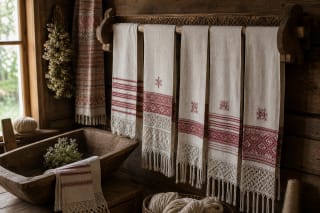
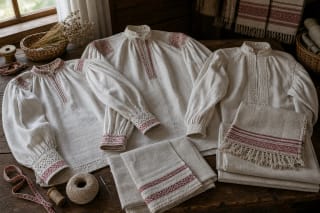
The chest held linen cloth, shirts, towels, tablecloths, sheets, sashes, aprons, shawls, embroidered objects, and sometimes jewelry, documents, money, or family relics. These were objects with both practical and symbolic value.
A dowry showed not only wealth but skill. Well-woven linen, orderly shirts, fine towels, or sashes testified to the textile abilities, patience, and household readiness of a woman and her family.
After the wedding, the chest could travel to the new home. It then became not only a dowry store but a piece of furniture carrying the memory of the family brought from home, with traces of a mother, grandmother, or native household's work.
Prieskrynis and inner order
Many chests had a prieskrynis, a smaller inner compartment or box usually built against one side of the chest. It was convenient for smaller and more valuable objects: sashes, jewelry, money, documents, sewing tools, or personal small items.
The prieskrynis shows that the chest was not an accidental box. It had an inner order: large textiles lay below, smaller things were separated, and frequently used or more valuable objects were kept more securely.
When a chest is restored or photographed, the prieskrynis helps explain its use. It is a small but very important construction detail that distinguishes a dowry piece from an ordinary storage box.
Painting, colors, and ornaments
Dowry chests were often decorated with painted flowerpots, tulips, lilies, roses, twigs, birds, geometric frames, colored bands, and sometimes stamped or incised elements. According to the Universal Lithuanian Encyclopedia, chests were painted green, blue, black, dark red, or brown, and among painted motifs the tree of life, celestial bodies, and paired animals dominate: birds, horses, or grass snakes shown in pairs. A dark ground made flower compositions stand out more clearly.
Floral ornaments do not necessarily have one fixed meaning. They may relate to youth, beauty, fertility, festivity, or simply a local painter's repertoire. It is more responsible to discuss the setting of the motifs than to insist that every flower meant only one thing.
Chest painting was both beauty and status. A more ornate chest was more visible in the room, suited the wedding dowry, and showed that the family invested not only in storage but in representation.
Construction and fittings
A chest consists of a plank body, bottom, lid, side or front boards, feet or supports, lock, hinges, handles, and often iron fittings. The construction had to be sturdy enough, because the chest held heavy linen and might be transported.
Iron fittings had a practical function: they strengthened corners, lid, and lock. Yet they were also decorative. Blacksmith-made details could give the chest rhythm, an impression of strength, and a feeling of protection.
Chests were usually made from light wood such as spruce, pine, or aspen, less often from ash or oak. Chests 100-160 cm long were strengthened with ornate forged fittings or sheet-metal geometric fittings, with folding iron handles at the ends, locks, and profiled feet. Poorly dried wood cracks, so the condition of an old chest often tells us both about its making and about later storage.
Regional differences
The construction and decoration of chests differed across Lithuanian regions. Aukštaitija chests are often described as narrowing toward the bottom, while Samogitian and Suvalkija examples more often have straighter sides. These are useful guides but not absolute rules.
Regions also differed in painting style: flowerpots, framed compositions, color combinations, ornament density, and fitting shapes may point to local taste or a maker's school. Yet furniture traveled with dowries, so one object may have the history of several places.
In Lithuania Minor, chests and kuparai had their own furniture-tradition features connected with local woodwork, Protestant domestic culture, and the coastal and lagoon environment. These forms are worth comparing, but they should not be flattened into a single model for all Lithuania.
Wedding and inheritance meaning
The dowry chest was closely connected with weddings. The dowry accumulated inside it, called šarvas in Dzūkija, showed what a young woman brought into a new household: textiles, clothing, towels, tablecloths, sashes, and sometimes other valuables. According to custom, the mother's dowry chest passed to the eldest daughter; during the wedding, kraitvežiai transported the dowry to the groom's home; and if a wife died childless, her parents could reclaim the unused part of the dowry under customary law.
The chest could be a gift, a family item, an inherited object, or a piece commissioned specifically for the dowry. Its painting and condition became a visible part of wedding representation, because the chest symbolically accompanied the young woman into her new home.
Later the chest could remain a family relic. Even when textile work changed, the old chest preserved memory of a mother, grandmother, wedding, native home, and handmade textiles.
Care and restoration
An old dowry chest should be protected from dampness, direct sunlight, mold, insects, sudden temperature shifts, and aggressive cleaning. The painted surface is especially sensitive, because household cleaners can remove not only dirt but the authentic paint layer.
In restoration, it is important to distinguish structural repair from surface renewal. Lock, hinges, fittings, prieskrynis, old paint, and even wear are parts of the object's history. A chest fully repainted to look new may lose historical value.
If a chest has family or museum value, it should be documented before sanding, varnishing, or repainting, and a conservator should be consulted. Sometimes the best care is stable conditions, gentle dust removal, and nothing more.