- When / context
- When a farm passed to the next generation, usually as its owners aged or a young couple established a household
- Tradition area
- Community life
- Themes
- Farm transfer, išimtinė maintenance agreement, aging parents, heir, užkurys, young bride, daughter-in-law, trousseau, marriage portion, elder care, customary law
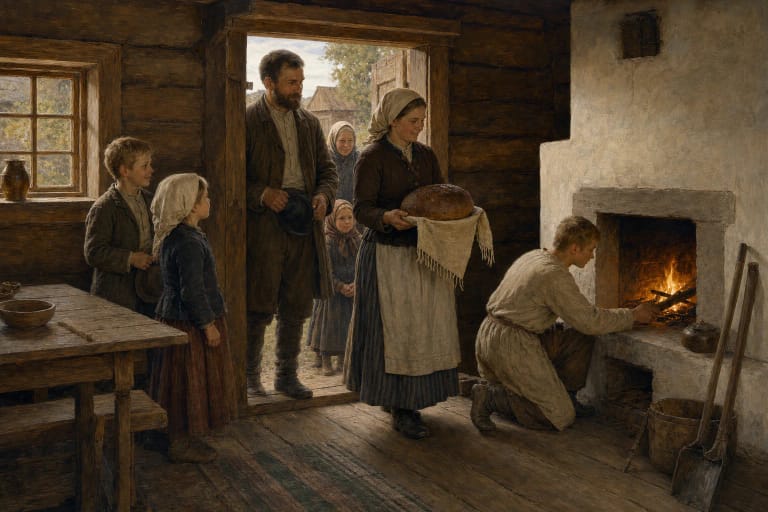
Transferring a farm in rural Lithuania meant more than inheriting land. Authority within the household was redistributed, support for aging parents negotiated, other children compensated, and a place found for a daughter-in-law, a newly married woman, or an užkurys who entered his wife's farm.
Farm Transfer Was More than Posthumous Inheritance
Inheritance in the strict legal sense begins when an owner dies, but a Lithuanian farm was often transferred while its owners were still alive. Illness, old age, or the marriage of a young couple could prompt the older generation to withdraw from daily management. A successor then learned the rhythm of work and assumed control of animals, buildings, debts, and stores, while the parents negotiated their future support. Farm transfer and inheritance were connected but not identical.
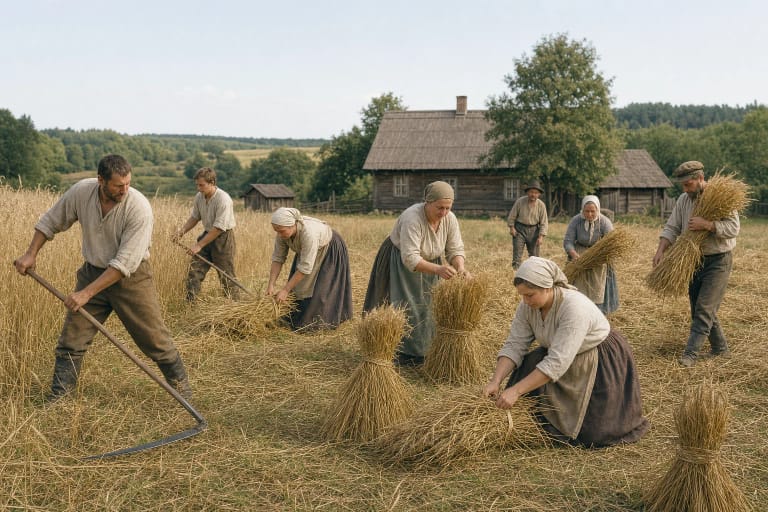
The transferred unit was more than acreage. It comprised buildings, livestock, tools, seed, food reserves, labor relationships, and the family's reputation. The new householder gained an opportunity to farm but also assumed obligations: maintaining parents and honoring settlements with siblings, hired workers, and neighbors. When several generations continued to live on one farmstead, authority might pass gradually and not always peacefully.
Who Received the Farm? Regional Patterns
The Universal Lithuanian Encyclopedia's account of customary law says that aging parents in Suvalkija and Samogitia more often transferred a farm to one son, or to a daughter when there was no son; the eldest could have priority. This helped keep a viable holding intact, but other children still had to be provided with property, a trousseau, a marriage portion, or money. Ability to work, marriage plans, health, family conflict, and debt could matter alongside birth order.
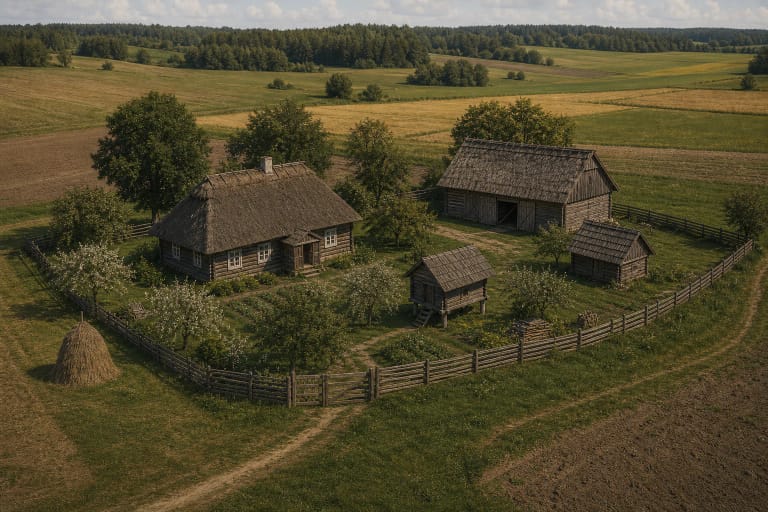
Land in Aukštaitija and Dzūkija was more often divided among sons and sometimes daughters. In eastern and southeastern Lithuania parents might retain several strips of land instead of drawing up a detailed maintenance contract. This distinction matters: an undivided farm inherited by an eldest son was not 'the Lithuanian rule.' Even within one region, a strip-field village, an isolated farmstead, a smallholding, and a prosperous farm offered different possibilities.
What Was an Išimtinė Agreement?
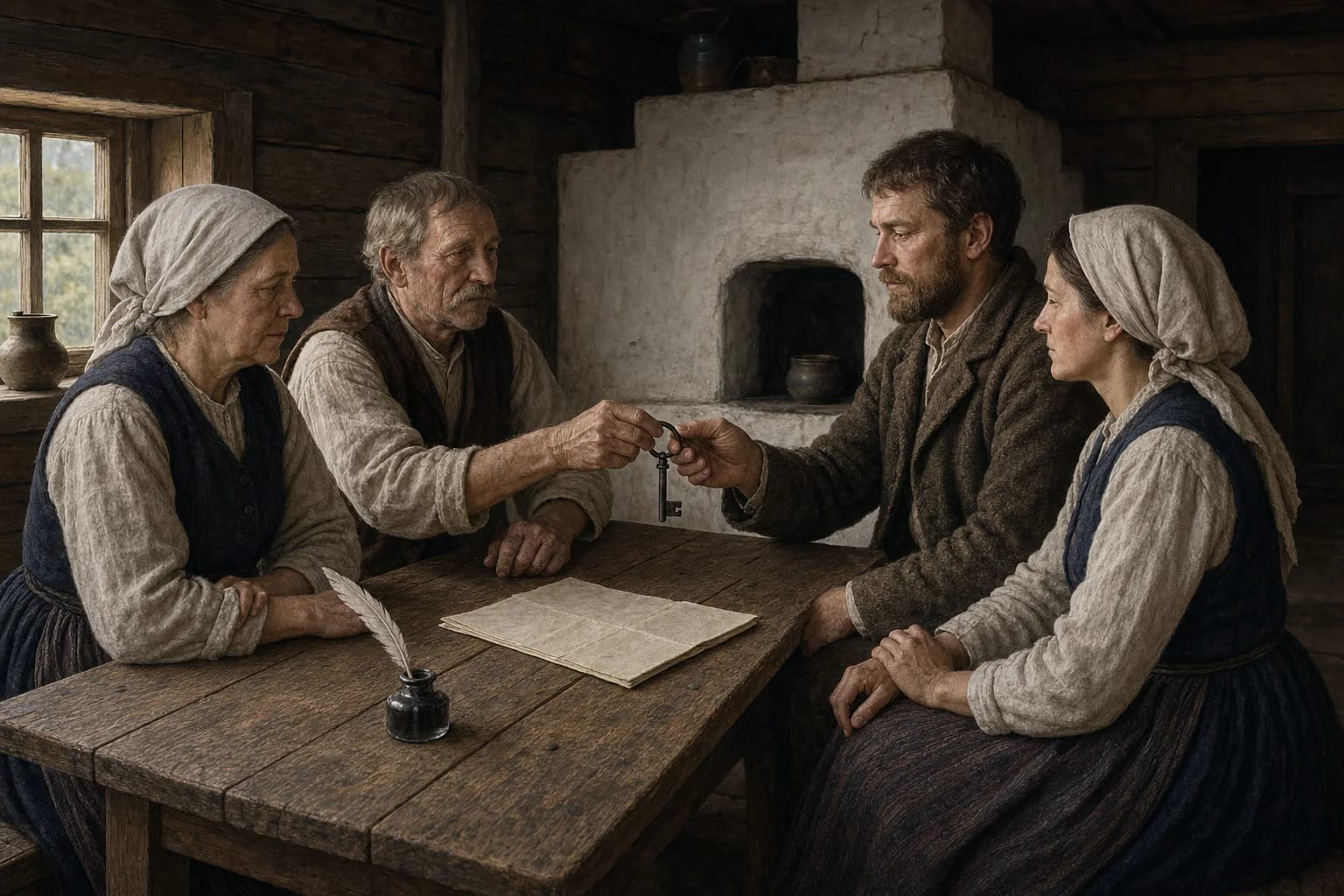
Išimtinė, also called ordinarija, was maintenance owed to the former owners under an agreement between the parties. The aging parents who received it were known as karšinčiai or išimtininkai. The arrangement lasted for life and could include not only daily support but care during illness and conditions for burial. A transfer of property was therefore tied to specific duties that the new holder owed the previous generation.
An išimtinė could still be agreed orally in the first half of the 19th century, but later it was increasingly written and certified by a notary. Writing mattered especially when a farm passed outside the immediate family or was sold. In customary understanding, a buyer could acquire a farm together with its duty to support the resident išimtininkai. The obligation was consequently attached not only to children's affection but to the economic value of the property itself.
What Did an Išimtinė Contract Provide?
Encyclopedic records list remarkably concrete provisions: living space, potatoes, grain, meat, milk, butter, eggs, cash, clothing, transport to church or town, a fruit tree, or a beehive. A 'geležinė karvė,' literally an 'iron cow,' meant the right to milk another cow when one stopped producing rather than ownership of one particular animal. That detail protected an older couple from seasonal shortage and shows how a farm's resources were converted into social security.
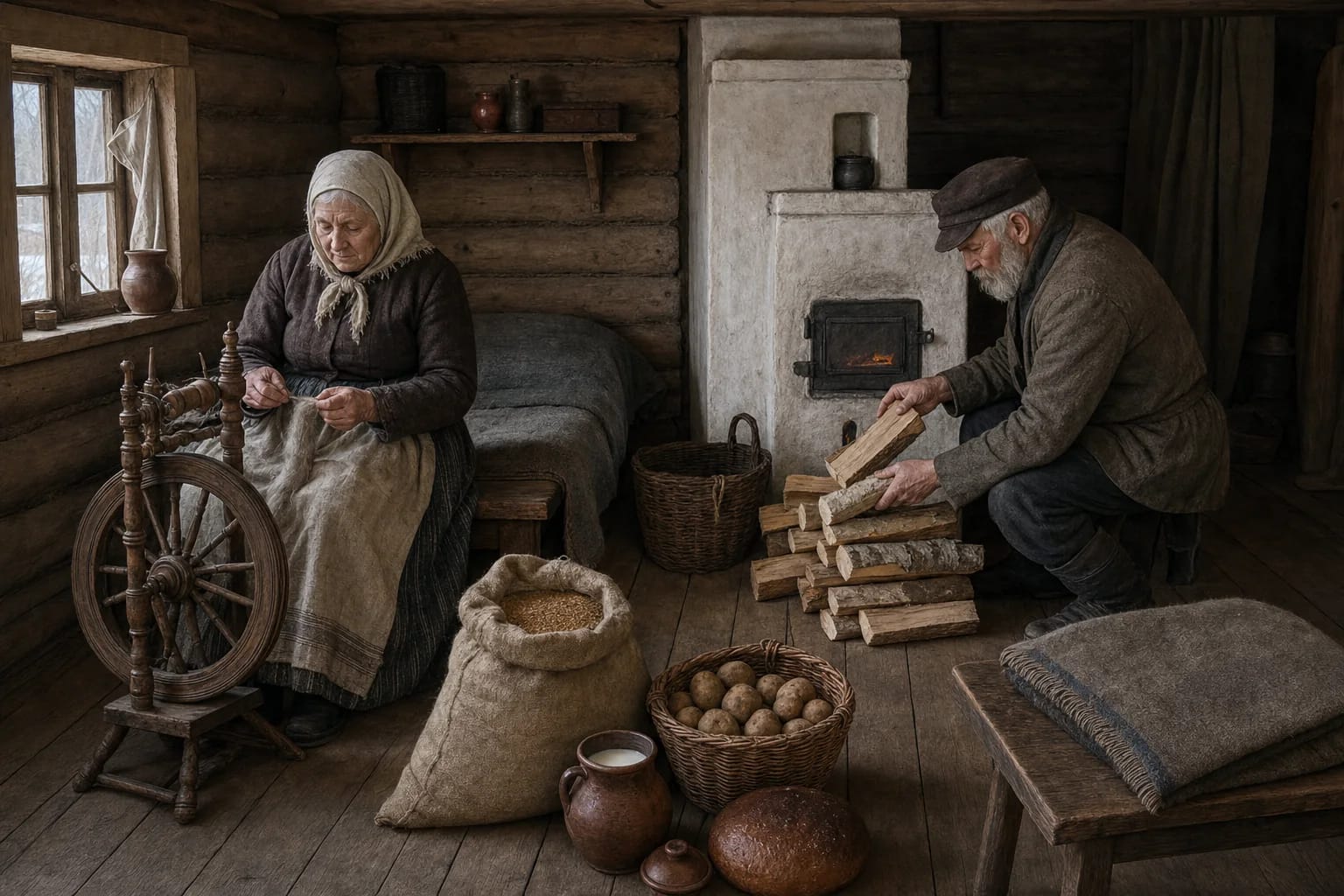
A long list may appear distrustful, but in daily life it reduced ambiguity. How much grain was due? Who supplied firewood? Would the parents eat at the common table? Who took them to a doctor or church? An unwritten promise could shift after the successor married, during a poor harvest, or through illness. Yet even a detailed document could not ensure kindness, and material maintenance was no substitute for respect and emotional connection.
Common Table, Priešininkė, and Stubelė
Living conditions differed noticeably by region. In eastern Aukštaitija, išimtininkai more often ate at one table with the family of the son or son-in-law who received the farm; the encyclopedia calls this the lightest form of išimtinė. Parents might also eat for a week at a time with different children. In Samogitia, a separate room called a priešininkė could be assigned to them. Separation offered some independence, but it could also create greater isolation in everyday life.
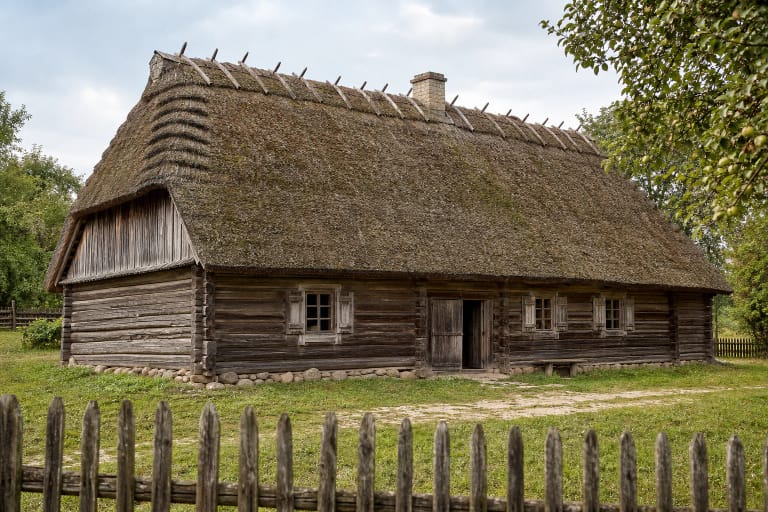
In Lithuania Minor, aging parents could be ceremonially escorted to a room called a stubelė during the successor's wedding. In other cases they retained the other end of the dwelling, the entire old house, or a small separate house on the farmstead if the successors built a new one. These forms cannot be explained by family feeling alone. House plan, farm size, construction resources, local custom, and the differing legal environments of Prussia and Lithuania proper all mattered.
Išimtinė between Care and Conflict
At its best, išimtinė balanced generations: the young received the base of a functioning farm and the old secured support and a place on their farmstead. The same agreement could generate tension. Successors might consider its demands excessive; former owners might believe that they received poorer food or too little fuel. When one of an older couple died, the provision was often halved unless the agreement said otherwise, even though the cost of a room and heat did not necessarily fall by half.
Community opinion could discipline an heir who neglected a duty, but it should not be idealized as reliable social protection. Older people lost bargaining power after transferring their property, especially when the agreement was vague and care depended on relatives with whom they quarreled. Išimtinė is therefore a history of solidarity and vulnerability. It helps explain older family terms but cannot replace present-day law governing property, inheritance, support obligations, and social care.
Užkurys: a Husband Entering His Wife's Farm
An užkurys was a man who moved after marriage into a widow's household or a farm with daughters but no son to succeed it. In eastern Aukštaitija, the term could be used for any son-in-law. Men from large and less affluent families were more likely to enter such an arrangement because marriage offered a chance to establish themselves on another holding. At the same time, it allowed the farm to remain within the daughter's family line.
The encyclopedia says that customary law did not automatically give an užkurys rights to the farm's land, although in the first half of the 20th century a share was increasingly secured by contract. Historian Dalia Leinartė warns against repeating the stereotype that he was always a powerless helper to his wife: his actual authority depended on the wealth of both families, the agreement, and his real role in the farm. Nicknames and humor signal an unusual male residence pattern, but do not establish the everyday position of every užkurys.
The Jaunamartė and Marti in a New Household
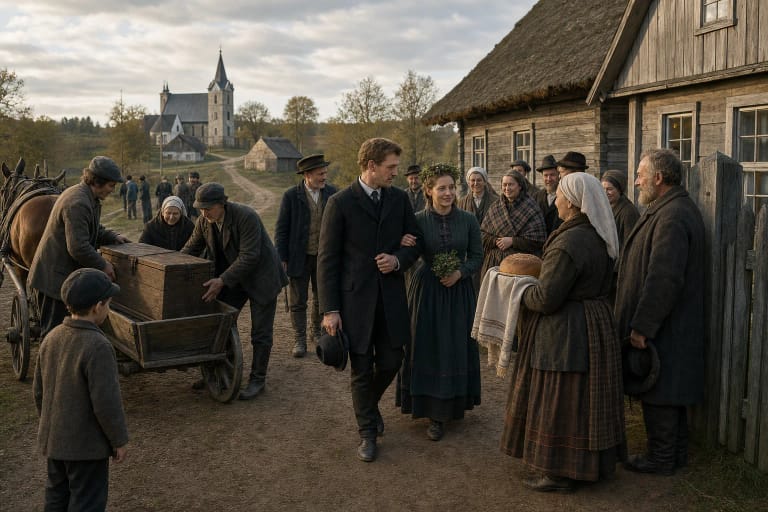
The more common pattern ran in the other direction: after marriage, a bride entered her husband's family farm. During her first married year she was called a jaunamartė. The encyclopedia links the end of that status to the first child, while some 16th- and 17th-century descriptions specified a first son. This was not a biological rule but the status language of a historical patriarchal household. She was later called a marti, or daughter-in-law, and more fully drawn into the duties of a household mistress.
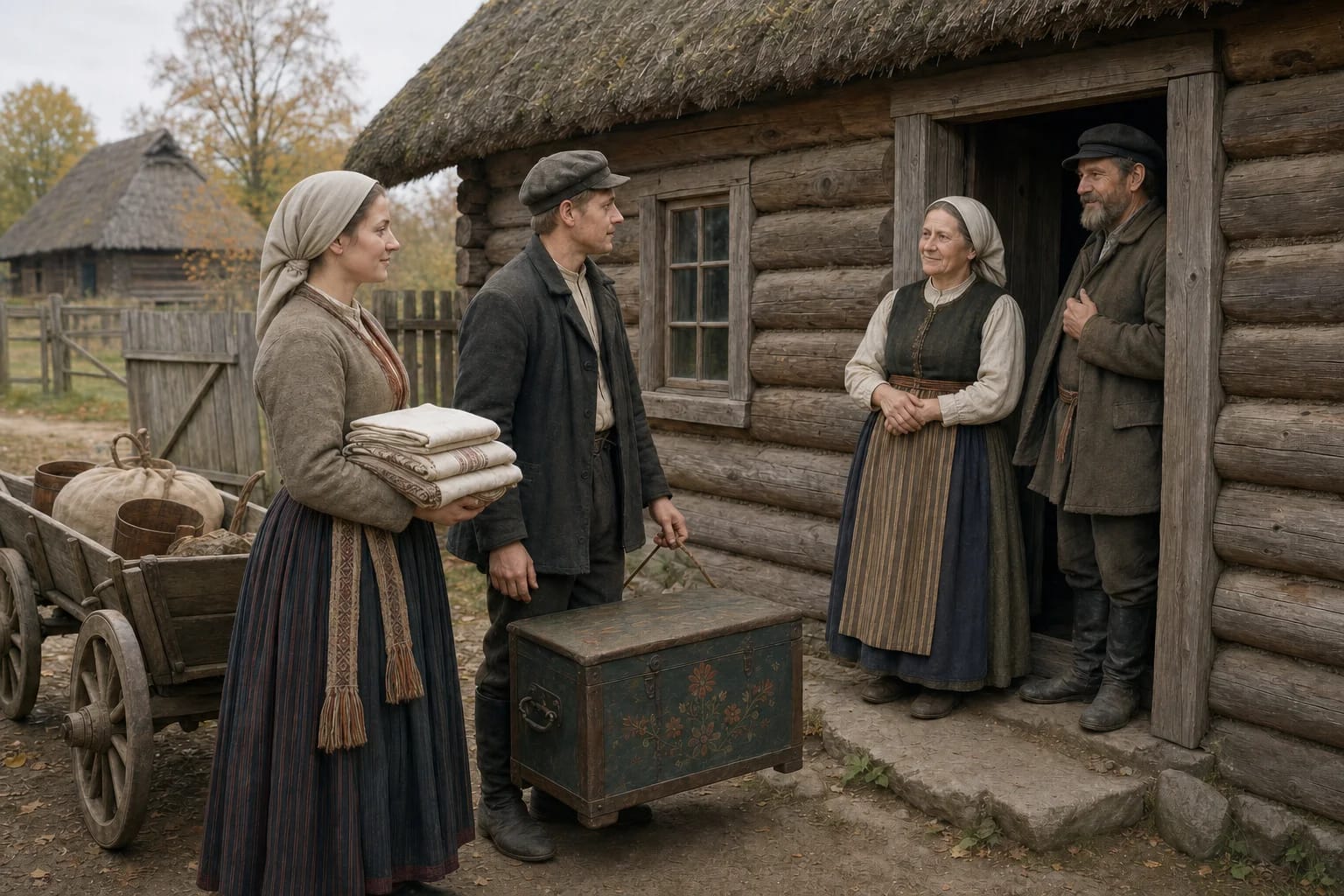
A jaunamartė gave woven sashes, towels, or lengths of cloth on significant first occasions: visiting the bathhouse, entering another home as a guest, beginning the rye harvest, or receiving a priest making parish rounds. Gifts built relationships with her husband's kin, neighbors, and parish, while also revealing how much adaptation was expected from her. Sources mention honoring her at the table and serving her first, but ceremonial respect did not remove her dependence on her husband, mother-in-law, or the farm hierarchy.
Trousseau, Marriage Portion, and Women's Property Limits
Customary law distinguished the kraitis, or trousseau, from the pasoga, a marriage portion. In the encyclopedia's account, clothing, textiles, household goods, and other trousseau property remained the woman's, while the marriage portion belonged jointly to the spouses. If a jaunamartė died within the first year without children, her parents or kin could recover the marriage portion and unused trousseau; if a mother left children, her brought-in property passed to them. Written law in force at the time also affected the outcome.
Men usually managed a farm's cash affairs, although a wife might keep income from selling butter, cheese, eggs, poultry, or vegetables. Such an economic sphere did not amount to equal property rights. A daughter's likelihood of receiving a farm often rose only in the absence of sons, while a woman's standing was tied to marriage and motherhood. These customs should not turn inequality into cozy nostalgia; they show how women acted within a restrictive system and which resources they could retain.
The same account of customary law gives a more complicated picture of vulnerable children. A child with a physical or mental disability retained a right to a share, while an unmarried mother, although condemned for having a child, usually did not lose hers. A child who defied parental will, however, could be disinherited. These coexisting norms were not consistently equal: one vulnerable person might be protected while another was disciplined through property and public opinion.
Period, Law, and Confession: No Single Model
Rules of transfer changed with landownership. Under serfdom, peasants could not everywhere dispose freely of land. After 1795, different parts of Lithuania lived under the laws of the Russian Empire, Prussia, the Napoleonic Code, and other legal systems. Custom still governed many family property relations until the First World War, but written contracts and notaries increasingly defined rights. Interwar land reform, the move to isolated farmsteads, migration, and hired work again altered what a 'family farm' meant.
Confession shaped marriage, family ritual, and community institutions, but the sources do not justify attributing each inheritance pattern directly to religion. Catholic Samogitia, confessionally mixed eastern Lithuania, and largely Lutheran Lithuania Minor also differed in law, house plan, landholding, and economy. Soviet collectivization broke the continuity of many private farms, and išimtinė declined by the mid-20th century. These terms illuminate rural life in the 19th and early 20th centuries; they are not a modern inheritance manual.