- When / context
- After moving into a new home; construction milestones were marked separately
- Tradition area
- Community life
- Themes
- Housewarming, new home, foundation feast, builders' finishing feast, rafter wreath, household fire, bread, blessing a home, neighbors, gifts
A Lithuanian housewarming was more than a party in a new building. Ethnographic sources reveal a sequence that could include marking the foundations, honoring builders and work parties, raising a rafter wreath, bringing in fire and bread, blessing the home, and receiving neighbors.
What Were Lithuanian Housewarming Customs?
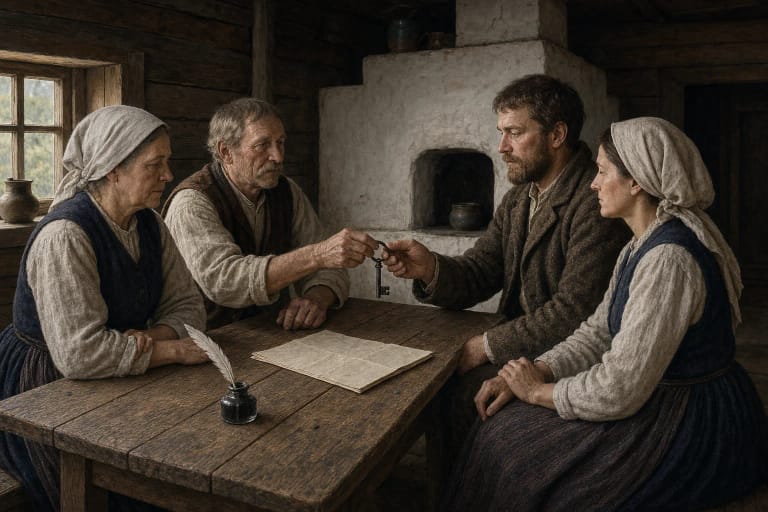
Įkurtuvės means the celebration of moving into a new house or apartment. The Universal Lithuanian Encyclopedia also records the older name įkurės and summarizes an earlier form as bringing in fire or honoring household spirits. That definition draws together evidence from different periods rather than supplying one ceremony to reenact. The decisive boundary was not the last nail driven into the roof but the beginning of habitation: the family brought in possessions, started the place used for heat and cooking, and received its people for the first time as hosts of the new home.
From the mid-19th century, sources increasingly describe housewarmings as feasts with songs and dancing, sometimes held about a week after the move. The interval was practical: the rooms had to be made ready for guests. Date, attendance, and splendor still depended on a family's resources. A newly established farmer, a small-town artisan, an estate worker, and a tenant could not hold the same celebration, while many moves left no record of ritual at all.
Housewarming, Foundations, and Finishing Feasts
Everyday speech sometimes calls any celebration during construction a housewarming, but ethnographic evidence supports three useful distinctions. Pamatinės marked a beginning associated with the foundations; a builders' pabaigtuvės, or finishing feast, could accompany the completion of an important structural stage; įkurtuvės came when the family began living in the building. All three might be visible in one locality, while elsewhere only a shared meal at the end of the work was remembered.
This distinction prevents the invention of a single 'old ceremony.' A wreath on the rafters did not mean that the family moved in that evening, and the first household fire was not the builders' reward. Names also shifted between contexts: pabaigtuvės referred not only to construction but to the completion of harvesting, threshing, flax processing, and other work done collectively. Each sign therefore belongs to a particular stage of the project.
Pamatinės and Responsibility to the Builders
The encyclopedia's overview of Lithuanian customs places pamatinės among work customs alongside communal work parties and finishing feasts. Its name links the occasion with the foundations, but detailed local sequences were not uniform. In one place an owner might feed the carpenters as work began; elsewhere the first wall course or another completed stage mattered more. It is more accurate to speak of marking the start of construction than to prescribe one nationwide set of actions.
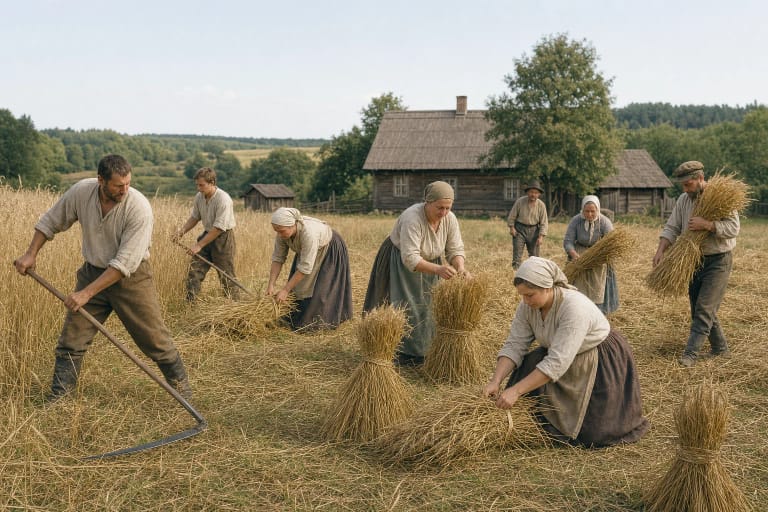
Food and drink carried a social obligation. A wooden house was the outcome of many hands, specialized knowledge, and help from neighbors. Carpenters determined how logs would be joined, roofers protected the building from rain, and helpers carried timber and raised heavy members. The owner's generosity acknowledged their skill and labor. This was not always romantic volunteer work: builders could be hired, and the meal supplemented rather than necessarily replaced an agreed payment.
The Rafter Wreath and the Builders' Finishing Feast
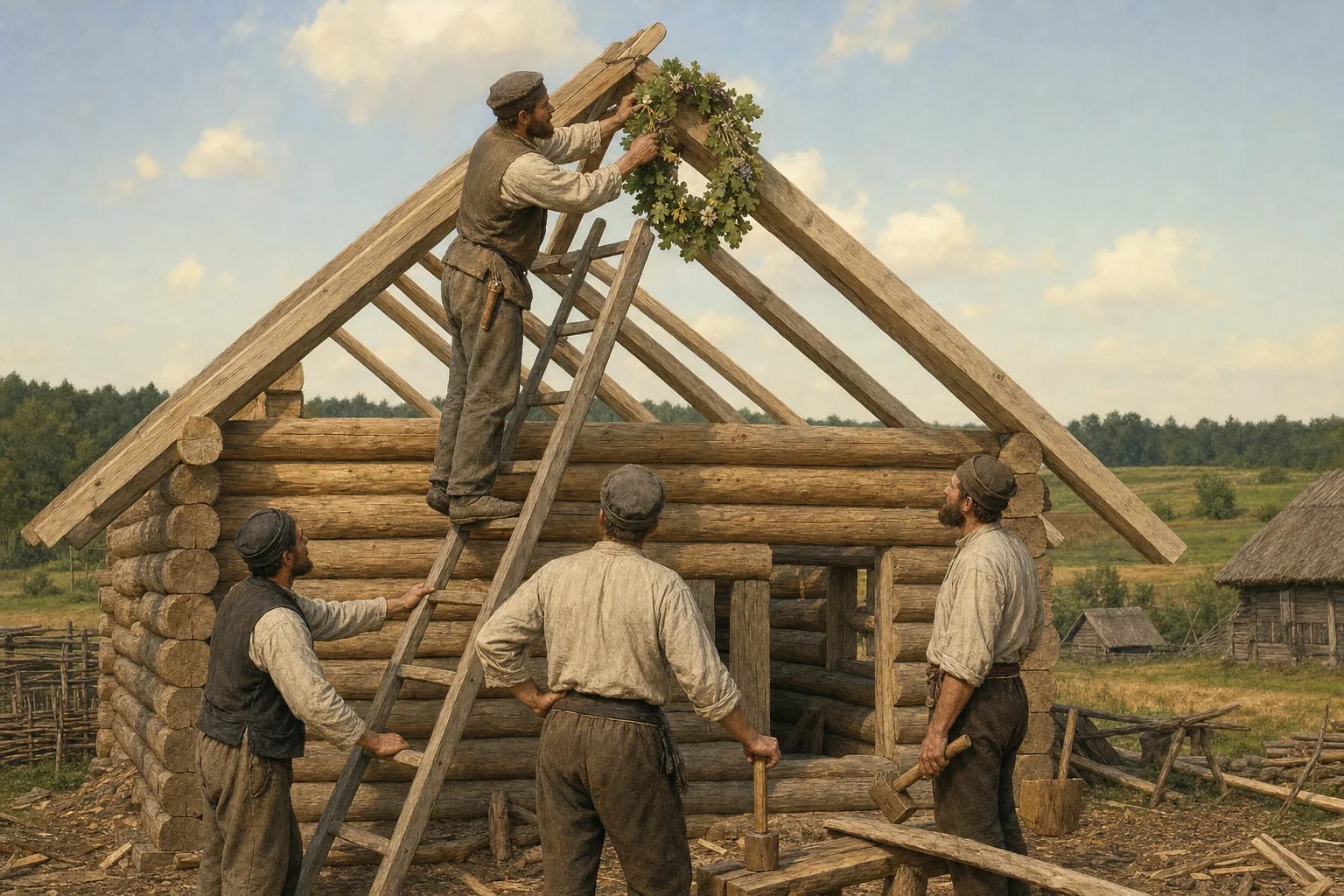
One of the best-attested construction signs appeared when the rafters had been raised. According to the encyclopedia, builders fastened a branch or a flower wreath to an end rafter. In Samogitia, a cheese shape cut from a board and a bottle might be added. The greenery publicly announced that a visible and dangerous structural stage had been completed and reminded the owner of an obligation to provide a finishing meal.
The custom changed without disappearing. The encyclopedia notes that an oak-leaf wreath still appeared at building sites in the early 21st century. This continuity does not make a contemporary event an exact copy of a 19th-century village practice. A modern professional crew works under contracts and safety regulations. A recognizable sign of thanks survives, but the relationship between client and builders has changed.
The Threshold and First Entry into an Empty House
Historical descriptions sometimes give the first entry to an animal. Matthäus Prätorius wrote in the 17th century that in Lithuania Minor a rooster and hen were admitted before people entered, with possible misfortune expected to fall on the birds; his account says they were not later slaughtered for food. Simonas Daukantas related a story about leaving a cat or dog in a new house overnight. These are sources of different date and character, not parts of a national protocol.
Such actions should not be reenacted, particularly by leaving an animal in an unsafe building. Their value lies in showing that an uninhabited room seemed unfamiliar and potentially dangerous and that crossing its threshold mattered. The modern saying that a cat should enter first may resemble an older motif, but resemblance alone cannot prove that every present-day choice is an unbroken ancient tradition.
Bread at a Lithuanian Housewarming
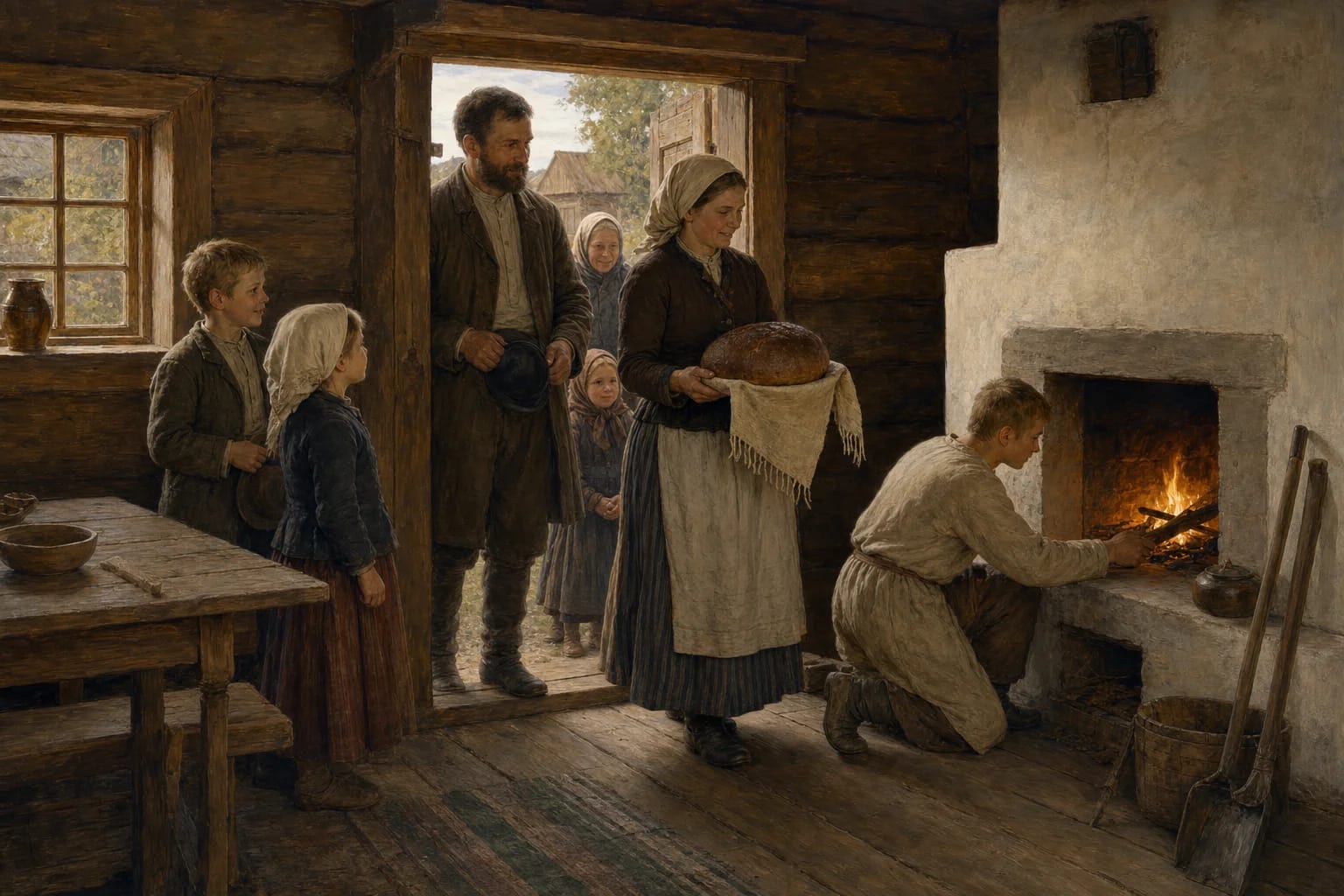
In Prätorius's account from Lithuania Minor, loaves were rolled into the new room before a feast was held. Bread was the foundation of daily subsistence and evidence that a host could feed both household members and guests. At a housewarming it was not merely decorative: it wished for sufficient food, productive work, and a door open to hospitality.
Other accounts mention bread blessed on Saint Agatha's Day being carried around a new building. Here the everyday value of bread meets a Catholic protective practice: in Lithuania Saint Agatha's bread was associated with protection from fire. The motifs should remain distinct. An ordinary loaf on a housewarming table, Prätorius's rolling of loaves, and blessed Saint Agatha's bread come from different settings even though all speak to security and sufficiency in the home.
The First Fire and Continuity between Homes
In the housewarming account transmitted by Daukantas, the new hearth is ceremonially kindled with fire brought from the previous dwelling. The act expresses continuity: the family changes walls without abandoning the entire order of its earlier life. Fire in the new house meant warmth, light, and the ability to prepare food. Until it burned, the building was not yet a fully functioning home.
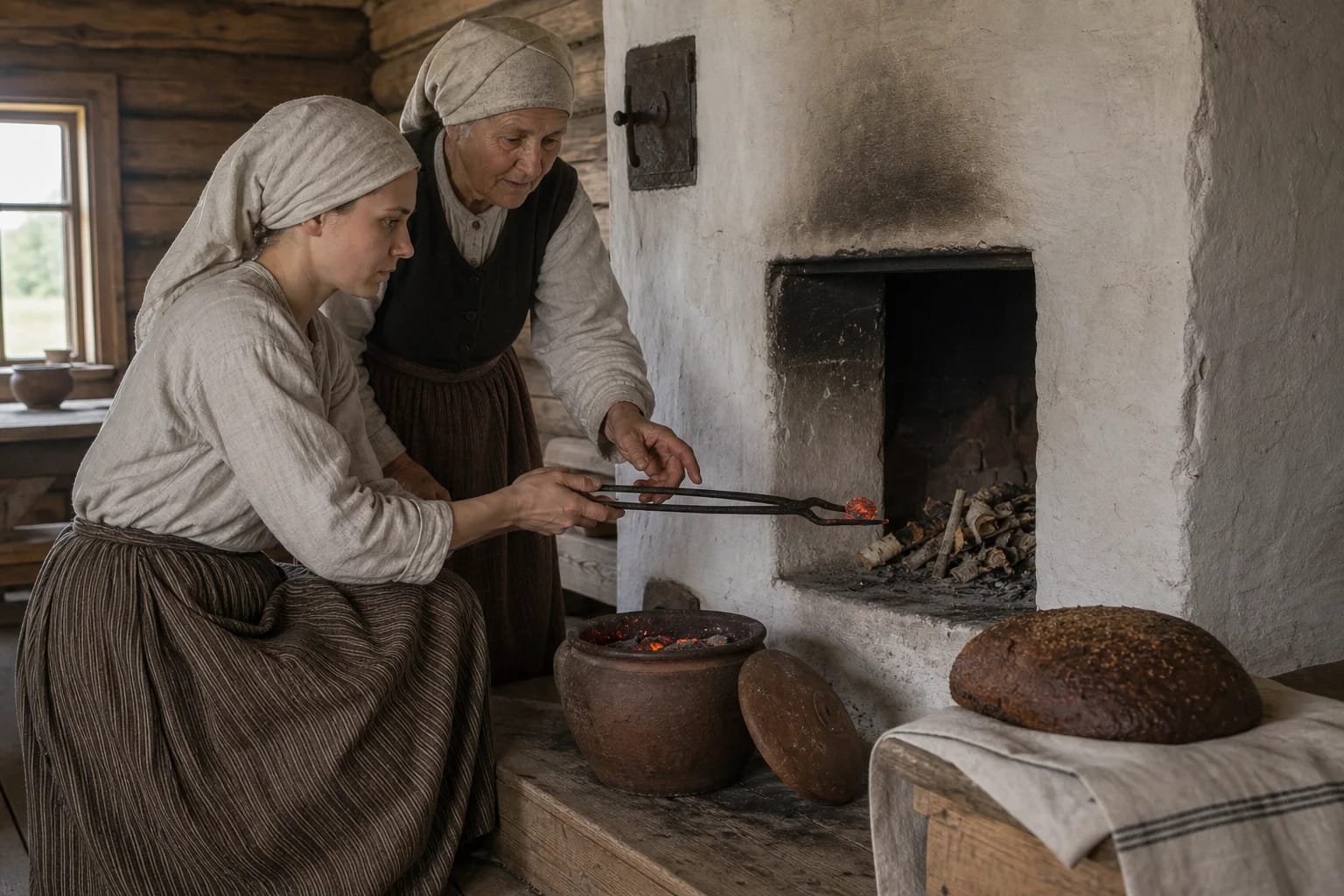
Claims about an 'eternal household flame' require caution. A 19th-century historical and ethnographic text combines collected material with its author's interpretation, and the practice is not documented equally across Lithuania. The hearth itself also differed among a Samogitian troba, an Aukštaitian pirkia, a Lithuania Minor stuba, and an urban dwelling. A shared symbol cannot replace the history of a particular building.
Blessing the Home and Confessional Difference
Accounts from Catholic settings describe walking around a house with Saint Agatha's bread, fumigating its corners with blessed herbs, and sprinkling them with holy water. In later practice a family might invite a priest to bless the dwelling and place a cross or devotional image inside. These acts connected household safety with the parish and a church blessing, although folk explanations of protection did not always correspond exactly to official theology.
Lithuania was not confessionally uniform. Lutheran parishes and Prussian administration shaped life in Lithuania Minor, while Catholics, Orthodox Christians, Old Believers, Jews, and other communities lived in eastern and southeastern Lithuania. This page primarily presents customs recorded in Lithuanian ethnographic sources; it cannot turn a Catholic blessing into a rule for every inhabitant of Lithuania. Even households of the same confession chose different degrees of ceremony.
Region and Social Position Changed the Celebration
The encyclopedia says that an entire village might attend a housewarming in Aukštaitija. This indicates the possible communal scale of the occasion, not a rule followed at every Aukštaitian home. Prätorius's testimony belongs to 17th-century Lithuania Minor, Daukantas's narrative to 19th-century historical writing, and much later field evidence chiefly to peasant farmsteads of the late 19th and early 20th centuries. Combining all these fragments into one evening would be an anachronism.
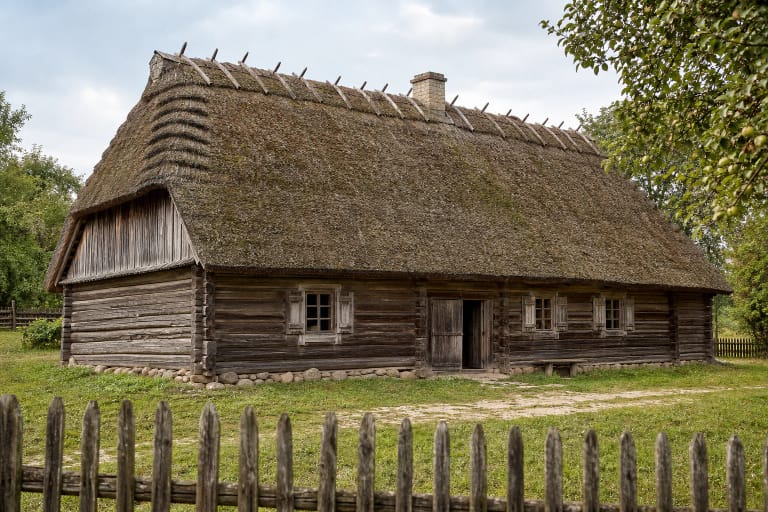
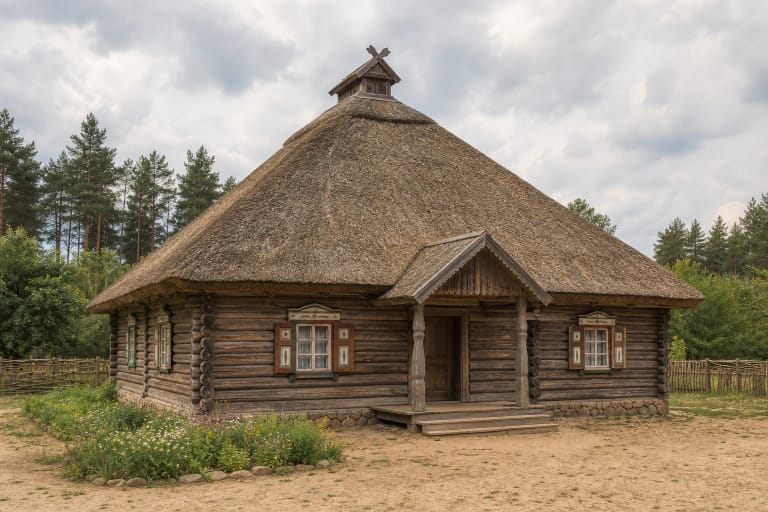
The dwelling itself varied. A broad Samogitian troba could contain many rooms; an eastern Lithuanian pirkia followed a different plan; in Užnemunė the word stuba was used and influence from Lithuania Minor was visible. A prosperous farmer, a landless worker, and a town family established homes under unequal conditions. For a tenant, moving did not mean ownership of land or building, and a poor household might receive only its closest kin. The custom adapted to social reality; it was not a test of luxury.
Neighbors, Gifts, and Housewarming Today
Inviting kin and neighbors publicly established the family's place. Guests learned where the new door and table were, while hosts thanked those who had helped with construction, hauling materials, or moving. From the mid-19th century, accounts increasingly describe housewarmings as feasts with songs and dancing. Ritual motifs did not necessarily vanish: bread, fire, blessing, and the first reception of guests could coexist with an ordinary celebration.
Present-day guests may bring bread, salt, a plant, a vessel, a towel, or another practical gift. Not every such object is old, and none needs an invented archaic explanation. A historically responsible continuation is to gather those who contributed to the home, share bread and its story, and mark a beginning in a way appropriate to the family or its confession. The point is not to reproduce animal ordeals or magical tests, but to retain hospitality, gratitude, and responsibility for shared space.