- Field
- Lithuanian women’s national-costume skirts, pleats, checks, stripes, and regional woven fabrics
- Type
- textiles
- Heritage status
- well attested
- Context
- Lithuanian skirts, national costume, checked skirts, striped skirts, pleats, selected weaving, marginė, kedelis, Aukštaitija, Dzūkija, Žemaitija, Suvalkija, Lithuania Minor
National-costume skirts, Checked skirts, Striped skirts, Marginė, Kedelis
Skirts forms and objects
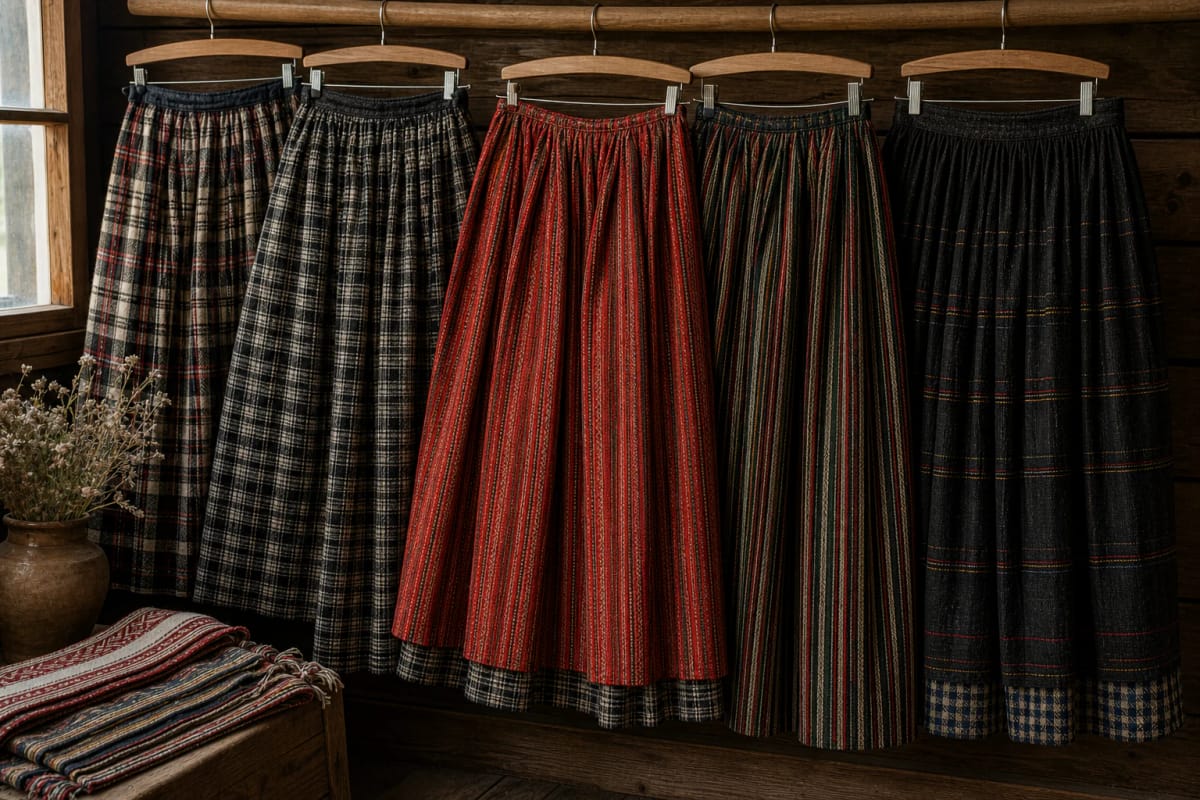
Checked Skirts: Skirts woven from intersecting lengthwise and crosswise color rhythms, especially associated with Aukštaitija and Dzūkija costume traditions.
Striped Skirts: Skirts woven with vertical or horizontal stripes, prominent in Žemaitija, Suvalkija, and other regional costumes.
Pleated and Gathered Skirts: Wide fabric drawn into pleats or gathers at the waist so the skirt falls well and allows movement.
Marginė and Kedelis: Lithuania Minor and Klaipėda-region terms connected with local women’s skirt forms and the Lietuvininkai costume.
What Is a Traditional Lithuanian Skirt?
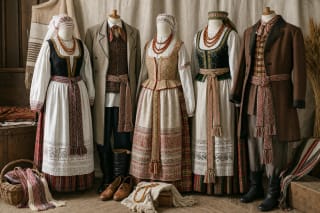
The skirt was a central part of women’s traditional dress, worn with a shirt, apron, bodice, sash, head covering, and other costume elements. It forms the largest field of color in the outfit and strongly shapes the regional impression.
Traditional skirts were long, wide, often woven from wool, half-wool, or mixed yarns. At the waist the fabric was gathered, pleated, or otherwise drawn in so the wearer could move and the skirt would fall properly.
A skirt should be read as part of costume architecture rather than as an isolated garment. If its color, length, or pattern does not fit the apron, bodice, and shirt, the whole costume loses regional accuracy.
Fabric, Width, and Construction
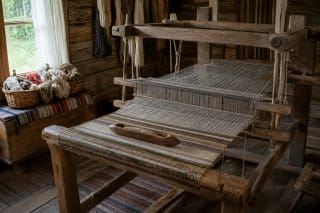
Skirts required a generous amount of cloth. Panels woven on home looms were sewn into a cylindrical or semi-cylindrical form, gathered or pleated at the top, and sometimes reinforced or finished at the hem. Sources describe long skirts made from three to seven panels, gathered at the waist, with several white or striped underskirts often worn beneath.
Woolen fabric gave the skirt weight, warmth, and strong color. Linen or cotton could appear in linings, waist parts, underskirts, or later versions, but wool was very important in festive skirts.
Construction has practical logic. A skirt that is too narrow does not look traditional and restricts movement; one that is too wide without proper pleating loses shape. Sewing matters as much as the woven pattern.
Checked and Striped Skirts
A checked skirt is built from crossing lengthwise and crosswise color rhythms. The size of the checks, contrast, and weave density can indicate region, period, or local taste.
A striped skirt relies on repeated vertical or horizontal bands. Vertical stripes lengthen the visual line of the garment, while strong red, green, blue, black, or other combinations can become the costume’s main accent.

Reconstruction should avoid a crude rule that one region is checked and another striped. There were variants, fashions changed, and museum examples show more diversity than simplified charts suggest.
Aukštaitija and Dzūkija Skirts
Aukštaitija skirts are often presented as checked, with lighter or clearly ordered color combinations, fitting the region’s white linen and nuometas traditions. They can be quite festive but not always loud. According to VLE, in the 19th century Aukštaitija and Dzūkija skirts were mostly checked, while festive ones were woolen or half-woolen, in green, red, violet, yellow, and in Dzūkija also blue or beet-red tones.
Dzūkija often favors smaller checks, darker or more restrained combinations, and a dense relationship with sashes and aprons. Its costume can appear rich in pattern but at a smaller scale.
In both regions, a checked skirt is not just ordinary cloth. It is a regional color code that has to work with the apron, bodice, and head covering.
Žemaitija Skirts
Žemaitija skirts are often associated with strong colors, especially red, dark, and saturated stripes. Žemaitija women were also known for wearing several skirts, with lower layers sometimes visible below the top one.
Wearing several skirts had practical and representative meaning: it added warmth, volume, and showed textile wealth. The layers were not accidental; they created the regional silhouette.
A Žemaitija skirt cannot be understood apart from scarves, bodices, and the colorful upper costume. Its brightness belongs to the whole clothing system.
Suvalkija Skirts
Suvalkija skirts often have a clear, ordered color logic: a darker ground, lengthwise stripes, good fabric quality, and strict harmony with the apron. Restraint and precision matter.
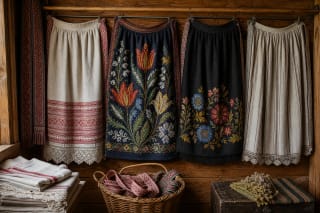
In Suvalkija costume the apron can be highly decorative, so the skirt should not compete chaotically with it. Its pattern holds the composition and supports the visual center of the full outfit.
This shows how one costume element can be more restrained so another - apron, bodice, or shirt - can stand out more strongly.
Lithuania Minor: Marginė and Kedelis
In Lithuania Minor, the dress of Lietuvininkai women includes local skirt names such as marginė and kedelis. They belong to the Klaipėda region and Prussian Lithuanian clothing world, where garment terminology and form differ from the larger Lithuanian regions.
Lithuania Minor skirts are often connected with darker color, a more restrained silhouette, a Lutheran cultural setting, and the delmonas pouch. In the first half of the 19th century, checked and lengthwise-striped woolen skirts (dark brown, black, blue, red, yellow) were woven there; by the late 19th century, dark, often black, finely pleated skirts with narrow colored cross-bands became common.
The Lietuvininkai skirt needs to be matched with regional bodices, aprons, head coverings, and the delmonas. Only then does the local logic appear clearly.
Underskirts and Layers
Women could wear more than one skirt. Underskirts gave warmth, volume, and shape, and sometimes showed at the hem. In Žemaitija, multiple skirts are an especially important visual feature.
The lower layer was not necessarily as ornate as the outer skirt. It could be more practical yet still tidy, because movement, sitting, or dancing might reveal it.
Stage costumes often simplify this layering. A historically convincing costume needs not only an outer skirt but the right volume, length, and understructure.
How to Evaluate a Skirt Reconstruction
Start with region and period. Then ask which museum example or description the cloth follows, what material was used, how checks or stripes are placed, what the length is, and how the waist is pleated or gathered.
Even beautiful fabric can become an inaccurate costume if the skirt is too short, too narrow, paired with the wrong apron, or built on the wrong color logic. National costume is a system.
A modern interpretation can be honestly modern, but a historical reconstruction should identify its source. That distinction separates museum accuracy from stage costume, souvenir design, or personal fashion.