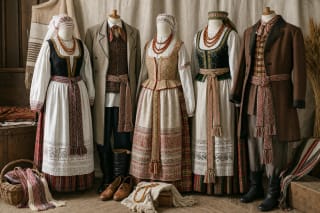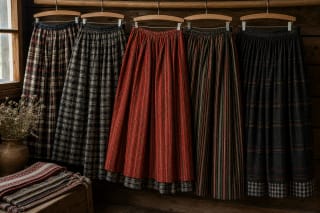
- Field
- Women's kiklikai, men's waistcoats, and the upper-layer construction of national costume
- Type
- textiles
- Heritage status
- well attested
- Context
- waistcoats, kiklikai, vystės, tabs, tongues, pleats, hooks, buttons, ribbons, women's national costume, men's national costume, regional waistcoat types
Kiklikai, Vystės, National-costume waistcoats, Women's waistcoats, Men's waistcoats
Waistcoats forms and objects
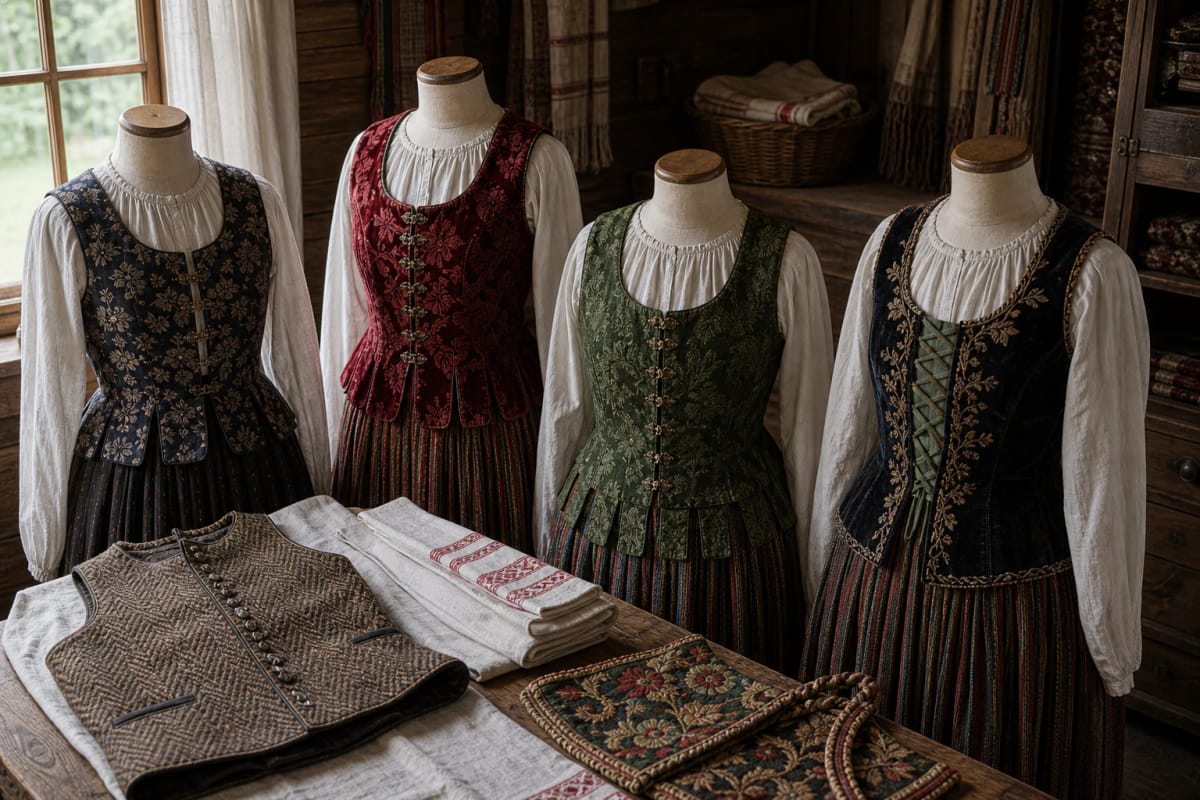
Women's kiklikai: Festive women's waistcoats worn over shirts and combined with a skirt, apron, sash, and head covering.
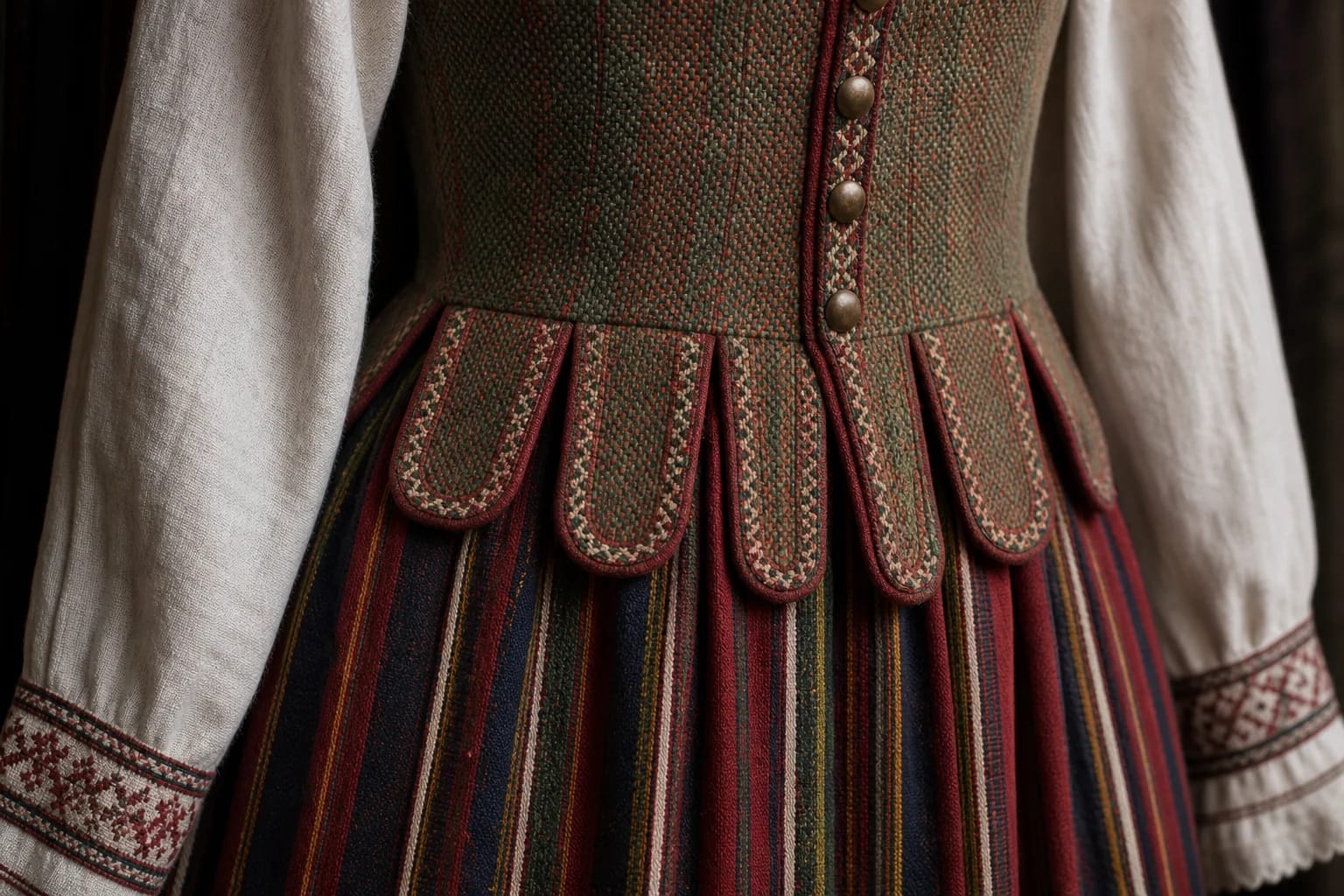
Waistcoats with tabs: A cut in which short tabs, tongues, or pleats are formed at the bottom, helping the waistcoat fall neatly over the skirt.
Fastened or tied waistcoats: Waistcoats could be closed with hooks, buttons, lacing, or ribbons, depending on region and period.
Men's waistcoats: Part of men's costume, worn over the shirt and under a sermėga, frock coat, or jacket, often with more restrained fabric and cut.
What is a waistcoat?
A waistcoat is a sleeveless upper garment that in traditional clothing shapes the waist and connects the shirt with the skirt or with men's costume. In women's national costume it is often called kiklikas, and in some places vystė.
The Universal Lithuanian Encyclopedia states that the first waistcoat examples in Lithuania are known from the tenth-eleventh centuries; from the sixteenth century the waistcoat became part of women's costume, and in the eighteenth century it became especially popular in men's costume as well, together with jacket and trousers. Women's festive waistcoats, also called kiklikai, became prominent as peasant holiday clothing in the late eighteenth and early nineteenth centuries because their cut and fabric were highly visible.
A waistcoat is not a simple decorative vest. It has construction: front, back, waist shaping, fastening, and sometimes tabs, tongues, or pleats. If the cut is inaccurate, the whole costume looks wrong.
The women's kiklikas
A kiklikas is a festive women's waistcoat worn over a shirt and combined with a skirt and apron. It may be short, reach the waist, have tabs, or be longer, depending on region.
The kiklikas emphasizes the waist, but it should not work like a modern corset. The form of the traditional garment depends on fabric, cut, and layers, not on a modern standard of body shaping.
Festive waistcoats could be sewn from woolen, silk, velvet, brocade, purchased, or home-woven fabrics. According to VLE, women in Aukštaitija, Dzūkija, and Suvalkija most often made waistcoats from bright factory-made materials such as brocade, velvet, satin, or wool; Žemaitian women used home-woven finely checked, cross-striped woolen or half-wool fabric; and in Mažoji Lietuva dark velvet or woolen waistcoats were worn. More expensive material showed status and the effect of urban goods on village clothing.
Tabs, tongues, and pleats
One of the most interesting construction features of the waistcoat is the shaping of the bottom. Tabs, tongues, or pleats allow the garment to move neatly from a narrower waist to a wider skirt.
These details are not only decoration. They help the garment fit, avoid discomfort when sitting, keep it from rising above the skirt gathers, and maintain a proper silhouette.
In modern copies the tabs are sometimes only imitated, but historical reconstruction requires understanding their cut. Even small sewing mistakes are very visible here.
Fastenings and trim
Waistcoats could be fastened with hooks, buttons, loops, lacing, or ribbons. The fastening determines not only comfort, but also the composition of the front.
Some waistcoats were decorated with tapes, edging, embroidery, metal details, ribbons, or fabric contrasts. In regional costume, however, decoration must be grounded rather than randomly added.
The fastening must actually work. A national-costume waistcoat should not be only decoratively pinned; it must hold the garment, match body proportion, and fit with the decorated shirt front.
Aukštaitija and Dzūkija waistcoats
Aukštaitian waistcoats often fit a costume of light white shirts and patterned skirts. They can be brighter, but usually have a clear, orderly form.
In Dzūkija, waistcoats often join a whole made of darker, finer patterns and more numerous sashes. The region's costume can look dense, so the waistcoat's color and length must be chosen especially carefully.
In both regions the waistcoat has to reveal important parts of the shirt: collar, sleeves, cuffs, or chest decoration. If the waistcoat covers everything, the logic of textile layers is lost.
Žemaitija waistcoats
In Žemaitian costume, waistcoats go with richer colors, shawls, several skirts, and a firm silhouette. They may be shorter, brighter, and made of purchased or home-produced fabrics depending on place and period.
It is important that the waistcoat not overpower the other layers of the Žemaitian costume. Shawls, skirts, aprons, and shirts together create a very rich image, so each element has its own place.
The Žemaitian waistcoat clearly shows that national costume is not a flat costume set, but a system of textile layers.
Suvalkija and Mažoji Lietuva waistcoats
Suvalkian waistcoats often have a more orderly, stricter composition, matching ornate aprons and clear skirt stripes. They need to support the symmetry of the whole costume.
In Mažoji Lietuva, the waistcoats of Lietuvininkai women are often associated with darker, more restrained fabrics, velvet or wool, Lutheran taste, and the clothing context of the Klaipėda region. Here the waistcoat fits with the delmonas and other distinctive details.
A waistcoat from Mažoji Lietuva should therefore not be automatically replaced by a general Lithuanian model. The region's history, materials, and clothing mood are different.
Men's waistcoats
Men also wore waistcoats, usually over the shirt and under an outer garment: a sermėga, frock coat, or jacket. A men's waistcoat was often more restrained, but important for the order of the whole costume.
It could be woolen, broadcloth, linen, or made from purchased fabric, with buttons, pockets, or lining. In men's costume the waistcoat connects the shirt, trousers, sash, and outer garment.
In presentations of national costume men's waistcoats are sometimes pushed aside, but they matter if one wants to show real clothing layers rather than only a shirt with a sash.
How to recognize a good waistcoat
A good waistcoat has a clear region, suitable fabric, orderly cut, good fastening, and correct length. It has to sit on the body so that the garment layers work together.
Look at the shoulder line, chest fit, side seams, tabs, fastening height, and relationship with the skirt or trousers. Beautiful fabric alone does not compensate for bad cut.
Historical reconstruction should be based on a museum example, Lithuanian National Culture Centre national-costume guidelines, or regional research. A contemporary interpretation can be freer, but it should be presented as such.