- Field
- Lithuanian women’s head and shoulder coverings: scarves, nuometai, kykai, and drobulės
- Type
- textiles
- Heritage status
- well attested
- Context
- Scarves, skepetos, kerchiefs, nuometai, kykai, drobulės, nuometavimas, married women’s head coverings, Aukštaitija, Žemaitija, Lithuania Minor, national costume
Scarves, Skepetos, Kerchiefs, Nuometai, Kykai, Drobulės
Scarves and Nuometai forms and objects
Scarves and Skepetos: Square or rectangular coverings for the head, shoulders, or neck, made from wool, linen, cotton, silk, or mixed fabrics.
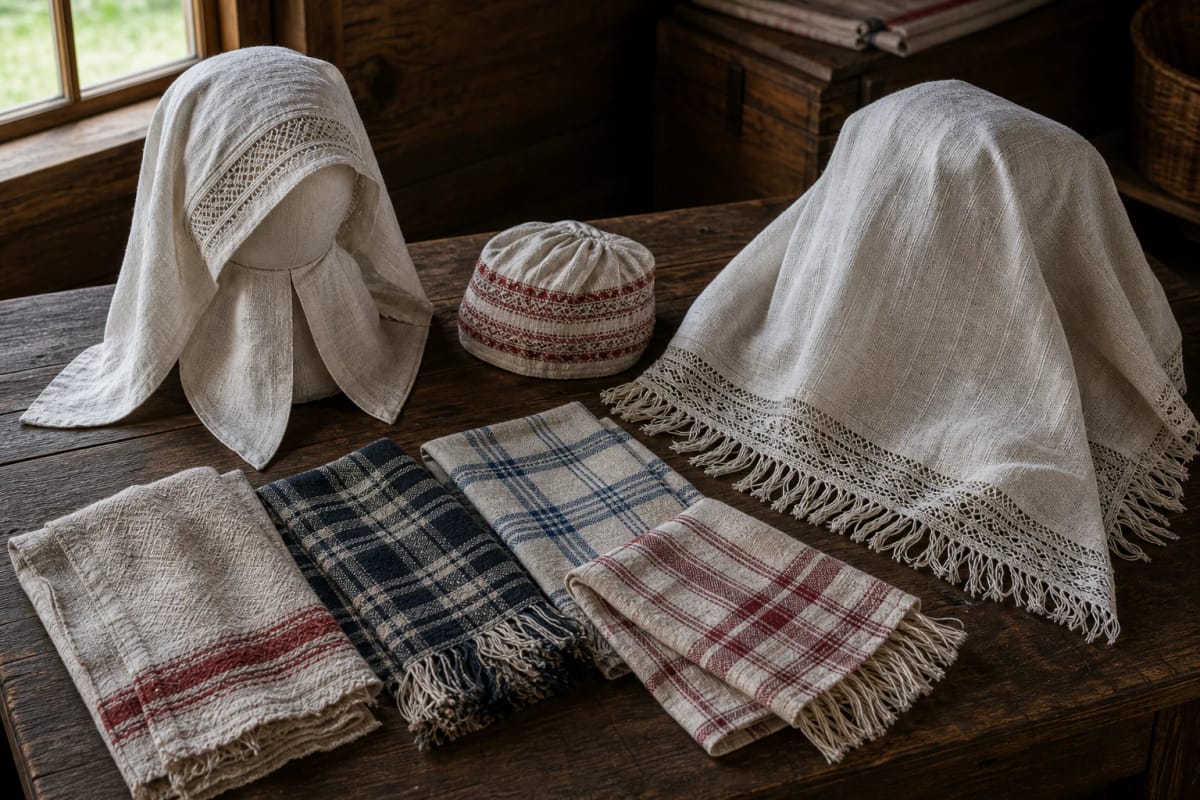
Nuometai: Long white linen head coverings for married women, especially associated with the Aukštaitija national costume and the wedding act of nuometavimas.
Kykai: Married women’s caps or head coverings, often worn under a scarf or together with other head coverings.
Drobulės: Larger white or light cloths that could cover the head, shoulders, or body and are connected with festive and ritual linen textiles.
What Is a Skara, and What Is a Nuometas?
Skara is the broader term: it can mean a covering for the head, shoulders, or neck, tied in many ways and woven or sewn from many materials. A scarf could be everyday or festive, woolen, linen, cotton, silk, checked, striped, or patterned.
Nuometas is narrower and far more socially defined. It is a long, often white linen cloth used by a married woman to cover the head, neck, and sometimes shoulders. In Lithuanian national costume it is especially associated with Aukštaitija.
The two terms should not be blurred. Every nuometas is a head covering, but not every scarf is a nuometas. A nuometas carries stronger signs of marriage, ritual, and region.
Head Covering and Marital Status
In traditional dress, head covering often showed whether a woman was unmarried or married. Girls’ hair, wreaths, ribbons, or galionai differed from the covered heads of married women.
Nuometavimas at a wedding marked the transition from maiden to married woman. The nuometas was not only a cloth but a public sign of changed social status.
Meanings varied across regions and periods, but the main rule is clear: a woman’s head covering was one of the strongest social codes in dress.
The Aukštaitija Nuometas
The Aukštaitija women’s costume is often presented as one of the more archaic forms, and the white nuometas is its distinctive sign. Historical descriptions note nuometai in Lithuania as early as the 11th-12th centuries (of two-ply linen, decorated with glass beads and bronze spirals); in the 18th-19th centuries they could be 3-4 m long and 0.5-0.7 m wide, woven from the finest linen, with red and blue cotton bands and pinikai at the ends. Northeastern Aukštaitija women, especially around Kupiškis, wore it festively into the early 20th century.
The nuometas must be tied correctly. It is not simply a scarf placed on the head; it requires folding, tension, fastening, and knowledge of how the cloth should fall.

An Aukštaitija nuometas shows how white linen cloth becomes a strong social object. It marks both region and the dignity of a married woman.
Scarves in Daily Life and Ceremony
Scarves were highly practical: they protected from cold, wind, sun, dust, and work conditions, covered hair, and warmed shoulders or neck. Fragments of scarves are found in 8th-13th century graves, sometimes decorated with bronze and fastened with bronze pins; everyday scarf use in towns declined from the early 20th century but lasted longest in Dzūkija, into the 1960s.
Festive scarves were brighter, larger, and made from better fabric, with fringes, checks, plant motifs, purchased cloth, or careful weaving. They could be worn in several layers.
Scarves also moved between village and town fashion. Industrial fabrics and bought kerchiefs changed the look, but the logic of covering the head remained.
Žemaitija Scarves
Žemaitija women were known for the abundance and brightness of their scarves. Costume descriptions emphasize that women there liked to wear several red checked scarves at once and combine different tying methods.
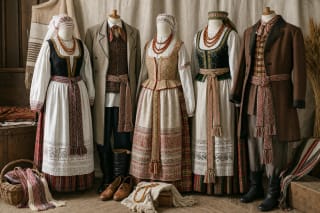
This creates a rich upper part of the costume. The scarves are not a random accessory; together with skirts, aprons, and bodices they shape silhouette, color, and regional character.
Žemaitija scarf wearing cannot be replaced by one neatly tied modern kerchief. Layers, volume, and color relationships are central to the look.
Kykai, Drobulės, and Other Coverings
A kykas is a married woman’s cap or close head covering, often worn with a scarf or beneath another head covering. It helped arrange the hair and create a base for the outer covering.
A drobulė is a larger white or light cloth that could cover the head, shoulders, or body. It belongs to the festive, ritual, and linen-cloth world and should not be reduced to a simple piece of fabric.
Local terms such as skepeta, skarelė, skarinys, pabriuvėlis, brinda, and others show the richness of head-covering vocabulary. Each term needs a place and meaning, not a generic translation.
Materials and Decoration
For nuometai and drobulės, linen was central: white cloth, correct width, fall, finished edges, and sometimes pinikai, openwork, or embroidery. Scarves could use wool, linen, cotton, silk, bought fabrics, and mixed materials.
Scarf decoration includes checks, stripes, fringes, edges, color relationships, and tying. Even a simple scarf can look regional if tied and matched correctly with the costume.
Nuometas decoration is often more restrained because its force lies in whiteness, length, and tying form. A heavily decorated or wrongly made nuometas can lose historical accuracy.
How Tying Changes Meaning
The same cloth can look completely different depending on how it is tied. A scarf may cover only the hair, wrap under the chin, fall over the shoulders, be tied at the nape, or be layered with another scarf.
A nuometas demands still more technique: folding, wrapping, fastening, and proportion must match the regional example. Even correct fabric will look wrong if tied like a modern scarf.
Learning national costume therefore means more than buying a scarf or nuometas. The wearer has to know how to tie it, whom it suits, and what it means.
Use and Reconstruction Today
Today scarves and nuometai appear in national-costume events, folklore ensembles, wedding interpretations, education, and museum reconstructions. The best practice rests on regional sources rather than attractive cloth alone.
For historical accuracy, it is especially important not to confuse girls’ and married women’s head coverings. A wreath, nuometas, kykas, and scarf can mark different statuses.
A modern scarf can be a good heritage-inspired accessory, but a historical nuometas requires more responsibility: fabric, length, width, tying, and social meaning all matter.