- Field
- Part of Lithuanian women's national costume, everyday clothing, and ritual textiles
- Type
- textiles
- Heritage status
- well attested
- Context
- aprons, women's national costume, linen aprons, woolen aprons, kaišytinės aprons, Aukštaitija, Žemaitija, Dzūkija, Suvalkija, Mažoji Lietuva, dowry textiles
National-costume aprons, Lithuanian aprons, Kaišytinės aprons, Linen aprons, Women's aprons
Aprons forms and objects
Everyday aprons: Stronger linen, tow, or mixed-fiber aprons intended for work and protection of the skirt, usually less ornate.
Festive aprons: Whiter, patterned, embroidered, kaišytinės, or colorful aprons worn with better clothing and national costume.
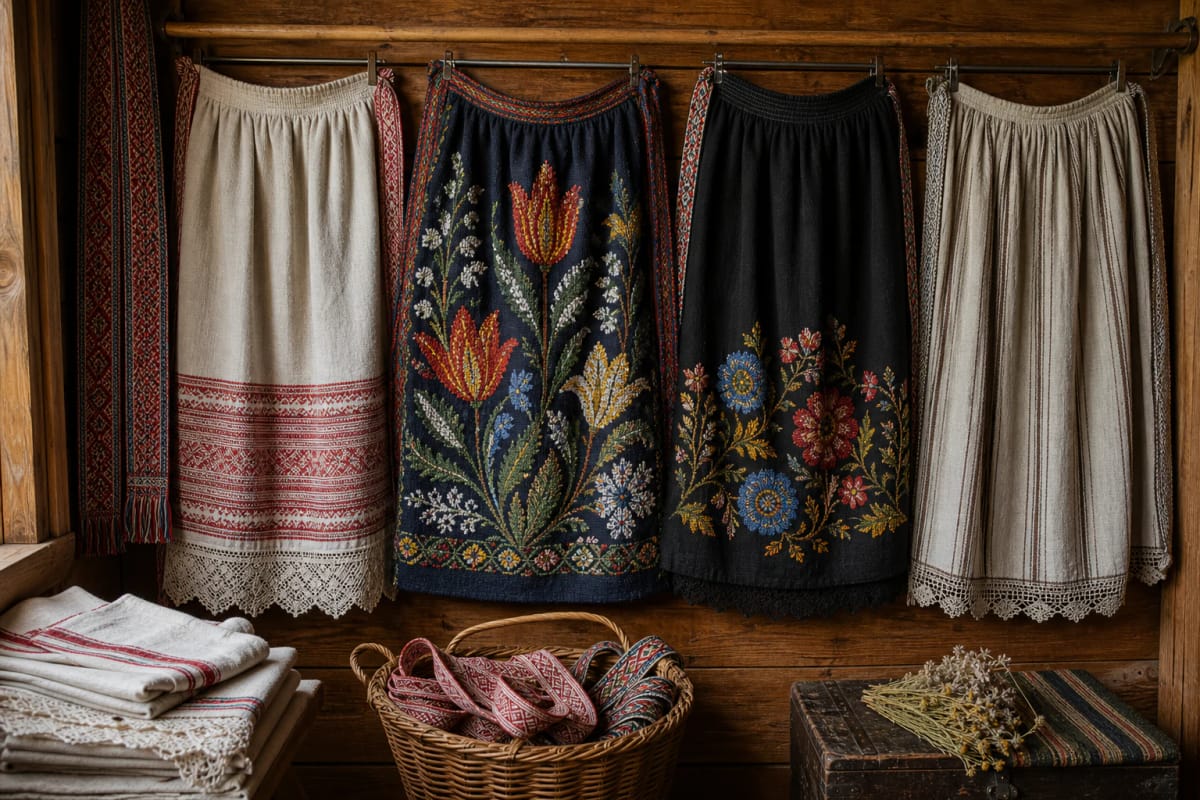
Kaišytinės aprons: Ornate aprons especially characteristic of Suvalkija, whose motifs are created with additional colored threads, often in plant forms.
Regional national-costume aprons: Aprons of Aukštaitija, Dzūkija, Žemaitija, Suvalkija, and Mažoji Lietuva differ in materials, colors, ornament, and wearing.
What is an apron?
An apron is a garment tied or fastened at the waist that covers the front of the skirt. In traditional Lithuanian women's clothing it protected the garment, but was also a visible, required, and ornate part of costume.
VLE notes that the apron is one of the oldest parts of women's clothing in Lithuania, worn already in the ninth century, and that appearing in public without an apron was considered improper in many places. It therefore cannot be understood only as a work item.
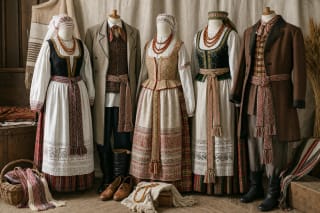
In national costume the apron joins skirt, waistcoat, shirt, and sash into one image. Its color, length, fabric, and ornament often immediately indicate region.
Work, festive, and ritual function
The everyday apron protected the skirt from dirt, flour, soil, ashes, and kitchen work. It needed to be strong, comfortable, easy to wash, and fairly simple.
The festive apron was a very different object. It could be white linen with red patterns, colorful, kaišytinė, embroidered, woven with plant or geometric motifs, and sometimes a very bright part of the whole costume.
At weddings, in dowry, and on other occasions the apron carried social meaning. It could show a woman's preparedness, the textile wealth of a family, and regional belonging.
Aukštaitija aprons
In Aukštaitian women's costume, aprons are often connected with white linen cloth and red or colored ornaments, especially in the lower part. The white ground fits Aukštaitia's tradition of shirts, nuometai, and lighter textiles.
Patterns may be woven in, embroidered, or composed in bands. The vertical clarity of the costume matters: shirt, skirt, apron, waistcoat, and sash should create a harmonious but not overloaded image.
An Aukštaitian apron often looks more restrained than a Suvalkian kaišytinė apron, but that restraint is a regional style, not a lack of ornament.
Dzūkija aprons
In Dzūkija, aprons survived longer than in many other regions, and before the Second World War festive wearing was still alive in some places. This matters because here we see not only reconstructed clothing, but a relatively late-living practice.
Dzūkian aprons may be darker, striped, embroidered, or decorated with plant motifs. They often fit with finely checked skirts, numerous sashes, and the textile taste of southeastern Lithuania.
A single model of Dzūkian apron should be avoided. Villages, periods, materials, and family means differed, so concrete museum examples are the best basis.
Suvalkija aprons
The aprons of Suvalkija, especially of Kapsai and Zanavykai, are often considered among the most ornate. Important here are kaišytinės aprons with bright plant ornaments, stylized lilies, tulips, roses, or twigs.
The kaišytinė technique creates ornament with additional threads only where the pattern is needed. This gives the apron a rich, clearly visible motif different from a simple stripe or check.

Suvalkian aprons show how weaving can become textile painting while remaining structurally woven, not merely surface decoration.
Žemaitija and Mažoji Lietuva aprons
In Žemaitija aprons fit richer colors, layered shawls, and brighter woolen fabrics. In some periods white and red aprons were visible, while later in some places they withdrew from festive costume.
In Mažoji Lietuva aprons belong to the distinct costume world of Lietuvininkai women. Darker coloring, the Klaipėda region setting, the delmonas, Lutheran context, and a different sense of restraint all matter here.
Aprons from these regions must be evaluated with the whole costume. Taken alone, an apron may look unusual, but with skirt, waistcoat, shirt, shawl, or delmonas it becomes clearly regional.
Weaving, embroidery, and edges
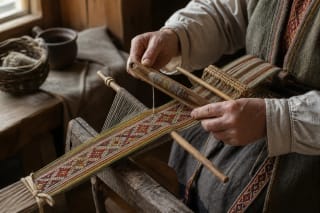
Aprons could be woven in plain, twill, rinktinė, kaišytinė, or other techniques. Some were additionally embroidered and decorated with lace, pinikai, tassels, or colored edges. According to VLE, embroidered aprons differed by region: in Dzūkija dark aprons were decorated with multicolored flowers and leaves, in Žemaitija with clover, cudweed, and checks, in Užnemunė with lilies, peas, and little stars, and in the Klaipėda region with plant and geometric patterns. As part of festive costume aprons disappeared in Žemaitija at the end of the nineteenth century, survived longest in Dzūkija until the Second World War, and as work clothing were also worn by men in some crafts, such as shoemakers, harness makers, and blacksmiths.
Construction matters: apron length must fit the skirt, the upper edge must tie neatly at the waist, and the lower ornament zone must not disappear into skirt folds or sit too low.
A good reconstruction has to show not only a beautiful pattern but correct proportion. Even a historical ornament can look inaccurate if the apron is too short, too long, or tied wrongly.
Apron and propriety
Today an apron is often associated with the kitchen, but in traditional clothing it was connected with public appearance and propriety. Covering the front of the skirt meant that a woman was fully dressed, orderly, and dressed according to community norms.
This aspect of propriety does not mean the apron was only a sign of control. It was also a surface for women's work, textile skill, taste, and regional identity.
The apron therefore joins social rule and creativity. It is required, but precisely in this required place a great variety of regional patterns and personal taste appears.
How to distinguish a historical apron from a stage one
Stage aprons often simplify colors, enlarge ornaments, use synthetic fabrics, or mix regional traits. This may suit the stage, but it is not the same as reconstructing historical national costume.
A historically grounded apron should have a clear region, period, material, technique, and relationship to skirt, shirt, waistcoat, and sash. If these elements are not explained, the costume becomes a general folkloric image.
The best approach is to rely on museum examples, Lithuanian National Culture Centre national-costume guidelines, work by regional researchers, and to state clearly whether the apron is a copy, reconstruction, or contemporary interpretation.