- Field
- Textile of Lithuania Minor and a detail of Lietuvininkės national costume
- Type
- textile
- Heritage status
- living tradition
- Context
- Delmonai of Lithuania Minor, Lietuvininkės, embroidered pouches of the Klaipėda region, pockets, bags, glass beads, initials, dates, flower and bird motifs
Delmonai of Lithuania Minor, Delmonas, Dalmonas, Daumonas, Dimžukas, Embroidered pocket
Delmonai forms and objects
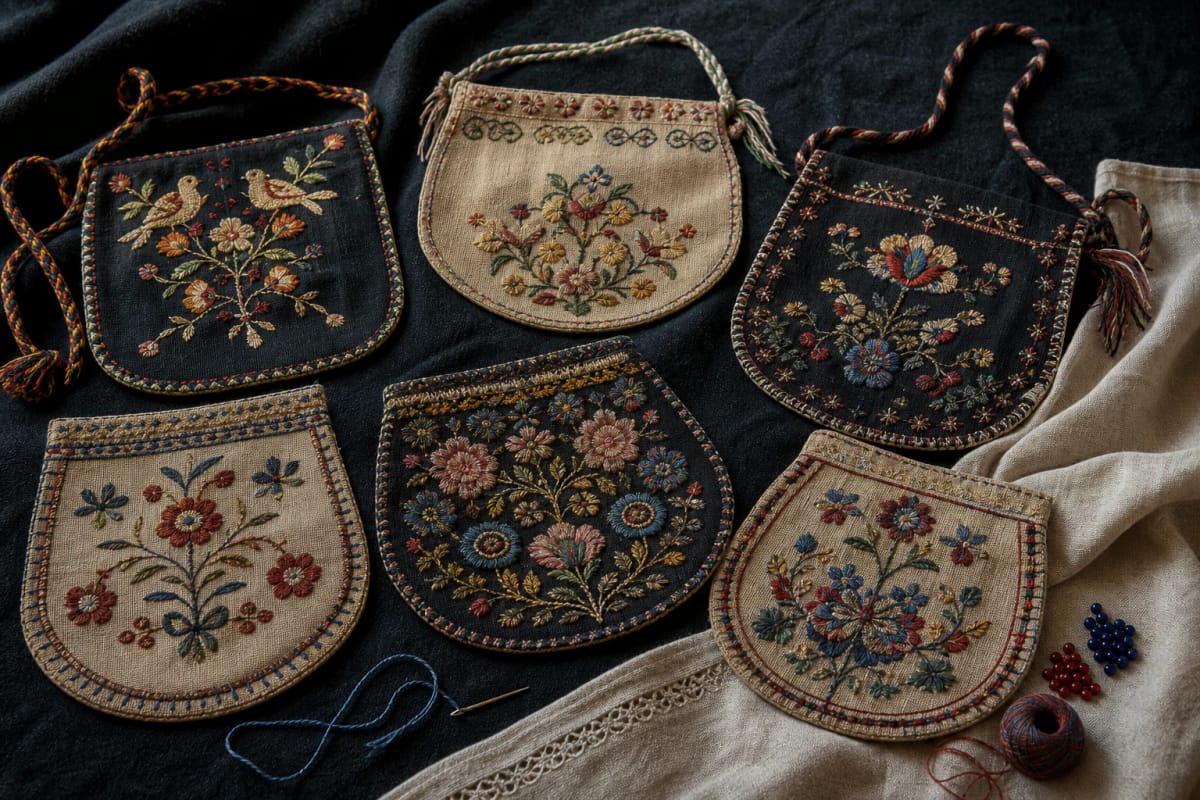
Rectangular delmonas: A clearly rectangular pouch, often with loops or ties, fastened at the waist.
Rounded-bottom delmonas: A pouch rounded at the bottom, giving a softer silhouette and more decorative field for embroidery.
Wavy or widening-bottom delmonas: A more complex delmonas with a decorative outline, waves, trapezoidal, or polygonal bottom.
Reconstructed delmonas: A delmonas recreated from a museum original, family memory, or research sources, worn today with the Lithuania Minor costume or as a contemporary accessory.
What is a delmonas?
A delmonas is an embroidered textile pouch worn at the waist by women of Lithuania Minor, especially in the Klaipėda region. It functioned as a pocket for small items, but also became one of the most distinctive adornments of the Lietuvininkės national costume.
A delmonas is not an ordinary handbag. It is worn with national costume, usually at the waist, and is a visible detail of regional identity. Its form, fabric, embroidery, colors, beads, initials, or dates speak about a person, family, and region.
In 2019 the delmonai of Lithuania Minor were entered in Lithuania's Intangible Cultural Heritage Inventory. This means that not only an old museum detail is protected, but also knowledge, reconstructions, embroidery skills, wearing practices, and transmission of tradition.
Names: delmonas, dalmonas, daumonas, dimžukas
Several names appear in sources and living speech: delmonas, dalmonas, daumonas, dimžukas, kišenė, tašė, kapšė, or krapštė. This variety shows that the object lived in everyday speech and had its own names in different localities.
The word 'pocket' helps explain the practical function but not the whole phenomenon. A delmonas is an externally worn, decorated, sometimes highly personal pocket. It shows that a practical object can become a regional art object.
In English texts it is best to keep the word delmonas while explaining the other names. This preserves the linguistic and local diversity of Lithuania Minor.
What were delmonai used for?
Delmonai held small personal objects: money, keys, a handkerchief, documents, letters, a prayer book, or other everyday necessities. Traditional women's clothing did not have modern pockets, so the delmonas had a clear practical function. VLE describes it as an ornate pocket tied at the waist with a woven band by the Lietuvininkės of the Klaipėda region and East Prussia, sewn from velvet, silk, woolen cloth, or cotton; it remained part of Klaipėda national dress until the twentieth century, and older women wore delmonai until the 1940s.
During political unrest or travel, a delmonas could protect money, documents, or letters under layers of clothing. It therefore becomes not only a beautiful pouch but an object of personal protection, memory, and survival.
At the same time, a delmonas was visible. When worn with national costume, it showed the identity and region of a Lietuvininkė. One object thus joins pocket, ornament, document hiding place, and cultural sign.
Forms and construction
Delmonai may be rectangular, rounded at the bottom, widening, wavy, or polygonal in outline. Form determines how the pouch hangs at the waist, how much it holds, and how the embroidery is arranged.
A delmonas is usually sewn from dark fabric, often woolen or another sturdy base. Lining, edge finishing, loops, ties, or fastening bands are added. Some delmonai have flaps or extra details.
Good construction must be both beautiful and practical. If the delmonas is too soft, it deforms; if too stiff, it loses its textile character. Sewing is therefore no less important than embroidery.
Embroidery, beads, and motifs
Delmonai are decorated with colored threads, glass beads, appliqué, and sometimes shinier details. Common motifs include flowers, bouquets, branches, birds, insects, human figures, crowns, harps, hearts, initials, dates, and meaningful texts.
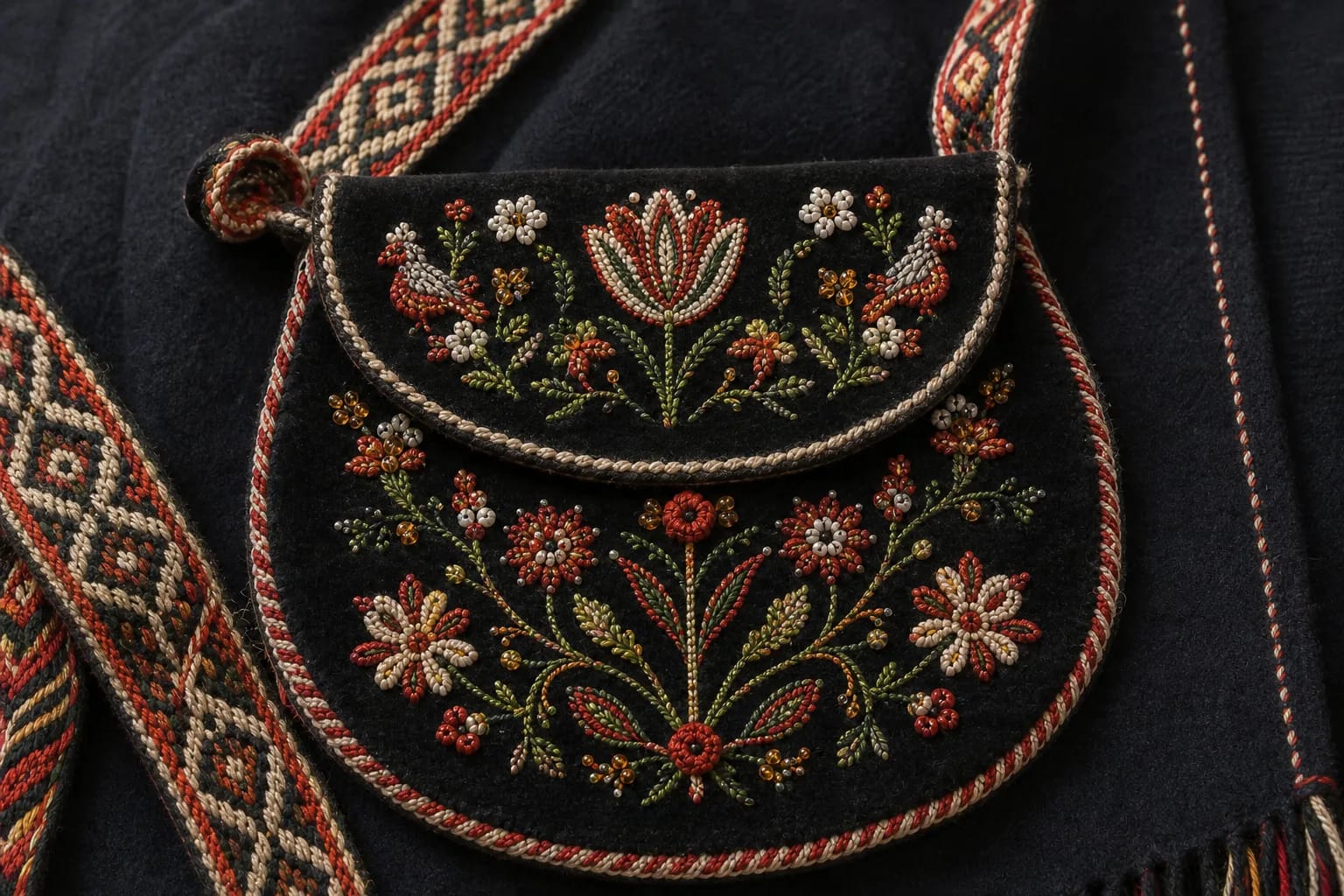
Initials and dates make a delmonas highly personal. They may indicate the owner, a gift, year of making, family memory, or an important life moment. The delmonas thus resembles not only an ornament but a small textile document.
The cultural context of the Klaipėda region also appears in inscriptions, sometimes in German, and in ornamental taste. This should be presented as part of the history of Lithuania Minor, not as accidental foreignness.
Delmonas and the costume of Lithuania Minor
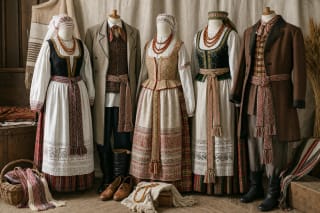
Today the delmonas is considered one of the clearest signs of a woman's national costume from Lithuania Minor. Such an external decorated pouch is not as prominent in the costumes of other Lithuanian regions, so it immediately points to the Klaipėda region and the world of Lietuvininkės.
It is worn at the waist and combined with the skirt, bodice, apron, sash, or other costume elements. Good coordination matters: a delmonas should not look like a modern handbag casually attached to national dress.
For that reason the delmonas should be studied together with the costume of Lithuania Minor, Lutheran and Prussian cultural contexts, regional textile, dialects, family histories, and museum collections.
Museums, family memory, and reconstructions
Many authentic delmonai are preserved in the National Museum of Lithuania, the History Museum of Lithuania Minor, the Hugo Scheu Museum in Šilutė, and other collections. Because textile is fragile, originals often rest in storage while exhibitions or reconstructions are shown to the public.
Some delmonas stories return through family memory. A deteriorated or lost delmonas can be reconstructed from a photograph, story, museum analogue, or surviving detail. Such reconstructions become work of family and regional memory.
Important figures in restoring and popularizing delmonai include Elena Matulionienė, Ieva Matulionytė, and other researchers and makers of Klaipėda region and Lithuania Minor textile. Their work helped bring the delmonas back into living use.
The delmonas today
Today delmonai are worn with the national costume of Lithuania Minor, shown in exhibitions, embroidered in educational programs, ordered as reconstructions, and sometimes used with contemporary clothing. This shows that the tradition is not only in the museum.
Still, a modern delmonas should be honest. If it is a reconstruction of a museum copy, the original should be named. If it is a contemporary interpretation, it can be excellent, but should not pretend to be an authentic nineteenth-century object.
The strength of the delmonas is its personal nature. Even when the form follows tradition, colors, initials, a date, or a motif can speak about a concrete person. That is how it remains alive: not only as beautiful history, but as worn memory.