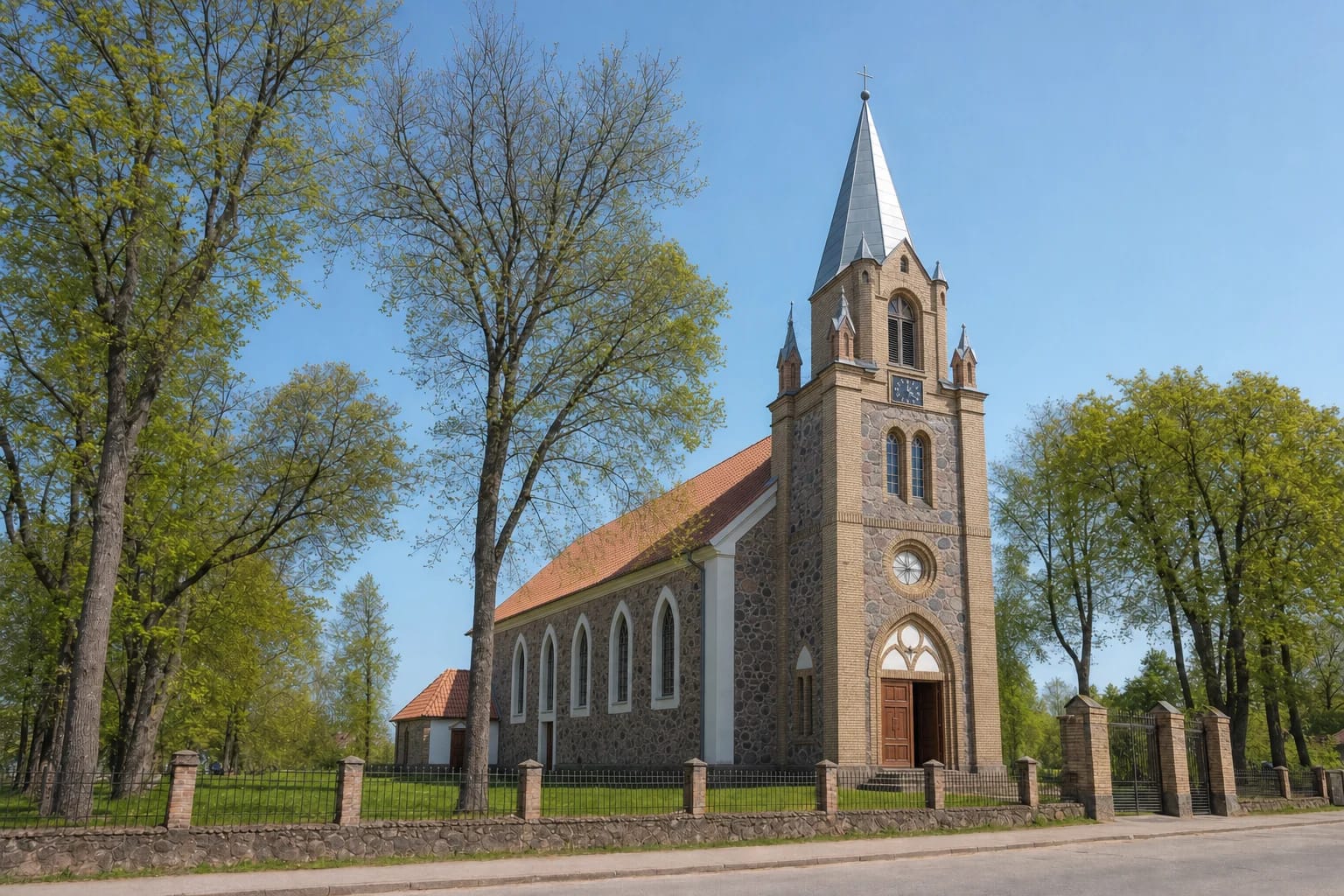
- Place
- Žeimelis, Pakruojis District Municipality
- Region
- Pakruojis District
- Type
- active single-nave Evangelical Lutheran church with a 1793 fieldstone body and an 1889-1890 clock tower
- Address
- 4A Vytauto Didžiojo Street, Žeimelis
- Coordinates
- 56.27121, 23.99766
- Visit duration
- 20-35 minutes for the exterior and churchyard; 45-60 minutes if you enter during a pre-arranged visit, service, or event
- Best time
- in daylight for the architecture; for the interior, only at a service, event, or appointment whose time has been confirmed with the parish
Žeimelis Lutheran Church, Žeimelis Evangelical Church
Two construction dates and one important denominational boundary
Žeimelis Evangelical Lutheran Church stands at 4A Vytauto Didžiojo Street, away from the town's central square. It is a state-protected heritage property of regional significance, register code 16039. Its 2,608-square-metre protected plot also lies within the historic part of Žeimelis. The map pin is the centroid of that registered plot, not a surveyed doorway, gate, or parking place.
The dates 1540 and 1793 often appear together, but they do not describe the same building. A timber Lutheran church was erected in 1540; the surviving masonry church was completed in 1793. VLE also records a Reformed church in Žeimelis from about 1595 and a Reformed school operating in 1592-1674. Those belonged to a distinct Reformed tradition and should not be folded into the history of today's Lutheran building.
This is an active Evangelical Lutheran parish church, not a museum or a Roman Catholic sanctuary. Its official present name carries no saint's dedication. The building was consecrated on Michaelmas, 29 September 1793, but that calendar date alone does not justify renaming it St Michael's Church.
From the timber church of 1540 to the fieldstone building of 1793
The parish's official history says that Caspar von Tiesenhausen, elder of Dünamünde, now Daugavgrīva, built a private timber Lutheran church at Žeimelis in 1540. The place then belonged to the Livonian Order and passed under the Grand Duchy of Lithuania in 1585-1587. The timber predecessor was rebuilt in 1653 and repaired in 1742, but it must not be mistaken for the masonry now standing.
Construction of the present church began on 8 October 1786 under Pastor Konrad Schulz. It was completed and consecrated on 29 September 1793. The original hall had no tower: the three-stage clock tower and sacristy were added only in 1889-1890. What visitors see from the street is therefore a deliberately readable combination of a late eighteenth-century hall and a late nineteenth-century vertical landmark.
VLE and the heritage register record repairs in 1908 and 1980-1982. The register notes that asbestos-cement sheets replaced the old clay tiles in 1981. In 2024 the Cultural Infrastructure Centre announced planned repairs to the main, sacristy, and tower roofs; a 2025 European Heritage Days listing said work had begun on the main roof and was continuing on the tower. No separate final-status notice was found by 20 July 2026, so check for temporary fencing or access restrictions before travelling.
A fieldstone hall, pointed openings, and a Riga clock of 1895
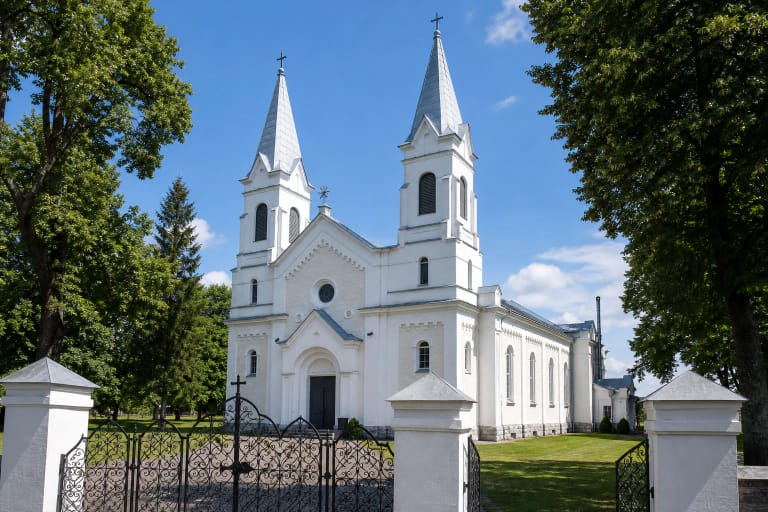
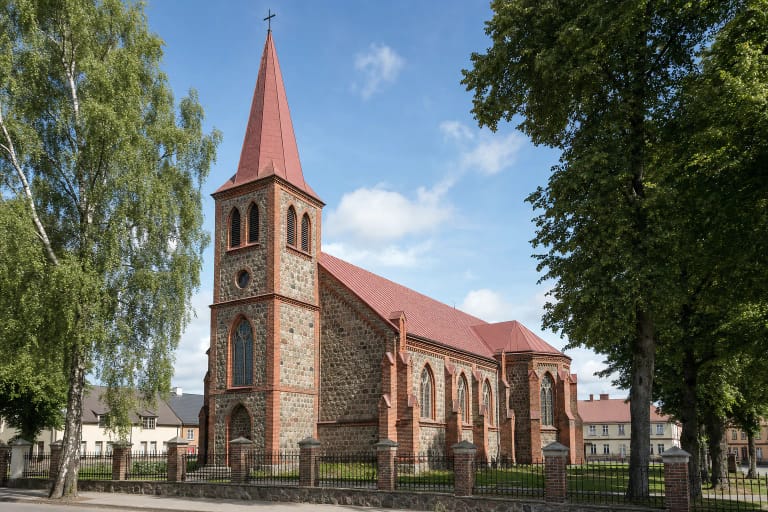
The Cultural Heritage Register describes a rectangular, single-nave hall church with a three-sided apse to the south, a sacristy, and a square three-stage tower capped by an octagonal pyramidal spire. Four small corner pinnacles rise above the tower's second stage; they were reconstructed in 2001. From the churchyard gate the tower reads as a strict vertical, while the long nave is clearest from an oblique street view.
Raised decorative joints articulate the fieldstone walls of the main body, while brick and render define openings, cornices, the tower, and the sacristy. Pointed, semicircular, circular, and segmental openings create a Gothicising exterior rhythm, yet the building is not a single-phase, textbook Gothic Revival church. A more precise description is a late eighteenth-century fieldstone hall using Gothic forms, completed visually by a late nineteenth-century tower.
The technical rarity in the tower is a mechanical clock made in Riga by J. Jaksch & Co in 1895. The register describes a mechanism approximately 70 by 70 by 30 centimetres on a timber frame, with weights, cables, and dials on the north, east, and west faces. Its condition was assessed in 2013: that confirms a protected historic mechanism, not that it now keeps perfect time or strikes reliably every day.
A low fieldstone base, stone posts, and metal sections enclose the churchyard. The three-part northern gateway has four octagonal brick piers, central double gates, and single side gates. This enclosure is itself a protected element of the site, so the best first view takes in the gates and boundary as well as the entrance tower.
A restrained interior, Schulz's epitaph, and the memory of Leijers
The single hall retains four blocks of seven-row pews with kneelers, three cylindrical stoves, and a timber organ gallery supported by two rows of four columns. At the south end stand a timber altar with a communion table and Crucifixion painting, a baluster chancel rail, and a timber pulpit. Three chandeliers, hymn boards, herringbone brick in the entrance bay, and board floors give the room specific historical texture without lavish decoration.
Pastor Konrad Schulz, who led construction of the present church, died in 1802 and, according to the parish history, was buried beneath its pulpit. A German epitaph on the masonry pulpit base records his dates, 1731-1802. It is one of the most meaningful objects inside because it connects the surviving fabric directly with the pastor responsible for its construction.
Another memorial tablet honours senior pastor Eriks Leijers, who served at Žeimelis from his ordination in this church in 1929 until his arrest on 30 December 1949. The parish history links his persecution to a protest against plans to convert Joniškis Lutheran Church into a warehouse. He died in a Siberian camp in 1951, and his exact burial place is unknown. The Latvian inscription on the tablet also records the congregation's historical language.
The register explicitly protects the organ gallery but does not provide a separate inventory for a historic organ mechanism. The parish account says the organ was repaired during the 1980-1982 works, yet no current recital or demonstration schedule is published. Treat the organ as a possible interior highlight, not a performance guaranteed on an ordinary visit.
A Semigallian borderland parish: Stender, Barclay de Tolly, and Grotthuss
The Lutheran history of Žeimelis crosses today's Lithuanian-Latvian border. Until 1783 the parish belonged to the Bauska diocese of the Courland Consistory. Latvian pastor, writer, and linguist Gotthard Friedrich Stender served here in 1753-1759. That was the age of the earlier timber church, not of the surviving building completed in 1793.
The parish register tradition says that the future Russian imperial field marshal Michael Andreas Barclay de Tolly was baptised in the earlier Žeimelis church on 27 December 1761, although no birth date was entered. Physical chemist Theodor von Grotthuss lived and worked at nearby Gedučiai from 1808, and the official parish history counts him among its members. These are documented connections to the congregation, not evidence that all three men knew the interior visible today.
The parish retrospective states that services had been held in Latvian until 1998, when the congregation decided on a Lithuanian sermon with a Latvian liturgy. That is valuable evidence for a particular phase of parish life, not a 2026 language timetable. Ask Pastor Juozas Mišeikis about the date and language of a current service because the official Žeimelis parish page publishes no regular calendar.
How to enter and what to check before you go
As of 20 July 2026, the official parish page published no daily tourist opening hours, regular worship calendar, or sightseeing admission price. The most dependable opportunities to enter are an announced service or concert, or an appointment made in advance. The official clergy directory lists Pastor Juozas Mišeikis for Žeimelis at +370 606 09273 and juozasmiseikis@gmail.com; verify both the contact and planned time again before setting out.
The exterior can be viewed from public Vytauto Didžiojo Street, but an open churchyard gate does not mean the church door is unlocked. The heritage register records three steps at the main entrance, five at each side entrance, and seven at the sacristy. No public information confirms a ramp, step-free route, or accessible toilet, so discuss mobility support in advance. The tower, clock mechanism, organ gallery, cellar, and sacristy are not automatically open for self-guided exploration.
No dedicated official visitor car park is marked at the church. Park only where local signs permit, do not block the churchyard gates, and leave access for the congregation and any conservation vehicles. Ask before taking photographs inside; during worship or a cemetery festival, do not photograph people or the liturgy without clear consent.