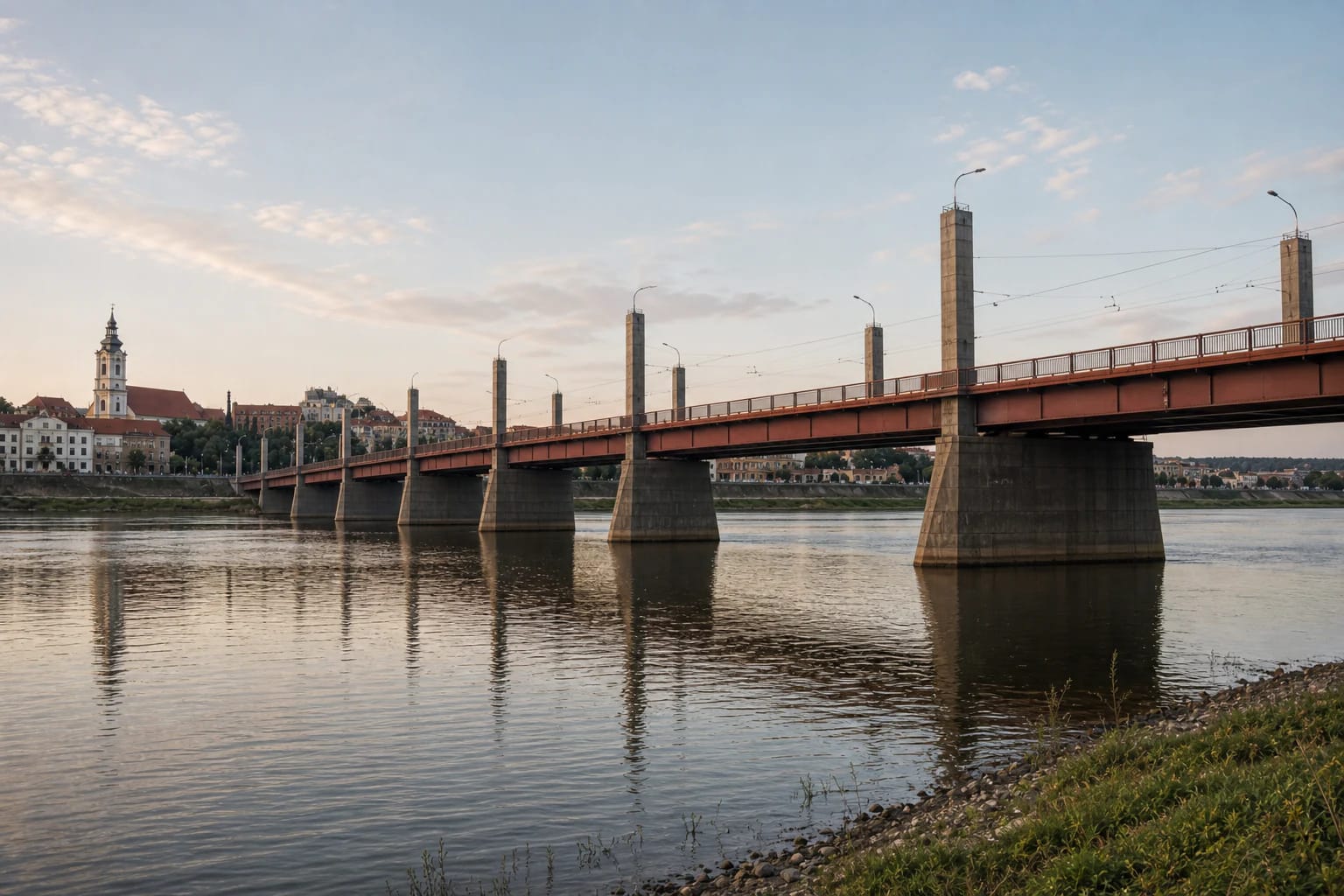
- Place
- Kaunas City Municipality
- Region
- Kaunas
- Type
- historic city bridge over the Nemunas
- Address
- Vytautas the Great Bridge, Kaunas
- Coordinates
- 54.89389, 23.88747
- Visit duration
- 20-45 minutes to view the bridge from the riverbank and cross it
- Best time
- morning or evening, when the steel structure and Old Town skyline stand out from the Nemunas banks
Aleksotas Bridge, Vytautas the Great Bridge over the Nemunas
Two banks and one of Kaunas's recognisable silhouettes
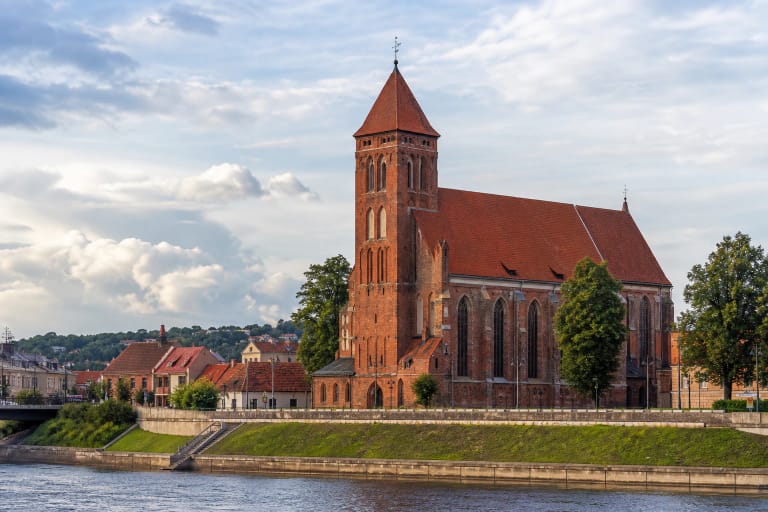
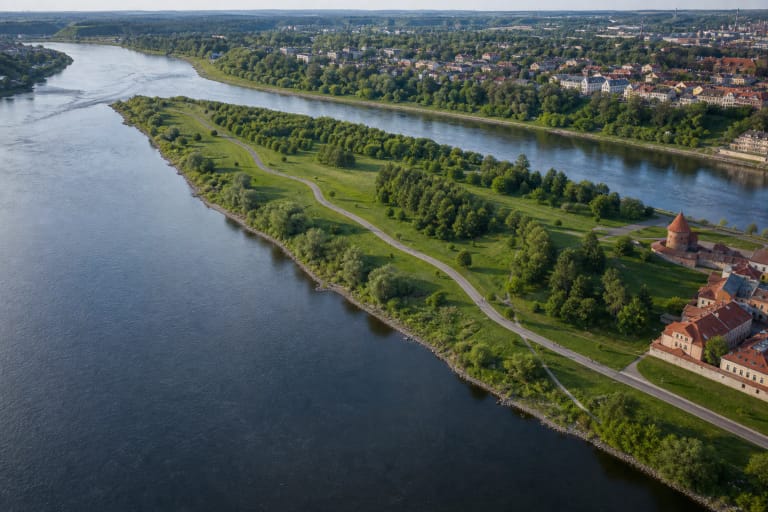
Vytautas the Great Bridge stands where Kaunas Old Town connects with Aleksotas on the left bank of the Nemunas. From the Old Town side, Vytautas the Great Church is close to the approach; from the Aleksotas slopes, the bridge appears as a long steel line above the river. The coordinates 54.8938948, 23.8874684 mark the bridge itself rather than one particular viewpoint on the bank.
This is an operating city road, not a museum display or a pedestrian promenade. Visitors get the most from it by viewing the bridge from the Nemunas banks, crossing in the pedestrian space when conditions allow, and noticing how the structure joins two parts of the city at different heights. Do not stop or photograph from the traffic lanes.
Two things should be kept distinct here: the interwar Vytautas the Great Bridge, whose structure did not survive, and today's bridge reconstructed after the Second World War. The crossing, location, civic memory, and restored name continue the identity of the older landmark, but the full 1930 material fabric does not remain intact.
The 1930 project was a calculated modern link for the city
For a long time there was no permanent bridge between Kaunas and Aleksotas. The Architecture and Urbanism Research Centre records a pontoon ferry near Vytautas the Great Church until the mid-nineteenth century, followed by temporary raft crossings in summer. During the First World War, wooden and pontoon solutions replaced one another, but they were weak, dependent on river conditions, and obstructed navigation.
An international design competition took place on 1 February 1927. After further discussions, the site beside Vytautas the Great Church was chosen because the shorter Old Town option was more favourable in the estimate. The bridge was designed and built by the Copenhagen company Højgaard & Schultz a/s, led by Danish engineer Knud Højgaard. Construction lasted 20 months.
The AUTC account gives the 1930 bridge a length of 245.6 metres and a width of 12.60 metres, at a cost of 3,610,600 litas. It was more than a transport project: on 9 January 1930, at the suggestion of mayor Jonas Vileišis, it was named for Vytautas the Great, and the formal opening followed on 11 January.
A movable span and a difficult wartime history
The historic 1930 design had four piers and four large openings, each 52.25 metres wide. At the centre was a 20-metre movable section that three electric motors could raise for ships; during floods it was intended to support navigation, while in ordinary use it was also described as a security measure. The detail shows that the bridge was designed for a living river, not only for road traffic.
The 1930 structure did not reach a full century. It was renamed Aleksotas Bridge in 1940, and on 24 June 1941, during the fighting of the June Uprising, the retreating Red Army blew it up. The AUTC account notes that only the first and fifth spans remained; pontoon and other temporary solutions then replaced the crossing.
The bridge was destroyed again near the end of the war, and a temporary reconstruction was swept away by a flood in 1946. From 1946 to 1948, people crossed the river by boat. The Encyclopaedia of Lithuania records that in 1948 the Soviet army, using German prisoners of war, rebuilt the bridge to Aleksotas and removed the Vytautas the Great name.
Why the bridge is called Vytautas the Great rather than Aleksotas
Aleksotas Bridge still appears in historical accounts and map searches because the Soviet period used that name for the crossing to the district on the left bank. After Lithuania restored its independence, the earlier name returned. You may therefore encounter both names, but this destination's current official name is Vytautas the Great Bridge.
The name matters here as a layer of civic memory, not merely as a sign. Speeches at the 1930 opening presented the bridge as a symbol joining riverbanks and Lithuanian lands. Its present function is practical, yet daily traffic still performs the same physical act of connection.
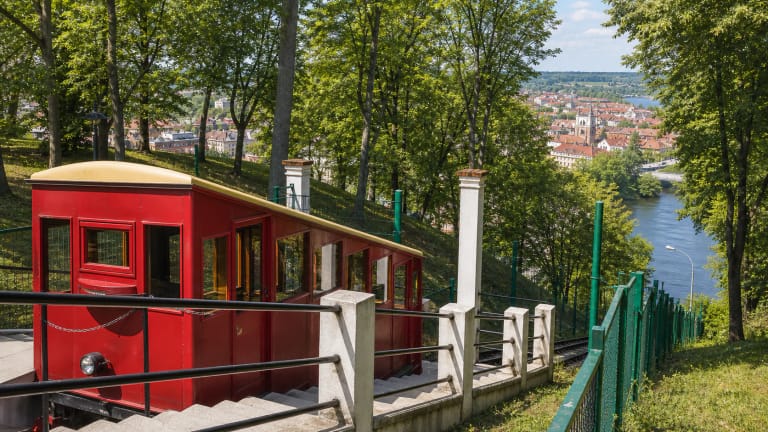
From the top of Aleksotas Funicular the bridge can look like one seamless historic ensemble, although the funicular and bridge were built at different times and serve different purposes. The funicular is its own attraction; the bridge is an independent Nemunas crossing and an engineering element of Kaunas's urban landscape.
Planning a visit to a working bridge
Allow 20-45 minutes to reach the riverbank, look at the piers and their relationship with the Old Town buildings, and make a short safe crossing on foot. Morning or evening light brings out the steel trusses; from the water side, the bridge's length and the rhythm of its piers are easiest to read.
There is no visitor ticket or gate because this is public city infrastructure. Access can nevertheless change with traffic controls, events, weather, or repair plans. Check Kaunas city notices before travelling if a particular pedestrian route matters, and follow signs and barriers at the site.
The bridge itself is not an observation tower. Choose the riverbanks or the Aleksotas hillside viewpoints for a broader panorama. The Nemunas edge may be slippery after rain, and traffic and lighting conditions differ after dark; respect for the working road and other road users comes before getting closer to the structure.