- Place
- Kaunas City Municipality
- Region
- Kaunas
- Type
- late-Gothic burgher house, cultural-heritage object, and exhibition space
- Address
- Aleksoto g. 6, Kaunas
- Coordinates
- 54.89561, 23.88641
Perkūnas House, House of Perkūnas, House of Perkūnas of the Kaunas Jesuit Monastery Complex, Gothic house at Aleksoto g. 6
A Gothic house near Vytautinė
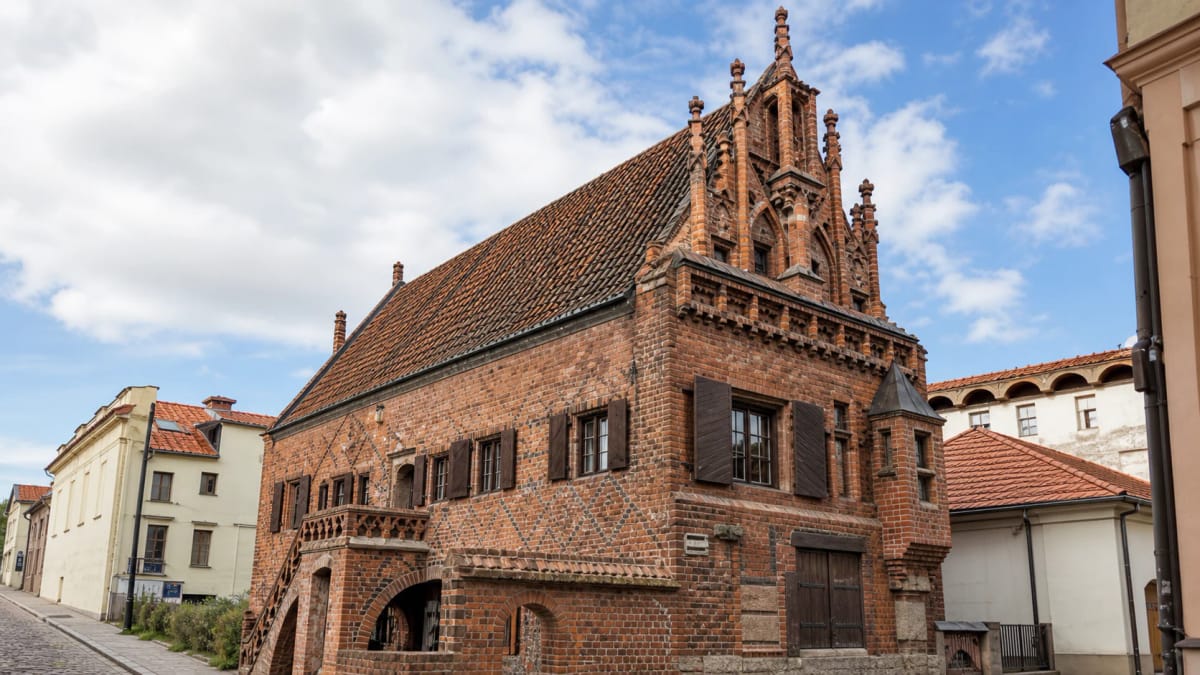
The House of Perkūnas stands at Aleksoto g. 6 in Kaunas Old Town, close to the Nemunas and the surroundings of Vytautas the Great Church. From the street it is a small but concentrated object: red-brick walls, high gabled roof, ornate eastern gable, oriel, black-brick ornament, and cellars that show this is real old urban masonry, not a decorative imitation.
KVR registers the object as the House of Perkūnas of the Kaunas Jesuit monastery complex, unique code 816. It is a cultural monument of national significance and part of the Kaunas Jesuit monastery complex. KVR names the style plainly: Gothic.
A name born from a figurine
The name Perkūnas did not arise because scholarship proved a pagan temple here. AUTC explains that in 1818 a bronze figurine about 27 cm high was found in the building wall. It moved through the museum world of Warsaw and St Petersburg, later disappeared, and its meaning was interpreted very differently.
Historian Teodoras Narbutas saw the image of Perkūnas in the figurine and called the building a temple of Perkūnas. AUTC treats this as a Romantic interpretation without basis for the building's original function. Still, the name stuck and became one of the strongest signs of Kaunas architectural heritage.
A documented burgher house
The key shift in modern interpretation is connected with researcher Jurgis Oksas. AUTC states that records found in Jesuit files in Moscow in 1985 showed that in 1546 Lithuanian merchant Steponas Dulkė sold a private residential house on Švč. Mergelės Marijos Street, now Aleksoto g. 6, to Bernardas Bitneris.
This evidence matters because it counters two popular versions: the temple of Perkūnas and the Hanseatic merchants' office. AUTC stresses that the building's original function was residential. That does not mean the house was simple; on the contrary, its decoration and scale point to a wealthy urban environment.
AUTC assigns the house to late Gothic and dates it to the late fifteenth century, so the 1546 sale document records an already existing building, not its construction. Research notes that the merchant Steponas Dulkė did not build the house himself: it had been inherited by his wife, who had already died by the time of the sale, so the original builder is not named in the documents (it was probably built by his wife's wealthy family).
A two-part building
It is useful to remember the building's interesting structure: originally it was a dual structure. One part is the House of Perkūnas visible today; the other, a storage part of similar size, was demolished in the eighteenth century. A capital wall separated the surviving section from the warehouse; today that wall reads as the northern facade.
KVR's list of valuable features still shows signs of this structure: compact rectangular two-storey volume with attic and cellar, cellar walls, barrel vaults with lunettes, network of main walls, openings and niches, wooden floors, and roof structure.
Jesuits, chapel, and college
KVR chronology states that in 1627 the building was transferred to the Bernardines, in 1655-1661 it was damaged, and in 1670 it was sold to the Jesuit order. The Jesuits reconstructed it and adapted it as a chapel. In 1722 the house was given to the college and reconstructed again; in 1732 it suffered in a fire.
This Jesuit layer explains why KVR connects the House of Perkūnas with the Kaunas Jesuit monastery complex. The building is not a single Romantic relic; it is part of the broader Old Town history of education, religious orders, and sacred life.
Theatre and nineteenth-century alterations
In the early nineteenth century the building was used as a warehouse. In 1843 it was transferred to the city board, repaired, and adapted as a theatre. This is an important layer of Kaunas cultural history: at one point a Gothic burgher house became a city stage.
In 1865 the building was reconstructed for use as living quarters for the preacher of Alexander Nevsky Cathedral. Such changes altered openings, volume details, and use, so today visitors see an object where Gothic remains, later adaptations, and twentieth-century restoration choices meet.
Restoration and questions of authenticity
KVR states that the building was returned to the Jesuits in 1923 and reconstructed, and that it was restored in 1964-1968 and 2009. The author of the 1964-1968 restoration project was architect Dalija Zareckienė; the 2009 conservation project was by architect A. Prikockienė.
AUTC explains in detail that the eastern gable was the best-preserved element of Gothic origin, so its restoration relied on abundant authentic data. Some details, especially parts of the oriel composition, the southern stairs, and the western gable, contain more interpretation. The House of Perkūnas is therefore valuable not only as Gothic architecture but also as a lesson in restoration history.
What to watch on the facade
Start with the eastern gable: vertical posts, pointed-arch niches, decorative aedicules, and brick rhythm give the building the intensity of miniature Gothic architecture. On the south side, look for red-brick masonry ornamented with black brick ends that form an interlacing diamond pattern.
KVR's valuable features mention the oriel, wooden shutters, oak plank doors with blacksmith-made fittings, cellar vaults, spiral stairs, and fireplace type. Even if visitors see only the exterior, these details explain why the house is considered one of Lithuania's most expressive examples of Gothic burgher architecture.
How to visit
The House of Perkūnas belongs to the environment of Kaunas Jesuit Gymnasium. Inside, there has been an exhibition on the life and work of Adam Mickiewicz, art exhibition and concert space, and theatricalized tours. Because opening hours and activities can change, check interior access before going.
For the exterior, a short stop is enough while walking from Town Hall Square toward Vytautas Church and the Nemunas riverfront. The best photographs are from Aleksoto Street, including both the long body and ornate gable. The narrow Old Town street limits angles, so details are often more rewarding than a broad panorama.