- Place
- Kaunas City Municipality
- Region
- Kaunas
- Type
- working interwar funicular and Kaunas panorama route
- Address
- Amerikos Lietuvių g. 6, Kaunas
- Coordinates
- 54.89144, 23.88730
Aleksoto keltuvas, Aleksotas Funicular, Aleksoto funikulieriaus statiniu kompleksas
A lift to one of Kaunas's best views
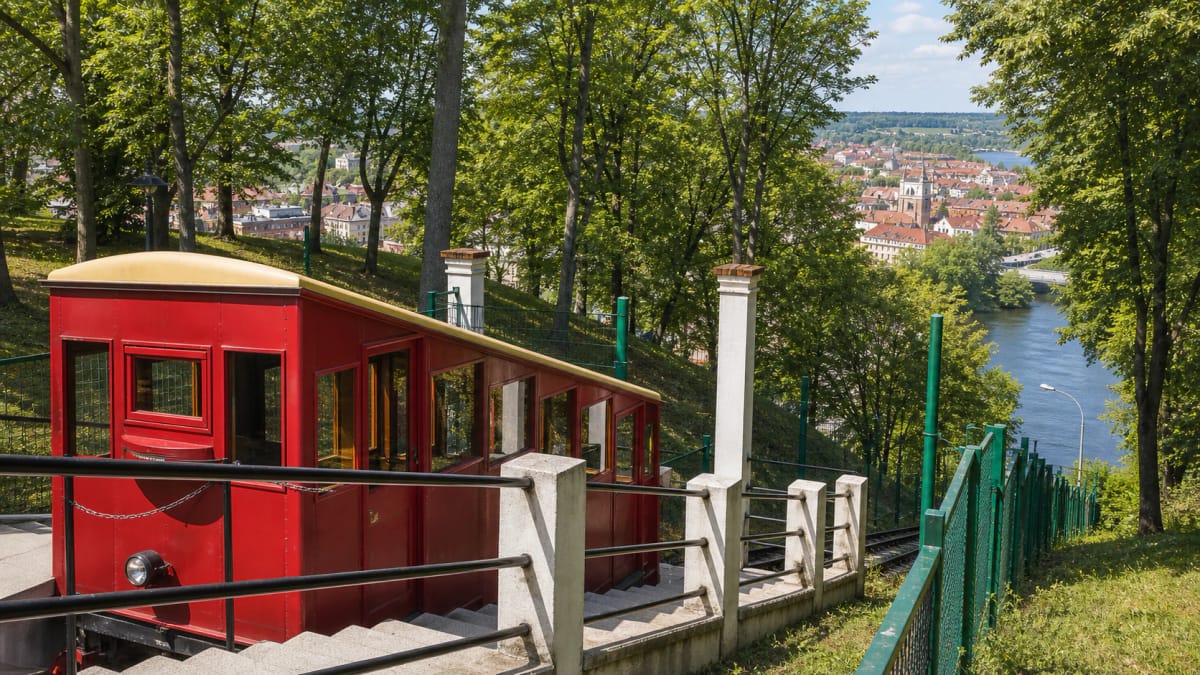
Aleksotas Funicular is a short ride whose value is larger than the journey itself. It climbs from the foot of Aleksotas Hill by Vytautas the Great Bridge to the upper Aleksotas side, near the viewpoint over central Kaunas, the Old Town, the Nemunas, and the Neris confluence.
Kauno autobusai presents it as a unique means of transport carrying people up Aleksotas Hill, while the Cultural Heritage Register links it with the modernization of interwar city infrastructure. Come for the view, but also for a very concrete piece of 1930s urban planning.
Why Kaunas built a second funicular
Žaliakalnis Funicular came first; Aleksotas became the second Kaunas funicular. According to the Cultural Heritage Register, the lift connecting central Kaunas with Aleksotas Hill was planned to encourage Aleksotas to grow, because the lack of convenient transport meant there were still few houses there.
The detailed register entry frames the aim through the Linksmadvaris settlement: Kaunas City Municipality decided to build the funicular to make access easier. Earthworks began on March 1, 1934.
The opening in 1935
Both the register and the operator give December 5, 1935 as the opening date. The ceremony was attended by Minister of the Interior Julius Čaplikas, Kaunas mayor Antanas Merkys, deputy mayor Colonel Steponas Rusteika, and other officials.
This was not just a novelty ride over a slope. Interwar Kaunas was building the infrastructure of a modern capital, and the Aleksotas lift was meant to connect the centre practically with the upper part of the city. Its story complements the Žaliakalnis Funicular: together they show how Kaunas solved urban problems dictated by its terrain.
Who built and equipped it
The register states that construction work was carried out by the company Mūras, the cars were made by Amlit in Kaunas, electrical equipment was installed by AEG of Berlin, and the machinery was produced and installed by the Swiss company Theodor Bell und Cie. A commission was appointed to assess the equipment; names in the record include K. Reisonas, N. Dobkevičius, J. Andriūnas, A. Ganfmanas, A. Mačiūnas, and others.
The operator also mentions engineer and professor Jurgis Čiurlys as a consultant. These names matter because Aleksotas Funicular is not only a romantic old machine: it is a meeting point of international technical expertise and a local urban need.
Technical details worth noticing
The operator describes a single-track funicular with two cars passing each other in the middle. The rails are steel, the track length is 132.9 m, the incline is 18 degrees, and one car can carry up to 25 passengers.
The authentic traction equipment, wooden pre-war cars, wooden benches, and station buildings have survived. The cars have automatic brakes designed to stop them from rolling downhill if the cable breaks. These details make the site technical heritage, not just a convenient ride to a viewpoint.
A protected heritage complex
In the Cultural Heritage Register, the site is listed as the Aleksotas Funicular building complex. Its unique code is 16775, its status is monument, and its significance level is national. The register also lists earlier codes G50KP and IV1018.
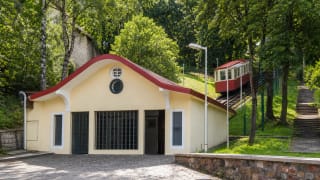
The protected complex includes several parts: the station, the pavilion, the track with equipment, and the equipment itself. The register's list of valuable features mentions the plan structure, volumetric-spatial composition, sharply sloping terrain, track route, concrete stairs with railings, and original transport and public function.
Hours, tickets, and Ziogas
On the operator page checked on June 14, 2026, operating hours were listed as daily 7:00-19:00, with a lunch break 12:00-13:00, departures every 10 minutes, and a one-way single ticket at 1.50 EUR. These details can change, so check the UAB Kauno autobusai page before going.
The operator also states that Kaunas public-transport period e-tickets are not valid on Aleksotas Funicular. If using an accumulating monthly ticket, passengers must validate each ride in the funicular validator or in the Ziogas app. One bicycle is allowed.
How to plan the route
The classic route is to start from the Old Town or city centre, cross Vytautas the Great Bridge, ride up on Aleksotas Funicular, and walk to the viewpoint at the top. You can return by the same lift or walk down if you want a longer urban route.
If you plan both Kaunas funiculars on the same day, Aleksotas and Žaliakalnis give different cross-sections of the city. Aleksotas is strongest for its panorama of the Old Town and rivers, while Žaliakalnis connects with the Resurrection Basilica, the museum quarter, and interwar residential districts.